Monday, August 2, 2027 · Partial solar eclipse · Rome, Italy
74.6% of the Sun covered in Rome
Local times for Rome, to the second, in CEST and UTC. Computed from NASA JPL's ephemeris and checked against timeanddate.com.
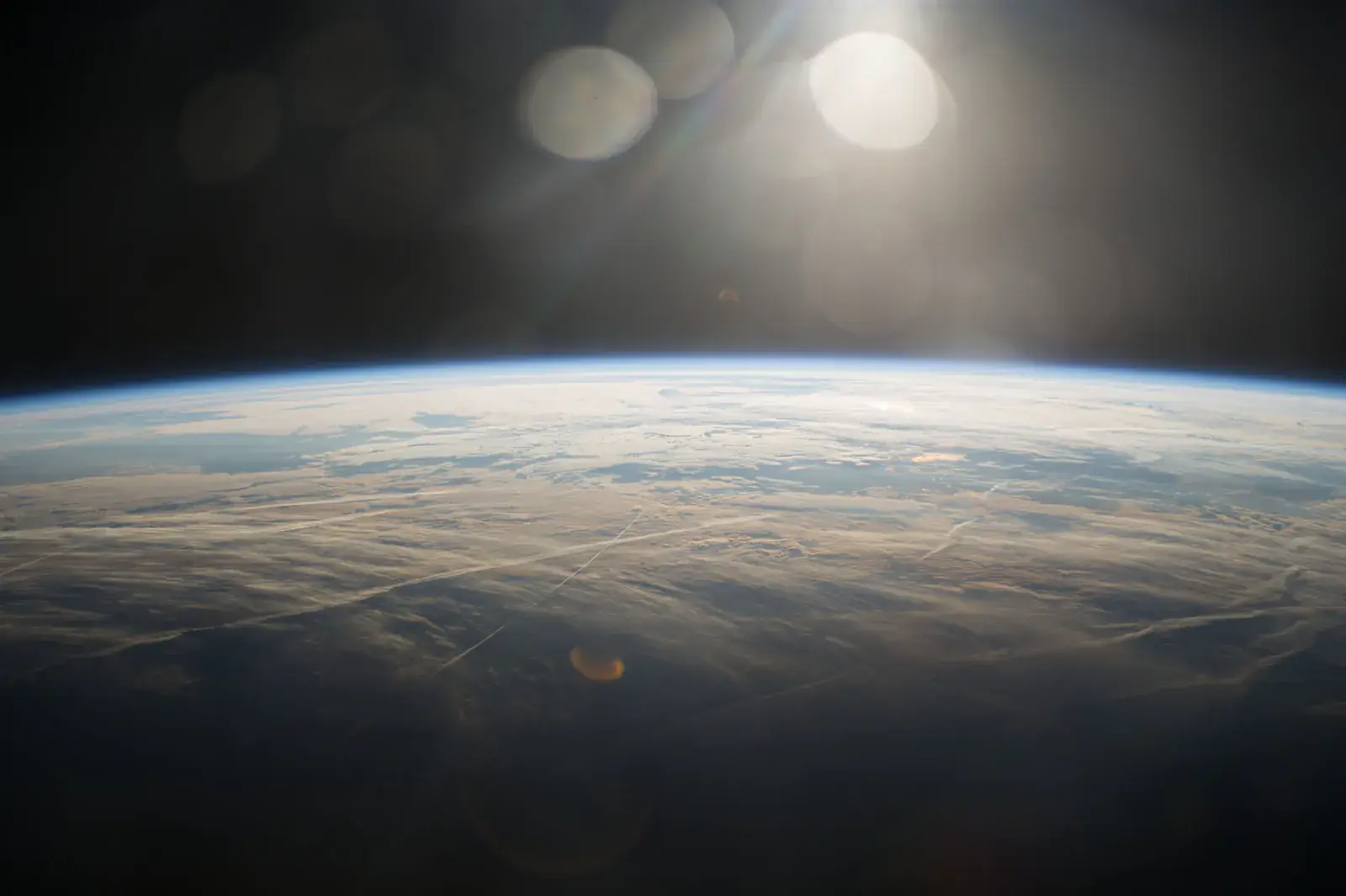
Photo: NASA (International Space Station crew)
At a glance
Rome sees a partial eclipse only: at 11:12:49 local time (CEST, UTC+2) on Monday, August 2, 2027, the Moon covers 74.6% of the Sun. There is no totality here.
- Eclipse here
- Partial74.6% of the Sun covered
- Maximum
- 11:12local time, CEST, UTC+2
- Partial phase
- 10:02 to 12:262 h 25 min
- Sun at maximum
- 54° highto the south-east
See where the 2027 eclipses land in your chartEclipse impact calculator: the next 18 months of eclipses placed in your natal houses and planets.
The times
When to look up in Rome
74.6% of the Sun covered at 11:12.
The partial eclipse in Rome lasts 2 h 25 min, from 10:02:14 to 12:26:51 CEST. It is deepest at 11:12:49, when the Moon covers 74.6% of the Sun's disc (a magnitude of 0.786, the share of the Sun's diameter hidden).
At mid-eclipse the Sun stands 54° above the south-east horizon, comfortably clear of buildings in most places. With 74.6% of the Sun covered, the light dims only a little and it stays full daylight. The bitten Sun is the thing to watch, through eclipse glasses.
The sky behind it
Topocentric Sun and Moon for Rome (41.903°, 12.496°, sea level) from NASA JPL's DE442 ephemeris with Skyfield, ΔT 69.1 s, contacts refined to the second. Totality uses NASA's lunar radius k = 0.272281 and a smooth lunar limb, so it can differ from limb-corrected predictions by a few seconds. Cross-check, timeanddate.com: begins 10:02, maximum 11:12, ends 12:26 local time, magnitude 0.787. Their times are shown to the minute.
More to read
Shorter reads. Each opens in place.
Totality nearby
Where to see totality from Rome
By our calculation, the nearest ground inside the path of totality is about 709 km to the south of Rome (searched in 5 km steps; that point can be at sea). The nearest city in our table that sees totality is Benghazi, 1,278 km away, with 6 min 09 s of totality from 11:27 EET.
Continue readingShow less
Safe viewing
Watching safely in Rome
Look at the partly covered Sun only through eclipse glasses that meet the ISO 12312-2 standard, or project it through a pinhole. In Rome the Sun is never fully covered, so keep them on for every look, from 10:02 to 12:26. Ordinary sunglasses are not enough, and cameras, binoculars and telescopes need a proper solar filter on the front.
Continue readingShow less
The astrology
What the eclipse means in astrology
Astrologers read this eclipse as a new moon at 9°55′ Leo; the main eclipse page covers what that means.
Continue readingShow less
Eclipse times in Rome
Computed for the city centre (41.903°, 12.496°). Local time is CEST, UTC+2, the clock in force on Monday, August 2, 2027.
| Moment | Local time (CEST) | UTC |
|---|---|---|
| Partial eclipse begins | 10:02:14 | 08:02:14 |
| Maximum eclipse | 11:12:49 | 09:12:49 |
| Partial eclipse ends | 12:26:51 | 10:26:51 |
| Measure | Value |
|---|---|
| Eclipse here | Partial |
| Sun covered at maximum | 74.6% |
| Magnitude | 0.786 |
| Sun altitude at maximum | 54° |
| Sun direction at maximum | south-east (123°) |
| Whole eclipse | 2 h 25 min |
| Shymea (DE442) | timeanddate.com | |
|---|---|---|
| Partial eclipse begins | 10:02 | 10:02 |
| Maximum eclipse | 11:12 | 11:12 |
| Partial eclipse ends | 12:26 | 12:26 |
| Magnitude | 0.786 | 0.787 |
All times are UTC. In the Americas the local date can be a day earlier; in Asia and Australia a day later.
Quick answers
what time is the solar eclipse in rome on august 2 2027
It runs from 10:02 to 12:26 CEST, deepest at 11:12, when 74.6% of the Sun is covered. In UTC that is 08:02:14 to 10:26:51.
is the 2027 eclipse total in rome
No. Rome is outside the path of totality, so the Sun is never fully covered there; the most it gets is 74.6%. The nearest city in our table with totality is Benghazi.
do i need eclipse glasses in rome
Yes, the whole time. Because the eclipse is partial in Rome, there is no safe moment to look without ISO 12312-2 glasses or a pinhole projector.