Part 4: Houses & Angles · Chapter 12 of 36 · 9 min
Why birth time matters: the mathematics of houses
Birth time matters because it fixes your local sky: the rising sign, Midheaven and houses. The planets barely move in a few minutes, but Earth turns about one degree every four, so the Ascendant shifts roughly a degree, more or less by latitude, and a planet near an angle or cusp can change house when the time is wrong.
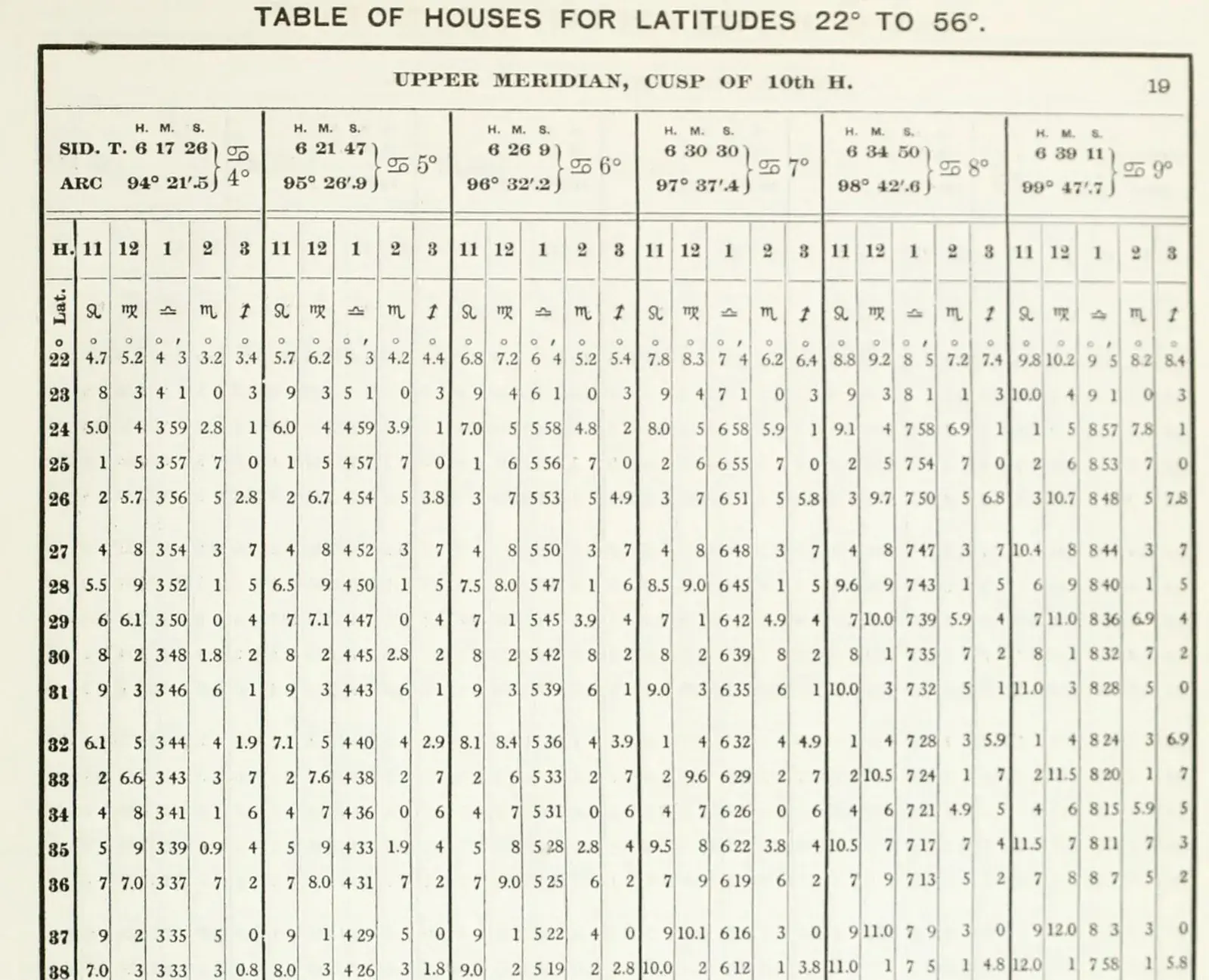
Birth time does not give the planets their meanings. It gives the chart a local sky. Without it, you can usually calculate planetary longitudes, many aspects, and often the Moon’s sign. You cannot reliably calculate the horizon, meridian, angles, or houses.
This distinction matters. In four minutes the Moon moves about 2 arcminutes on an average day; most planets move far less. The horizon can move roughly a degree, sometimes more, sometimes less. The planets have barely shifted, but your position beneath them has turned. Houses describe that turning.
The clock as a coordinate
Earth rotates once relative to the stars in about 23 hours, 56 minutes, 4.09 seconds. This is a sidereal day. The corresponding rate is about 15.041° per mean solar hour, so four mean solar minutes rotate the local sky by roughly 1.003° of hour angle.
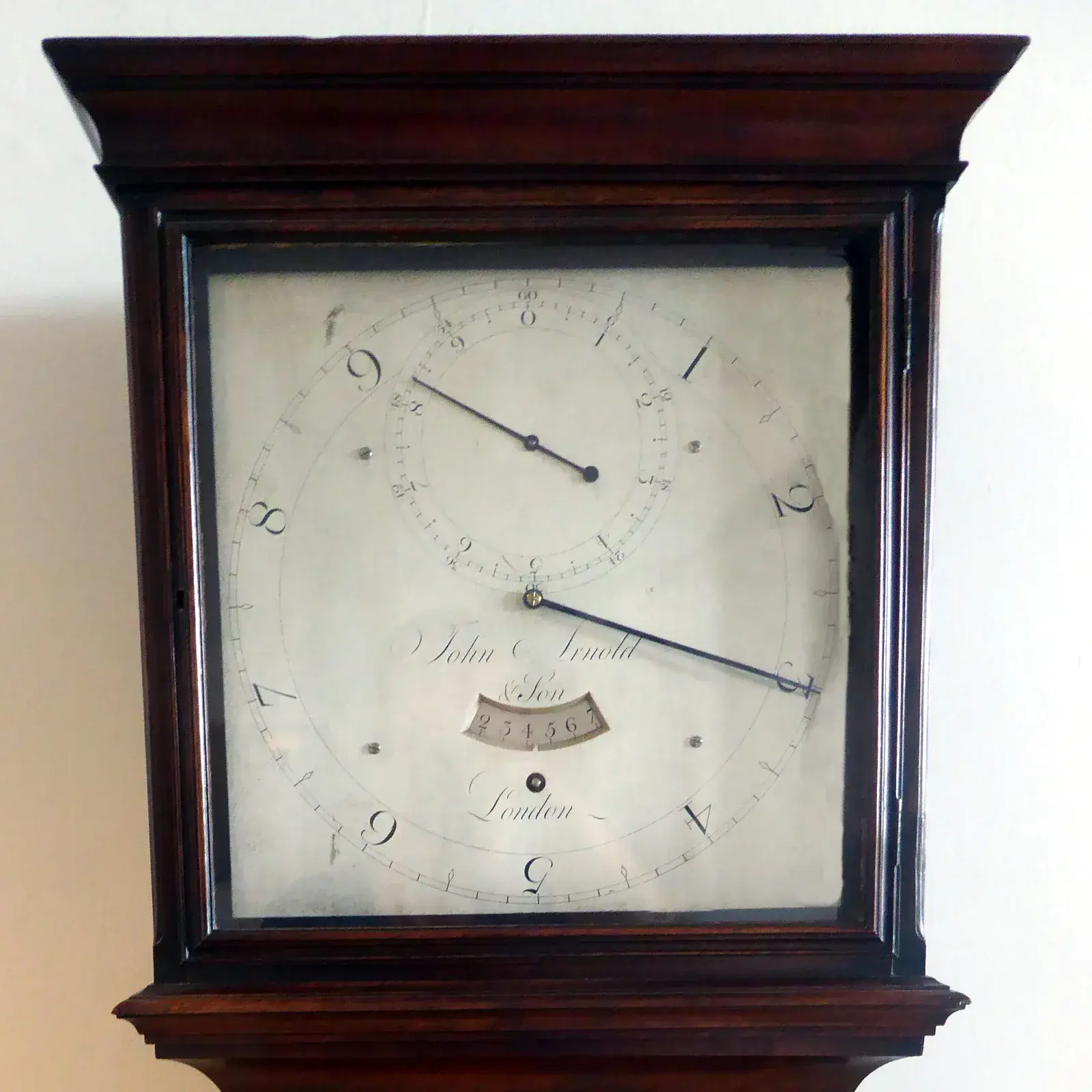
That familiar four-minutes-equals-one-degree rule applies to Earth’s rotation coordinate. It does not say that the Ascendant advances exactly one zodiacal degree every four minutes. The zodiac follows the ecliptic, tilted against Earth’s equator by about 23°26′. The horizon cuts that tilted circle at changing angles. Latitude alters the cut again.
Three inputs create the local frame:
- Date and time place Earth at a particular stage of its daily and yearly motions.
- Longitude tells you how far the location has rotated east or west of Greenwich. One degree of longitude corresponds to four sidereal minutes.
- Latitude tilts the local horizon relative to the celestial equator. It strongly affects the Ascendant and unequal house cusps.
A location farther east reaches the same meridian orientation earlier. A location farther north sees the ecliptic meet its horizon at a steeper or shallower angle. Time supplies the turn; place supplies the tilt.
From civil time to local sidereal time
A recorded birth time begins as civil time: the clock reading used at that place. It must be converted before it can describe the sky.
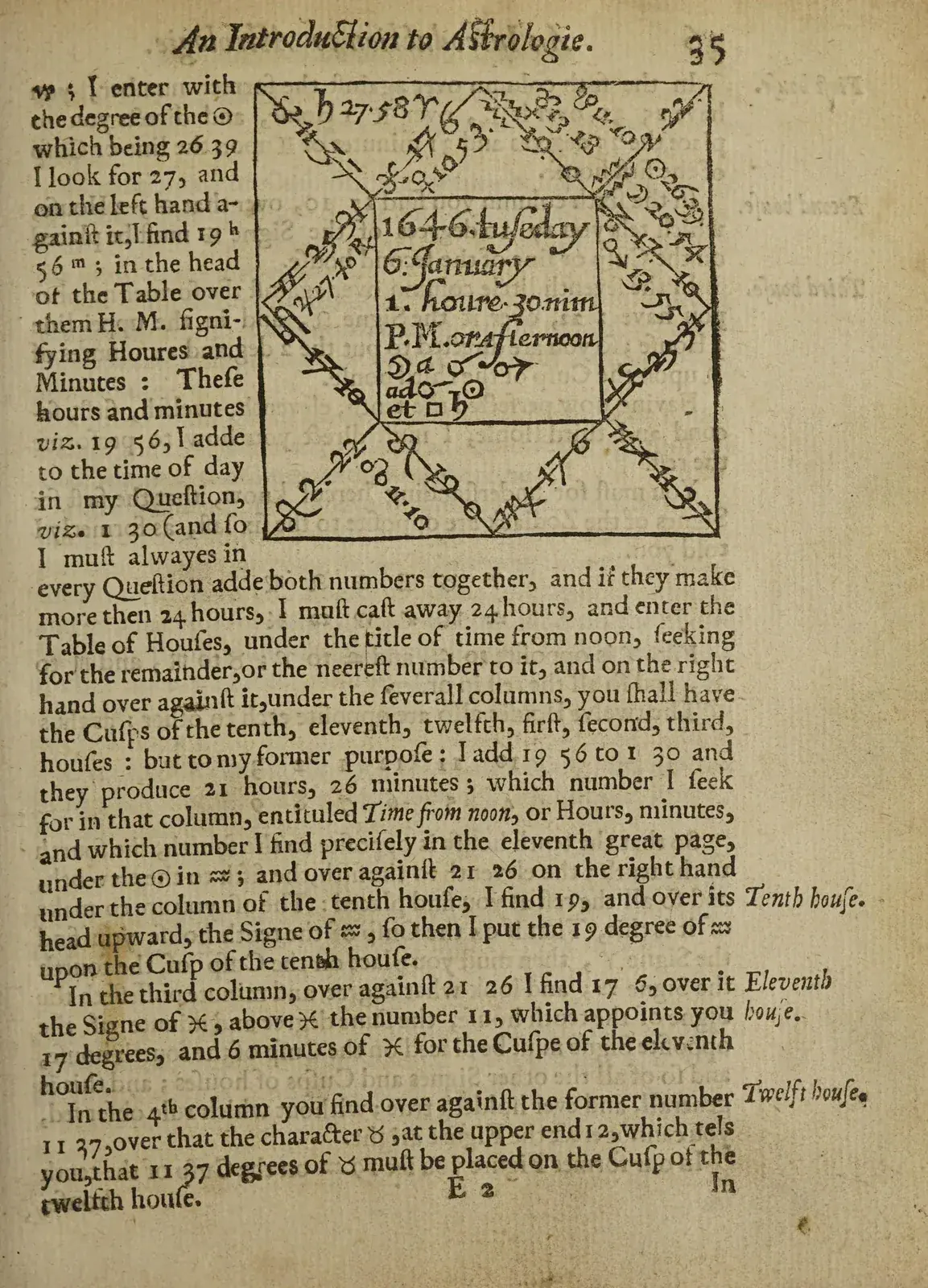
- Identify the civil date, clock time, and place. Use the actual locality, not the time-zone reference meridian.
- Apply the historical UTC offset. Daylight-saving changes, wartime adjustments, and regional exceptions matter. A one-hour error rotates the local frame by about 15°.
- Convert the result to a Julian Date. Julian Date is a continuous day count used in astronomical calculation. It removes the awkwardness of months, leap years, and midnight boundaries.
- Calculate Greenwich sidereal time, then add geographic longitude. With east longitude positive:
LST = GMST + longitude, reduced to 0°–360°.
Local sidereal time, or LST, is the right ascension currently crossing the local meridian. Right ascension is longitude measured along Earth’s celestial equator rather than along the zodiac. LST tells you which equatorial degree is due north-south at that moment.
A widely used compact expression for Greenwich mean sidereal time is:
GMST = 280.46061837° + 360.98564736629°D + 0.000387933°T² − T³/38710000
Here D = JD − 2451545.0 and T = D/36525. Reduce the answer modulo 360°. This is suitable for understanding and ordinary checks; production software uses current astronomical standards and carefully managed time scales.
Earth rotation follows UT1, while planetary ephemerides use a more uniform scale called Terrestrial Time. In present-day charts, software usually handles the small distinction automatically. For old historical dates, the difference must be estimated because Earth’s rotation was not observed with modern instruments. Extra printed decimals cannot repair an uncertain historical clock.
The four angles
The Ascendant is the zodiacal degree intersecting the eastern horizon. The opposite intersection is the Descendant. The Midheaven, or MC, is the conventional intersection of the ecliptic with the local meridian whose right ascension matches LST. Its opposite is the IC.
These are intersections of circles, not objects. The Ascendant is not a planet sitting in the east. The MC is not the zenith, the point directly over your head. A chart wheel may draw the MC at twelve o’clock for convenience, but page position is not altitude.
Let λ be ecliptic longitude, ε the obliquity of the ecliptic, φ geographic latitude, and θ local sidereal time. For a point on the ecliptic, the horizon intersections satisfy:
cosφ cosθ cosλ + (cosφ sinθ cosε + sinφ sinε) sinλ = 0
This equation produces two opposite solutions. The one moving upward through the eastern horizon is the Ascendant; the other is the Descendant. You need not calculate it by hand each time. Its value is that it exposes the machinery: time appears through θ, latitude through φ, and the ecliptic’s tilt through ε.
The MC is found by converting LST from equatorial right ascension to ecliptic longitude. Latitude does not enter that conversion. Two people born at the same moment and longitude share essentially the same MC even if their latitudes differ, while their Ascendants may differ substantially.
The MC’s zodiacal motion is fairly regular but not perfectly uniform. Over four sidereal minutes, it advances about 0.92° to 1.09°, depending on zodiacal longitude. Ascendant motion has a much wider range, especially at high latitudes. Twelve rising signs do not each receive a fixed two-hour shift.
A worked four-minute example
Take a simplified location on the equator, so φ = 0°, and use ε = 23°26′. Suppose local sidereal time is exactly 90°. The horizon equation then gives the rising ecliptic point as 180°00′, or 0°00′ Libra. The MC is 90°00′, or 0°00′ Cancer.
Advance the clock by four sidereal minutes. LST becomes 91°. Solving the same equations gives approximately:
- Ascendant: 1°05′ Libra
- MC: 0°55′ Cancer
The sky rotated exactly 1° in right ascension, yet the Ascendant moved 1°05′ and the MC only 0°55′. Obliquity created the difference.
Now place Mars at 0°42′ Libra and hold its longitude fixed for this short demonstration. At the first time, Mars is conjunct the Ascendant with a longitudinal orb of 0°42′. The Ascendant reaches Mars about 2 minutes 34 seconds later. At the four-minute mark, their orb is 0°23′, but the Ascendant has passed Mars.
In equal and quadrant houses, Mars has crossed from the first-house side of the horizon to the twelfth-house side. In whole-sign houses it remains in the first house because Libra remains the rising sign. One small clock change has produced three distinct facts: the conjunction remained close, the horizon crossing changed, and one house system preserved the house placement while others did not.
What a house system divides
A house cusp is a boundary generated by a chosen division rule. The first cusp is normally the Ascendant in degree-based and quadrant systems; the tenth is normally the MC in quadrant systems. Intermediate cusps depend on the system.
- Whole-sign houses make the entire rising sign the first house and count successive signs from there. The Ascendant degree remains important as an angle, but it is not the first-house boundary. A small time change matters greatly when the Ascendant is near a sign boundary.
- Equal houses begin the first cusp at the Ascendant and place every following cusp exactly 30° farther along the ecliptic. The MC may fall within the ninth, tenth, or eleventh house rather than defining the tenth cusp.
- Porphyry houses divide each ecliptic arc between the Ascendant-Descendant and MC-IC axes into three equal sections. The divisions are equal within a quadrant, not necessarily 30° each.
- Placidus houses divide the time taken by ecliptic points to move between horizon and meridian into thirds. The cusps must usually be found iteratively. You are dividing stages of daily motion, not equal pieces of zodiacal longitude.
- Regiomontanus houses divide the celestial equator and project those divisions toward the ecliptic through the north and south points of the horizon. Campanus houses begin from equal divisions of the prime vertical, the great circle running through east, zenith, west, and nadir.
Unequal systems may place two consecutive cusps in the same sign while enclosing another sign completely within one house. These are duplicated cusp signs and interceptions. They are consequences of the projection, not missing pieces of zodiac.
Above roughly 66°34′ latitude, some ecliptic degrees may remain above or below the horizon throughout a daily rotation. Placidus depends on rising and setting intervals, so parts of its construction may become undefined. Programs may report an error, substitute another method, or apply a special convention. Whole-sign and equal houses do not depend on those semi-arcs and remain calculable.
No coordinate theorem selects one house system as symbolically superior. Each system answers a different geometrical question. Mathematics can verify whether the rule was followed. It cannot choose the meaning for you.
Precision, uncertainty, and honest use
A recorded time of 8:30 may mean exactly 8:30, a value rounded to the nearest five minutes, or a later entry copied from another clock. Even a time printed to the minute is not automatically accurate to the minute. Precision belongs to the record, not to its typography.
The event being timed also requires a convention. Different records may mark complete emergence, first independent breath, or the moment someone looked at the clock. Astronomy cannot decide which human event astrology should use. If the source is unclear, keep the uncertainty visible.
Do not convert a time uncertainty directly into a fixed number of Ascendant degrees. Recalculate the chart at the earliest and latest plausible times. Record which angles, cusps, house placements, and angular orbs remain stable. A ten-minute range is not one chart with fuzzy edges; it is a family of possible local skies.
Rectification is an underdetermined inverse problem: many proposed times can be made to fit the same events when enough interpretive choices are available. It can generate a working hypothesis, not restore a missing timestamp as observed fact. With no reliable time, omit houses and angles rather than treating a noon placeholder as a discovered Ascendant.
Common mistakes, corrected
- Four minutes always equals one Ascendant degree. Four minutes is about one degree of Earth rotation. The Ascendant’s zodiacal rate depends on latitude, LST, and obliquity. Calculate it; do not assume it.
- The MC is the highest point in the visible sky. It is a meridian-ecliptic intersection. The zenith is directly overhead and usually has no zodiacal longitude because it need not lie on the ecliptic.
- Houses are another name for signs. That is true only as a deliberate feature of whole-sign houses. Equal and quadrant cusps can cut through signs.
- A planet within five degrees of a cusp is mathematically in the next house. The five-degree rule is an interpretive convention, not part of cusp calculation. Geometrically, a projected longitude lies on one side of a boundary or the other.
- An exact longitude conjunction with the Ascendant means the body is physically on the horizon. Planets can sit north or south of the ecliptic. That ecliptic latitude is ignored by a simple longitude comparison, so exact longitude need not mean exact altitude.
- Different software results prove the sky is ambiguous. First compare UTC offsets, calendar handling, coordinates, longitude signs, house systems, and polar conventions. The sky calculation is reproducible once those choices match.
Receipts and reproducibility
Jean Meeus’s Astronomical Algorithms, especially its chapters on sidereal time and coordinate transformation, gives the compact equations used here. The Explanatory Supplement to the Astronomical Almanac documents modern time scales and reference frames. Earth-rotation corrections are published by the International Earth Rotation and Reference Systems Service. The Swiss Ephemeris technical documentation publishes implementable house algorithms and notes their high-latitude limits. Historical civil offsets can be checked against the IANA Time Zone Database, though early local records may still require archival confirmation.
Those sources establish the coordinates and calculations. They do not establish the symbolic claims assigned to houses. Keep the receipt attached to the kind of claim it can support.
Practice
- Choose a timed chart and write down the civil time, historical UTC offset, latitude, longitude, and house system.
- Record the Ascendant, MC, and all cusps. Recalculate at minus 4 minutes, plus 4 minutes, minus 15 minutes, and plus 15 minutes.
- For every planet within 3° of an angle or cusp, calculate the longitude orb at each time. Note any boundary crossing separately from the orb.
- Repeat once with whole-sign, equal, and Placidus houses. Identify what changed because of time and what changed because of the division rule.
- End with two lists: placements stable across the full interval, and placements that must remain conditional.
Key terms
sidereal day · local sidereal time · right ascension · ecliptic · obliquity · horizon · meridian · Ascendant · Midheaven · house cusp · quadrant house system · UT1 · orb · birth-time uncertainty
Check your reading
Three questions from this chapter’s worked example and its common mistakes. Two of three marks the chapter complete.
Does four minutes of clock time always equal one degree of Ascendant?
What is the MC, geometrically?
Is a planet within five degrees of a cusp mathematically in the next house?