How Shymea Computes a Western Astrology Chart
How Shymea turns a wall-clock birth time into a chart, and where the AI is not involved.
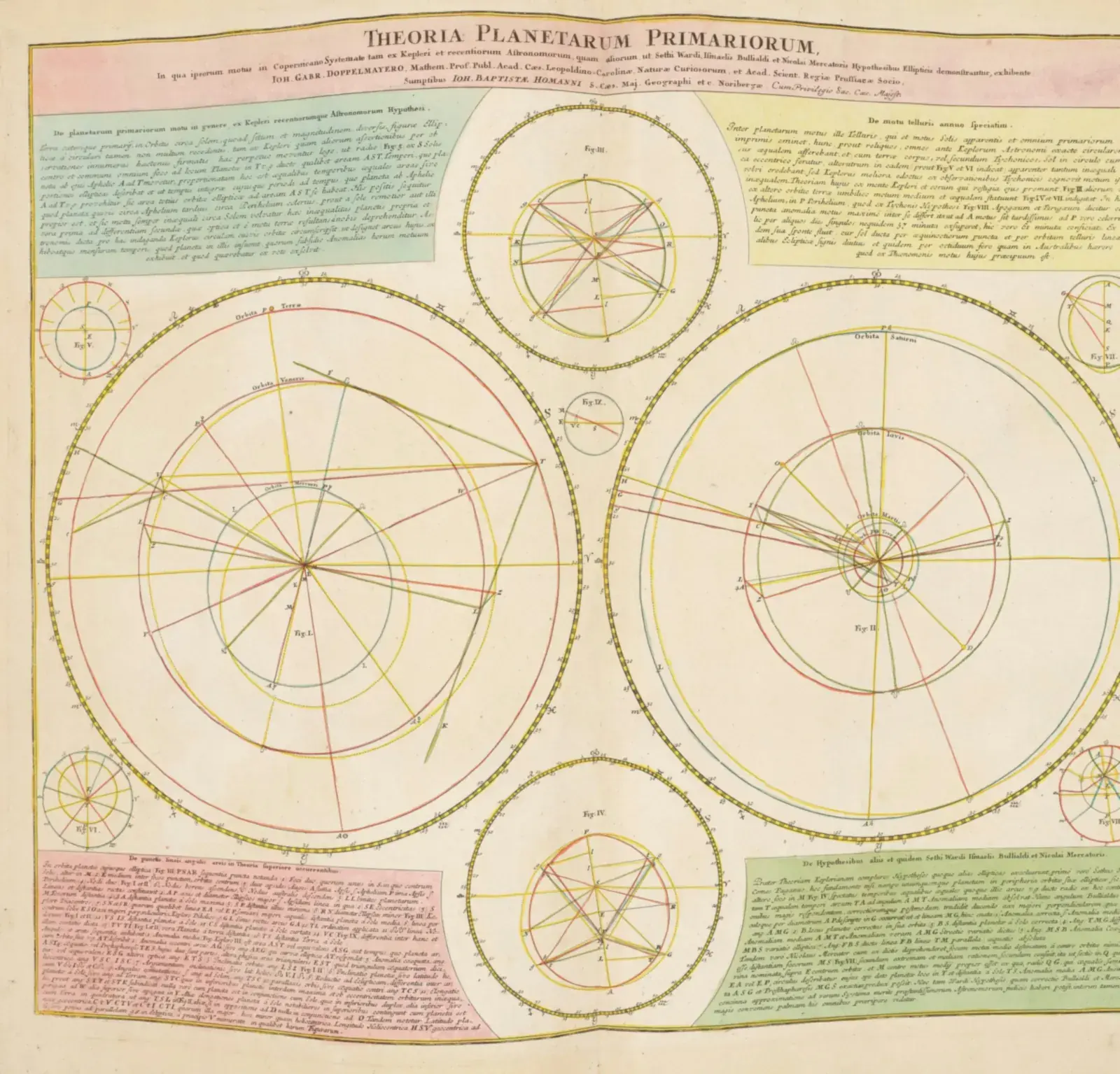
A chart is a calculation before it is an interpretation. Shymea keeps that order fixed: normalize the moment and location, calculate the astronomical positions, derive the Western astrology placements, and only then produce language or apply judgment rules.
This separation matters. A fluent interpretation cannot repair a wrong time zone, a miscalculated house cusp, or an aspect that was never present.
DE442 is the source, not the reading
Shymea uses JPL’s DE442 solar-system ephemeris as the astronomical foundation for its calculations. An ephemeris is a numerical model of where solar-system bodies are estimated to be at a given time. It supplies position and motion data in an astronomical coordinate frame; it does not supply signs, houses, aspects, personality descriptions, or predictions.
DE442 is therefore an input to the chart engine, not an astrology engine by itself. Shymea still has to transform those coordinates into the geocentric, ecliptic framework used by Western astrology and then derive the chart’s symbolic structure.
High-precision astronomy should not be confused with proof of astrology. DE442 can make the underlying planetary coordinates consistent and reproducible. It cannot establish that an astrological interpretation is scientifically valid.
From a wall-clock time to a chart placement
Consider one of the central calculations: turning a recorded moment into a planet’s zodiac longitude.
A local date and time are not yet an astronomical timestamp. The engine must resolve the location’s time zone and daylight-saving rules, convert the result to UTC, and then use the astronomical time scales required by the ephemeris. This can be straightforward for a recent timestamp and less certain for an old record from a place with incomplete or changing civil-time rules.
For the requested instant, DE442 provides position data for Earth and the relevant solar-system body. The engine derives the body’s position as seen from Earth rather than treating its solar-system coordinates as an astrological placement. In simplified vector form:
geocentric position = body position − Earth position
The result is transformed into the ecliptic reference used for the chart. Its direction on that plane becomes an angular longitude, calculated with a quadrant-aware arctangent and normalized to the range from 0° up to, but not including, 360°.
A Western tropical chart divides that circle into twelve equal 30° signs beginning at the equinoctial reference point. A longitude of 103°14′, for example, falls 13°14′ into Cancer because Cancer begins at 90°. The sign label is derived from the number; it is not guessed from text or supplied by an AI model.
Aspects are calculated from those longitudes. For two bodies at longitudes λ₁ and λ₂, the shortest separation is:
min(|λ₁ − λ₂|, 360° − |λ₁ − λ₂|)
That second term handles the wraparound at 0°. Bodies at 359° and 1° are 2° apart, not 358° apart. The engine compares the separation with an aspect angle and its configured orb. Determining whether an aspect is applying or separating also requires motion data; a keyword lookup is not enough.
Houses add another calculation layer. They depend on the chart’s location, local sidereal time, latitude, and selected house system. They are not read directly from DE442. Because Earth turns roughly one degree every four minutes, uncertain birth times can move the angles and house cusps quickly, with the Ascendant shifting unevenly by latitude and sign.
What makes a calculation reproducible
The same inputs and settings should produce the same chart. Those settings include the timestamp, geographic coordinates, zodiac framework, house system, aspect definitions, orb rules, supported points, and calculation-data version.
Input quality still sets a ceiling on output quality. A rounded birth time may be sufficient for many planetary sign placements while remaining unreliable for the Ascendant, Midheaven, houses, and placements close to a cusp. Shymea should not turn that uncertainty into false precision.
Reproducibility also means keeping derived facts separate from prose. The engine determines that a placement or aspect exists. A later layer may explain its traditional meaning, but it cannot alter the calculation to fit a more appealing narrative.
Ask: calculated first, interpreted second
Ask is Shymea’s AI interpretation product. Shymea’s own engine calculates the chart and derives the relevant planets, houses, aspects, and other chart factors before any interpretation begins. It never asks a language model to do the astronomy.
Only those derived placements are sent to Azure OpenAI for interpretation — the same boundary applies to Shymea's astrology reports, which are generated from computed placements rather than from your raw birth record. No personal data leaves our platform — only derived chart placements. Names, email addresses, birth dates, birth times, and birth locations are not sent to the model.
Ask produces a conversational interpretation rather than a verdict. Personal statements should carry visible In your chart receipts pointing to the placement, house, or aspect behind them. A receipt shows the astrological basis for a statement; it is not scientific proof that the statement must be true.
The interpretive layer can connect symbols, explain tensions, and adapt its language to the question. It can also misunderstand context or overstate a theme. Calculation accuracy and language quality are separate concerns, which is why the chart evidence remains visible.
Decide uses a different engine
Decide is not Ask with a shorter answer. It casts a horary chart for the exact minute of the question and judges it through a rule-based implementation of William Lilly’s 1647 method, including significators, dignities, and the traditional trials.
No AI participates in the verdict. The computation remains internal and returns YES, NO, or ASK AGAIN, together with confidence and the chart figure. That confidence describes the rule system’s internal strength and clarity; it is not a calibrated probability, a promise, or a guarantee that an event will occur.
What the method cannot claim
Astronomical precision makes the calculated sky model more dependable. It does not remove the interpretive and evidential limits of astrology.
- Astrology cannot reliably diagnose health conditions or replace medical care.
- It cannot determine legal rights, obligations, or likely court outcomes.
- It cannot guarantee investment performance or financial results.
- A chart cannot recover experiences, motives, or circumstances that were never provided.
- Symbolic interpretations are context-dependent and may fit imperfectly or not at all.
- Horary rule confidence is not the same as empirically measured predictive accuracy.
- Errors or uncertainty in the recorded time, location, time-zone history, or selected settings can change the chart.
Shymea can show how a result was calculated and which astrological considerations support an interpretation. It cannot turn those considerations into certainty.
Common questions
- Does AI calculate my chart in Ask?
- No. Shymea’s engine performs the astronomy and derives the planets, houses, aspects, and other chart factors. Azure OpenAI receives only derived placements and interprets them; it never performs the chart calculation.
- Why does an exact birth time matter?
- The angles and house cusps depend on Earth’s rotation and the birth location. Even a small time error can change the Ascendant or house placement, while many slower planetary sign positions remain unchanged.
- Does using DE442 prove astrology works?
- No. DE442 supports consistent astronomical positions. It does not validate astrological meanings, personality claims, or predictions.
- What data leaves Shymea when I use Ask?
- No personal data leaves our platform — only derived chart placements. Names, email addresses, birth data, and locations are not sent to Azure OpenAI.
- Is Decide an AI verdict?
- No. Decide uses fully internal, rule-based horary calculations based on Lilly’s 1647 method. AI has no role in its `YES`, `NO`, or `ASK AGAIN` verdict.
Sources
- JPL planetary and lunar ephemerides (DE-series) — NASA Jet Propulsion Laboratory — the DE-series ephemerides this page names as its astronomical source.
- JPL DE ephemeris SPK kernels (de442.bsp) — NASA JPL's kernel directory — the DE442 file itself, the specific ephemeris Shymea evaluates.
- Skyfield — The astronomy library Shymea uses to evaluate those ephemerides.
- IAU SOFA — International Astronomical Union — the reference algorithms for astronomical time scales and coordinate transformation.
- IANA Time Zone Database — The historical time-zone and daylight-saving rules a birth timestamp has to be resolved against.
Every technique on this page needs one thing first: a chart computed from your exact birth date, time, and place.