Part 5: Aspects · Chapter 16 of 36 · 9 min
Orbs: how close is close enough
Exactness is simple. A square is exact at 90°.
Exactness is simple. A square is exact at 90°. A trine is exact at 120°. Charts, however, rarely arrange themselves in perfect whole numbers. One planet may stand 88° from another. Another pair may be 124° apart. You need a rule for deciding whether those near-matches count.
That rule is the orb: the distance between an aspect’s exact angle and the angle actually formed by two chart factors. If Venus and Mars are 93° apart, they form a square with an orb of 3°. The aspect misses exactness by 3°, yet remains close enough under most working policies.
Close enough is not a fact waiting to be discovered in a table. It is a technical judgment. The judgment can be disciplined, disclosed, and tested against experience. It cannot honestly be presented as a law of nature.
Exact angle, actual distance, orb
Begin with the zodiacal longitudes of the two factors—their addresses around the 360° circle. Find the shortest distance between them:
d = min(|λ₁ − λ₂|, 360° − |λ₁ − λ₂|)
Then compare that distance with the exact angle of the possible aspect:
orb = |d − exact aspect angle|
Suppose Venus is at 10° Cancer and Mars at 13° Libra. Their longitudes are 100° and 193°. The shortest distance is 93°. A square is exact at 90°, so the square has an orb of 3°.
Do not call 93° the orb. It is the planets’ angular separation. The orb is the 3° difference between that separation and exact square geometry.
An allowable orb is the maximum distance your method accepts. If your maximum orb for a square is 5°, the Venus–Mars square counts. If your maximum is 2°, it does not. A stated orb of 5° normally means 5° on either side of exactness, creating a total window 10° wide.
The cutoff is procedural rather than absolute. An aspect at 4°59′ does not possess a quality suddenly lost at 5°01′. Still, you need a boundary or nearly every planet can be connected to several others. A boundary disciplines attention. It does not mark a seam in the sky.
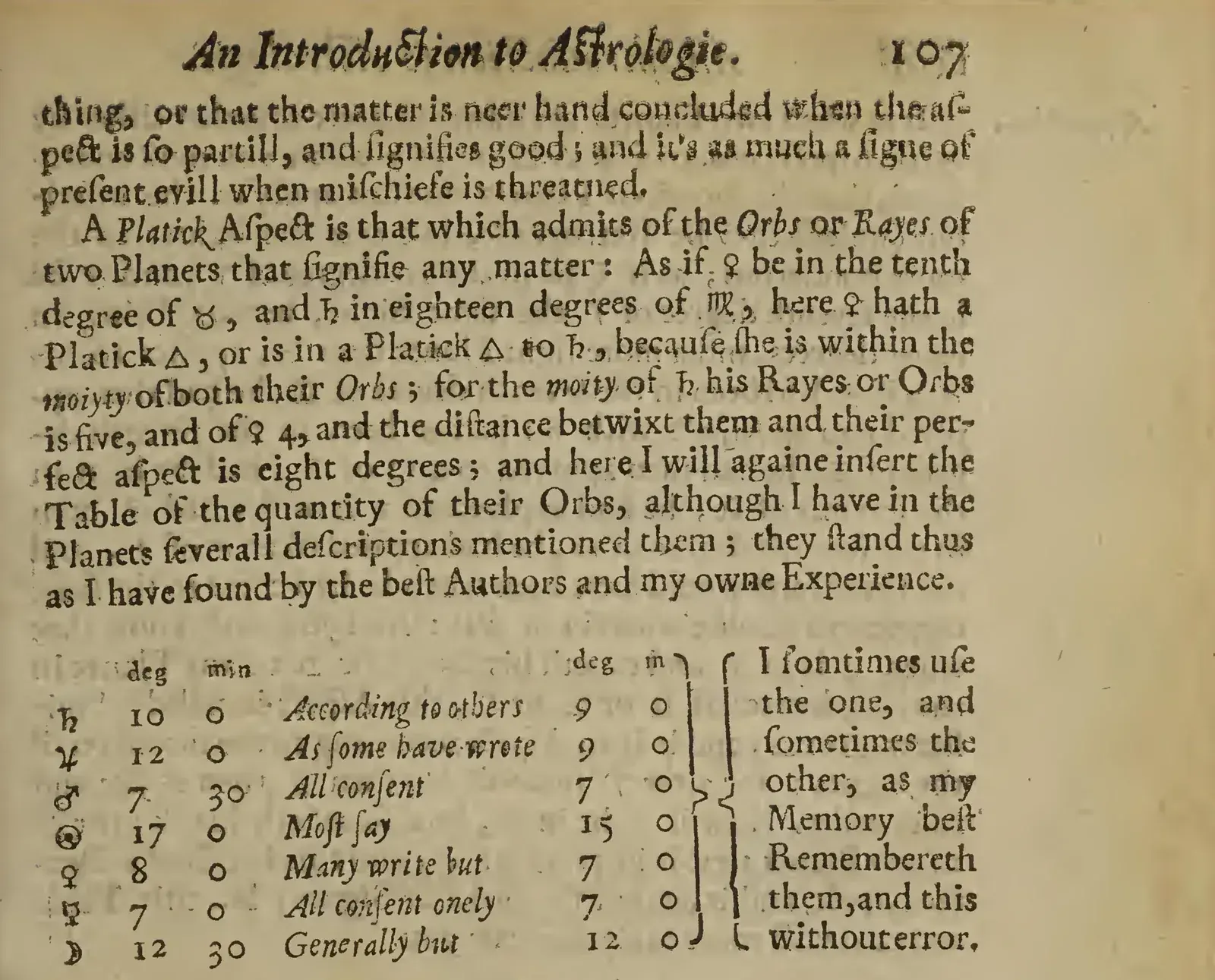
Astrologers have never used one universal orb system. Older Western authors often assigned orbs to planets rather than aspects. William Lilly’s Christian Astrology of 1647, for example, gives different planetary orbs and works with their moieties—each planet’s share of the permitted distance. Much contemporary practice instead assigns a maximum orb to each type of aspect. These systems are not interchangeable. Combining generous planetary orbs with generous aspect orbs quietly inflates the chart.
There is no replicated research establishing that 5° is a natural square boundary while 6° is not. Tables are inherited craft conventions, adjusted by different schools and astrologers. This is why your rule should be visible rather than smuggled into the reading.
What closeness changes
All else being equal, a tighter aspect deserves more weight. Its geometry is more specific. A ±2° window occupies less of the circle than a ±8° window, so fewer planetary pairs qualify by chance as the window narrows. That does not prove an astrological effect. It does explain why tight aspects are more discriminating chart features.
Tightness often feels like inseparability. The two planetary functions repeatedly arrive together. Mercury tightly square Saturn may describe thinking and restraint as one closely bound problem: every attempt to speak meets an internal standard, while every standard demands precise language. At a wider orb, the same connection may remain recognizable without organizing experience so insistently.
A tight aspect is not automatically pleasant, difficult, mature, or important in every setting. Exact Venus sextile an asteroid does not necessarily outweigh a 4° Sun–Saturn conjunction on an angle. Planetary prominence, angularity, repetition, rulership, aspect pattern, and the questions actually present in a life all affect emphasis.
A partile aspect is very close to exact. Usage varies historically; in this course, call an aspect partile when its orb is less than 1°. A platic aspect is wider but still within the accepted orb. Partile means concentrated. Platic means spread across a broader band. Neither term supplies an interpretation by itself.
Worked mini-example
Consider these positions and daily motions:
| Factor | Position | 360° longitude | Daily motion |
|---|---|---|---|
| Saturn | 16°02′ Taurus | 46°02′ | +0°03′ |
| Sun | 14°18′ Leo | 134°18′ | +0°57′ |
Subtract the longitudes:
134°18′ − 46°02′ = 88°16′
The shortest distance is therefore 88°16′. The nearest major aspect is the square at 90°.
90°00′ − 88°16′ = 1°44′
The Sun and Saturn form a square with an orb of 1°44′. Under the working policy below, a square involving the Sun may receive up to 7°, so this aspect is comfortably admitted. It is tight, though not partile under the definition just given.
Now determine whether it is applying or separating. The Sun is moving about 57′ per day while Saturn moves about 3′. Their separation is increasing by roughly 54′ per day, and it needs to increase by 1°44′, or 104′, to reach 90°.
104′ ÷ 54′ per day ≈ 1.9 days
The square is applying: its miss distance is shrinking as the planets move toward exactness. This estimate assumes nearly constant daily motion, so an ephemeris would provide the exact time. The arithmetic establishes aspect condition. It does not establish that a particular event must occur.
A moderate working policy
Use the following table for natal work unless a specific technique requires something else. These are maximums, not promises that every admitted aspect will carry equal weight.
| Aspect | Exact angle | Default maximum | Maximum if Sun or Moon is involved |
|---|---|---|---|
| Conjunction | 0° | 6° | 8° |
| Opposition | 180° | 6° | 8° |
| Square | 90° | 5° | 7° |
| Trine | 120° | 5° | 7° |
| Sextile | 60° | 4° | 5° |
| Quincunx | 150° | 3° | 3° |
| Semisquare or sesquisquare | 45° or 135° | 2° | 2° |
| Semisextile, quintile, or biquintile | 30°, 72°, or 144° | 1°30′ | 2° |
The Sun and Moon receive more room because they are visually dominant and move through experience as broad organizing functions. This is an astrological convention, not a measured physical threshold. Do not widen every aspect merely because a luminary is present; use the listed maximum and still rank the tighter contacts first.
For conjunctions to the Ascendant or Midheaven, use 5°. For other major aspects to those angles, begin with 3°. A birth angle depends on the recorded time, so an uncertain birth time cannot be repaired by adding orb. Wider tolerance does not turn uncertain data into precise data.
For lunar nodes and comparable calculated points, use about 3° for conjunctions and oppositions, less for other aspects. For most asteroids, 1° to 2° is enough. A chart containing dozens of points creates hundreds of possible pairs; narrow orbs keep accidental matches from becoming a chorus.
You may widen one leg of a clear aspect pattern by up to 1° when several other legs are tight, but label the exception. Do not average the pattern’s orbs. Each pair either meets your stated rule or receives an explicit waiver.
Applying and separating
An applying aspect is moving toward exactness. A separating aspect has passed exactness and is moving away. You determine this from actual motion, not merely by asking which planet has the earlier zodiacal degree.
Retrograde motion can reverse the obvious-looking answer. Near a station, a faster planet may also slow enough to alter the sequence. The reliable method is plain: calculate the orb at the chart time, calculate it again a little later, and see whether it decreases or increases.
Traditional interpretation often gives applying aspects a sense of gathering pressure. The functions are coming into contact, so their combination may feel unfinished, urgent, or actively forming. Separating aspects are often read as more familiar: the contact has already occurred in symbolic time, leaving a practiced response or consequence.
Treat that distinction as tone, not rank. A separating aspect can dominate a chart. An applying aspect can remain secondary. Claims about how the two are experienced have not been established with enough consistency to support rigid conclusions.
Sign boundaries do not erase degree geometry
Mercury at 29°42′ Pisces and Venus at 1°06′ Aries are only 1°24′ apart. They form a conjunction even though they occupy different signs. This is an out-of-sign conjunction: close degree geometry crossing a sign boundary.
The boundary still matters. Mercury operates through Pisces while Venus operates through Aries, so the conjunction joins functions using noticeably different styles. The aspect says they are close. The signs say their ways of acting are not identical.
A more striking case is Mars at 28°50′ Gemini and Jupiter at 1°10′ Libra. Their shortest separation is 92°20′, producing a square with an orb of 2°20′. Gemini and Libra form a whole-sign trine, yet the planets themselves form a degree-based square because both stand near sign edges.
Different methods handle this differently. In a whole-sign aspect method, signs establish the relationship and degree closeness increases emphasis. In a degree-based method, the 92°20′ geometry establishes a square, marked as out of sign. This course records both pieces: Mars square Jupiter, 2°20′ orb, out of sign. The label preserves the complication instead of choosing one fact and deleting the other.
Orbs change with the job
An orb policy should fit what you are trying to observe.
- Natal interpretation: Use the moderate table above. You are identifying durable structural relationships, so there is room for broader major aspects.
- Synastry: Start tighter—about 5° for luminary conjunctions and oppositions, 3° for most other major aspects, and 2° or less for minor aspects. Two charts create many more planetary pairs, so wide orbs quickly produce an unhelpful number of contacts.
- Transits: Separate a broad period of approach from the exact timing band. For careful logs, mark slow-moving transits within 1° of a natal factor and record each exact pass. A wider approach may be meaningful to the person, but the 1° band keeps timing claims testable.
- Secondary progressions and solar arcs: These methods use small symbolic movements to represent much longer spans of time. Orbs of 1° or less are customary because a single degree may correspond to a substantial interval.
- Midpoints and other sensitive degrees: Begin around 1°30′ and tighten when many points are being examined. The more possible contacts you test, the more restraint you need.
These numbers are working tolerances. If you use different ones, state them before interpretation and retain them across comparable charts. Changing the rule after noticing an appealing contact is not sensitivity. It is selection after the fact.
Common mistakes and their corrections
- Treating software lines as discovered facts. A program draws aspects according to its stored settings. Inspect those settings. Two programs can display different charts from identical birth data because their orb policies differ.
- Rounding before calculating. Positions at 14°29′ and 19°31′ are 5°02′ apart, not 5°. Keep minutes until the final result, especially near a cutoff.
- Using the separation as the orb. A pair 117° apart has a trine orb of 3°, not 117°. Always subtract the exact aspect angle.
- Giving every aspect the conjunction orb. A 7° conjunction may be useful; a 7° sextile is usually too diffuse. Smaller aspect divisions need tighter tolerances to remain distinct.
- Assuming tighter means better. Orb measures exactness, not ease or merit. A partile square is not a defective trine. It is a concentrated square.
- Stretching an orb to rescue a preferred interpretation. Decide the policy first. If an excluded contact still seems relevant, note it as a hypothesis rather than quietly moving the boundary.
- Ignoring motion. Applying and separating cannot be read reliably from a static order of degrees. Check daily motion, especially around retrogradation and stations.
- Ranking by orb alone. Tightness matters, but so do the planets involved, contact with angles, repeated themes, and the architecture of the whole chart.
An orb is a tolerance, not a verdict. Its value lies less in where you draw the line than in whether you keep the line honest.
Practice
Choose one natal chart and write down your orb policy before looking at its aspect grid. Select six planetary pairs, including at least one luminary contact and one minor aspect.
For each pair, record:
- Both zodiacal longitudes.
- Their shortest angular separation.
- The nearest exact aspect angle.
- The calculated orb, including minutes.
- Whether the aspect is admitted under your policy.
- Whether it is applying or separating.
- Whether it crosses an expected sign boundary.
Then compare your results with the software display. If they differ, locate the setting responsible rather than assuming either result is self-evident. Finish by ranking the three strongest admitted aspects. Give one sentence of reasoning for each, using more than orb alone.
Key terms
orb · allowable orb · exact aspect · partile aspect · platic aspect · applying aspect · separating aspect · moiety · out-of-sign aspect · relative motion
Check your reading
Three questions from this chapter’s worked example and its common mistakes. Two of three marks the chapter complete.
Sun at 134°18′ and Saturn at 46°02′ give a separation of 88°16′. What is the orb of the square?
Should every aspect get the conjunction orb?
Does a tighter orb mean a better aspect?