Venus cycle · Oct 24, 2026
Venus Star Point 2026 lands Oct 24 in Scorpio
At 03:44 UTC on Oct 24, 2026, Venus slips between Earth and the Sun at 0°45′ Scorpio. It is one corner of a five-pointed star Venus draws every eight years, and sky watchers have been counting it since Babylon.
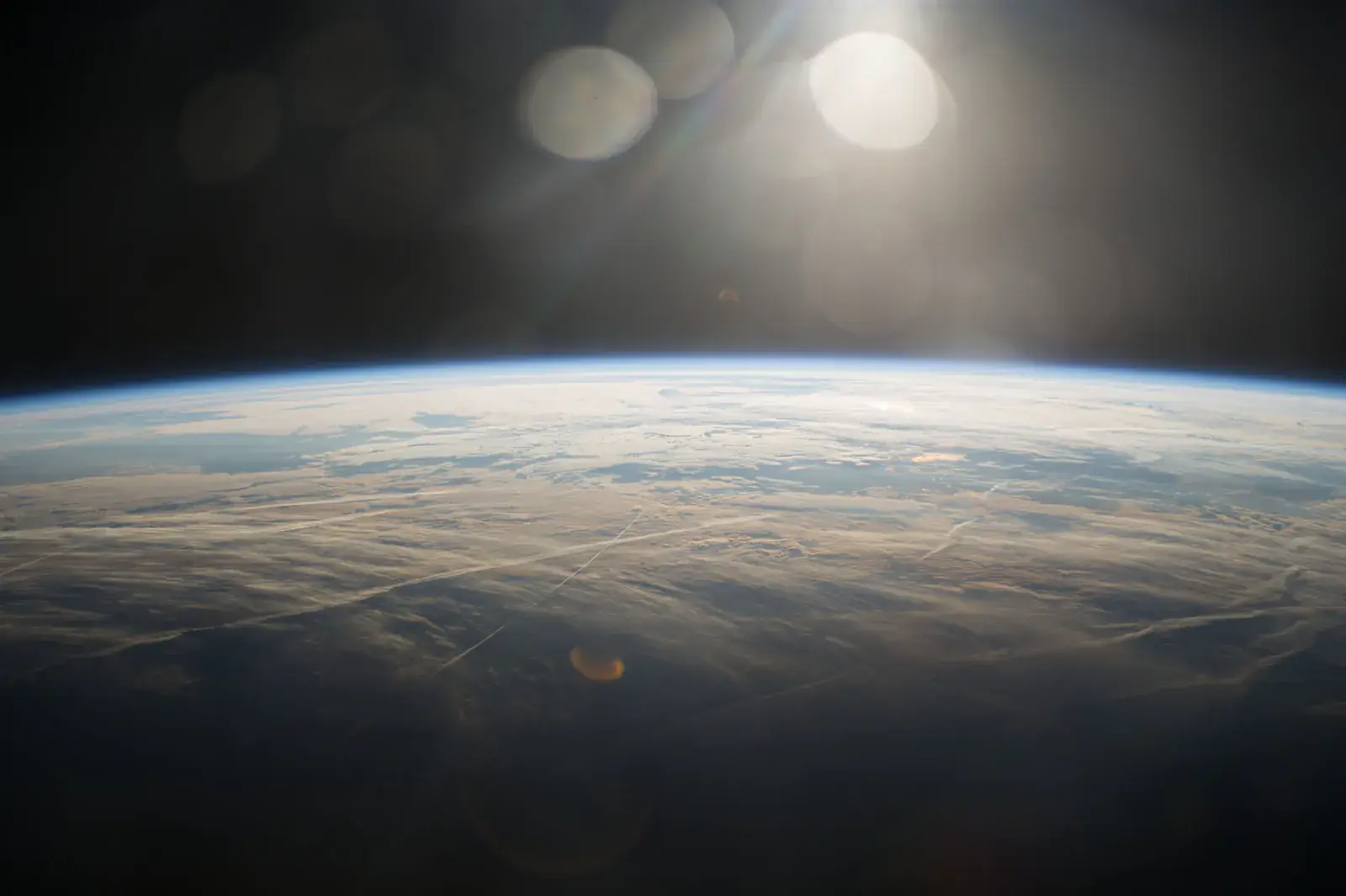
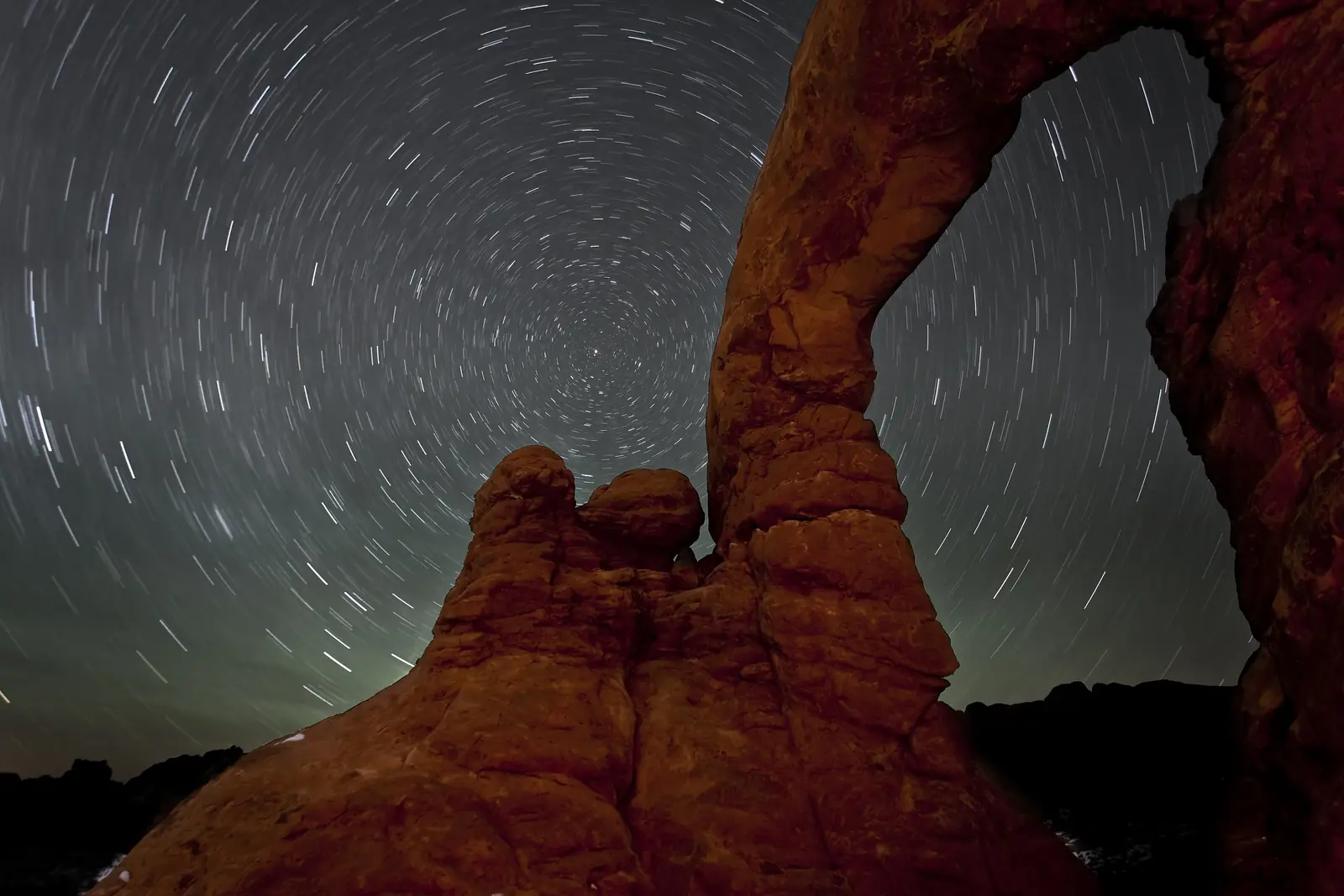
Photo: NPS / Jacob W. Frank
At a glance
The 2026 Venus star point is Oct 24, 2026 · 03:44 UTC, at 0°45′ Scorpio: the first degree of Scorpio.
- Exact moment
- Oct 24, 2026 · 03:44 UTCLate on Oct 23, 2026 in North America
- Where
- 0°45′ ScorpioThe first degree of Scorpio
- Inside Venus retrograde
- Oct 3, 2026 to Nov 14, 2026Day 21 of 42
- Eight years ago
- Oct 26, 2018 at 3°06′ Scorpio2°21′ away
- Next star point
- Jun 1, 2028 at 11°26′ Gemini
Find your Scorpio houseFree birth chart: see where 0°45′ Scorpio lands in your life.
The date
Oct 24, 2026: the night Venus goes quiet

Try this today
- Note where you are on Oct 24, 2026. Eight years from now, Venus comes back to almost this exact spot.
- In mid-November, look east about 45 minutes before sunrise. The brightest point there is Venus, back again.
- Write down one thing you value now that you did not value in 2018. Tuck it inside a book you love.
Venus retrograde 2026 datesEvery retrograde station, computed
You may have noticed it in September: that bright point low in the west after sunset, the one you mistook for a plane. Then it sank lower each evening, and now it is gone. Venus has not left. It is passing between Earth and the Sun, too close to the glare to see.
The exact moment is Oct 24, 2026 at 03:44 UTC, when Venus and the Sun share the same degree of the zodiac: 0°45′ Scorpio. Astronomers call this an inferior conjunction. Astrologers call it a Venus star point, and this one lands right at the doorway of Scorpio. If you live in North America, that is still Oct 23, 2026 on your clock.
It sits in the middle of the Venus retrograde of 2026: 21 days after Venus stationed at 8°29′ Scorpio on Oct 3, 2026, and 21 days before it turns direct at 22°52′ Libra on Nov 14, 2026. Every inferior conjunction falls inside a Venus retrograde, because that is the stretch when Venus swings past us on the inside track.
After the meeting, Venus moves to the other side of the Sun in our sky. Within a couple of weeks it starts rising before dawn. The evening star becomes the morning star. Same planet, new shift.
The sky behind it
Computed with skyfield from the JPL DE442 ephemeris, geocentric, tropical zodiac. Venus stations retrograde Oct 3, 2026 · 07:15 UTC at 8°29′ Scorpio, meets the Sun Oct 24, 2026 · 03:44 UTC at 0°45′ Scorpio, and stations direct Nov 14, 2026 · 00:27 UTC at 22°52′ Libra.
The pattern
Why five meetings draw a star
Try this today
- Draw a circle, mark five evenly spaced dots, and join every second dot without lifting your pen. That is the order Venus visits them.
- Look up which signs hold your Sun, Moon and rising. Are any of them among Gemini, Capricorn, Leo, Aries, Scorpio?
If you ever doodled a star in the margin of a school notebook, you already know this shape. Venus draws it too, just very slowly.
Venus circles the Sun in about 224.7 days. Seen from Earth, it catches up with the Sun again every 583.9 days, a span called the synodic period. Both figures come from the NASA Venus fact sheet.
Five synodic periods add up to almost exactly eight Earth years. So do thirteen orbits of Venus. So after five meetings, Venus and Earth are back in nearly the same places, and the dance starts over.
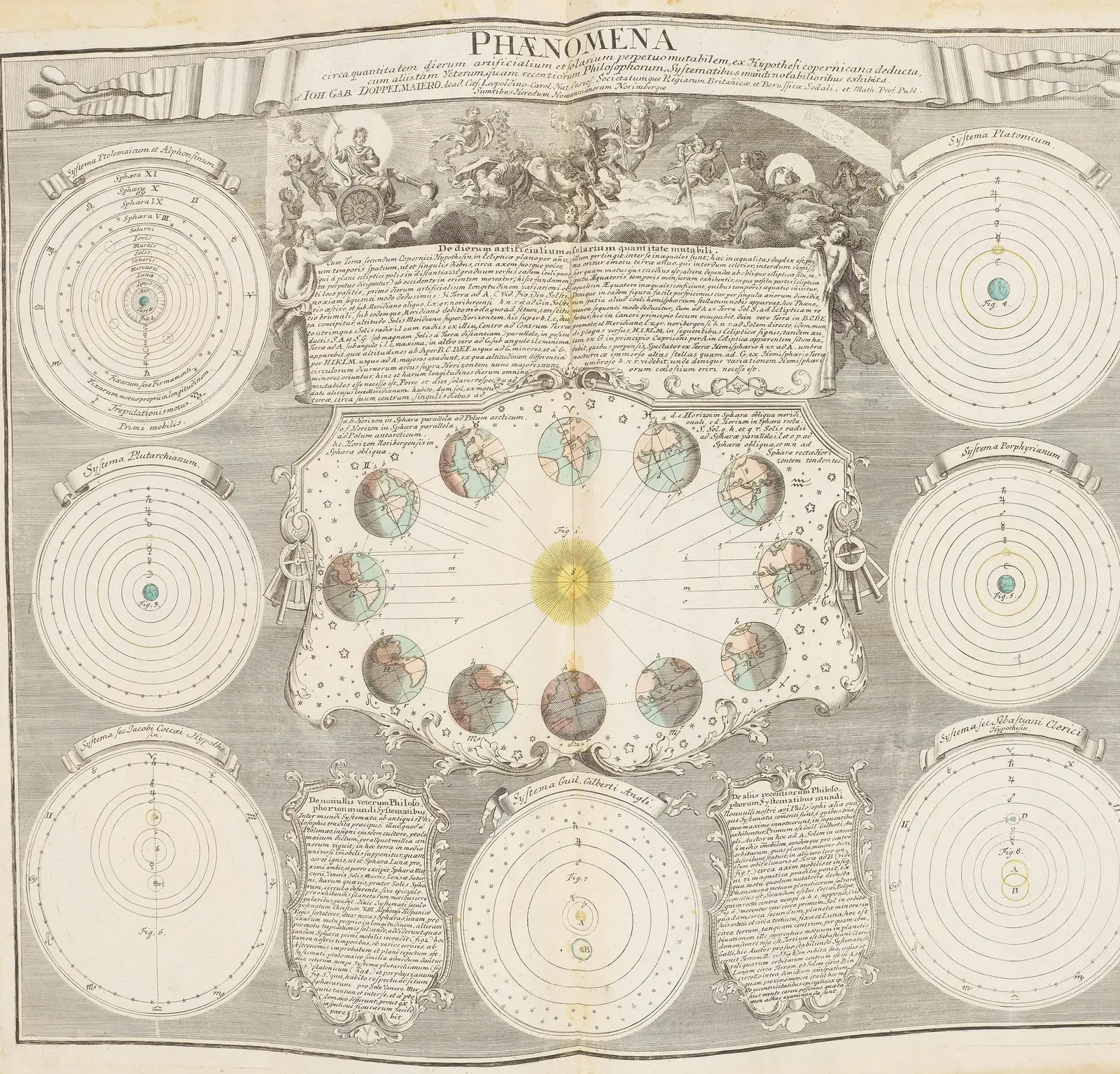
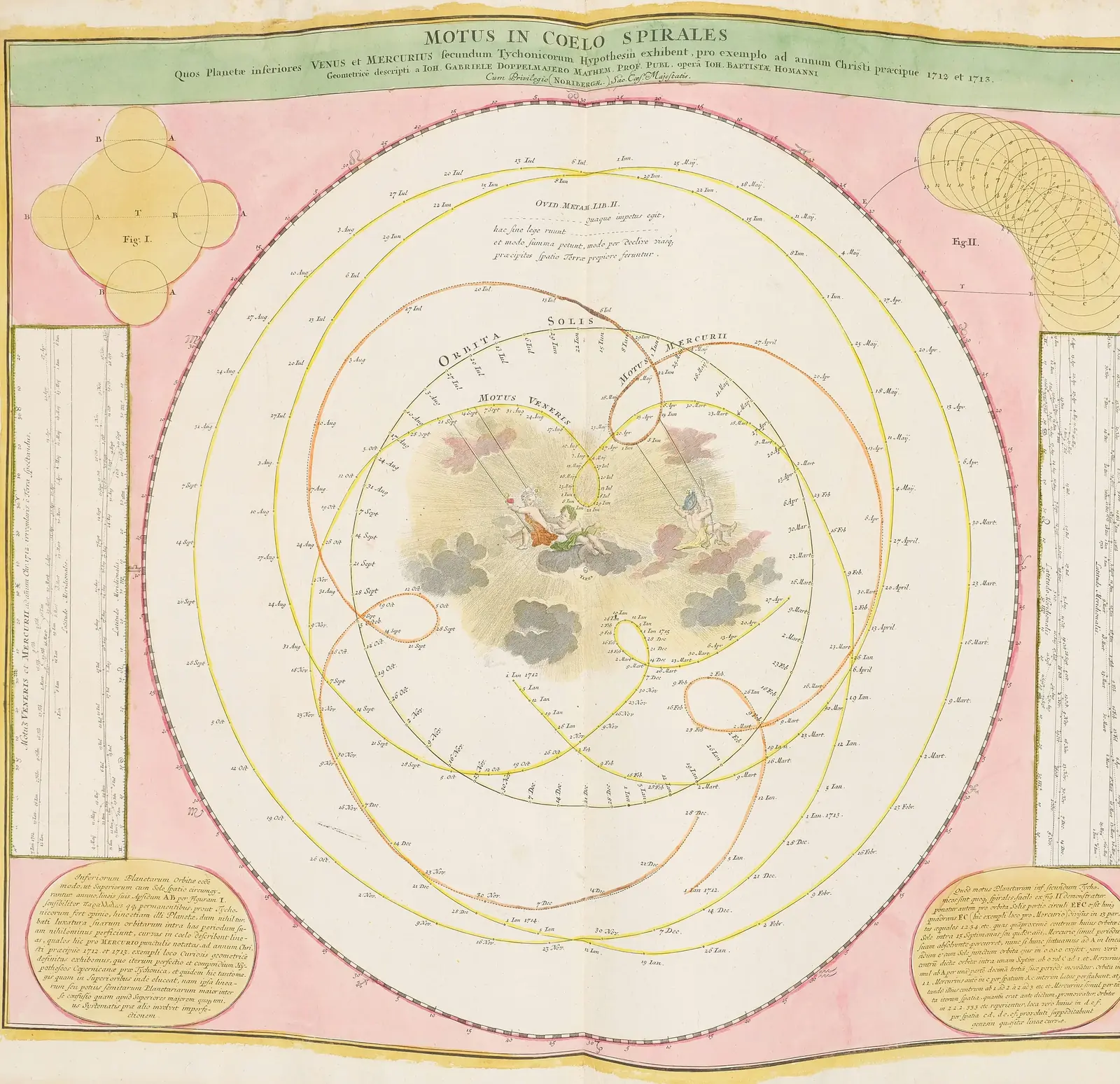
In our data the step from the 2025 star point to the 2026 one took 580 days and moved 208°06′ around the zodiac. Each meeting jumps about three-fifths of the way around the circle. Join five of them in date order and the lines cross into a pentagram. Trace Venus's whole path around Earth over the same eight years and you get a looping, five-petalled rose. Wikipedia's Pentagram of Venus shows the looping figure.
The star you are living inside right now has its corners in Gemini, Capricorn, Leo, Aries, Scorpio: the meetings of 2020, 2022, 2023, 2025, 2026. The next one, on Jun 1, 2028 at 11°26′ Gemini, starts the second lap.
The sky behind it
Mean gap between star points across our 1930–2034 list: 583.9 days, from 66 computed meetings.
The slow turn
Eight years on, 2°21′ earlier
Try this today
- Find a photo from autumn 2018. Look at it for a full minute before you decide how you feel about it.
- Next on this corner: Oct 21, 2034 at 28°23′ Libra. Put it in your calendar as a note to your future self.
Think back to Oct 26, 2018. Where were you living? Who did you text first in the morning? That day Venus met the Sun at 3°06′ Scorpio.
On Oct 24, 2026 it meets the Sun at 0°45′ Scorpio: the same corner of the star, 2°21′ earlier in the zodiac. The meeting also comes about 2.4 days sooner than eight full calendar years would suggest (2919.6 days in all). The five-to-eight match is close, but not perfect, and that tiny miss is where the drift comes from.
Across every 8-year pair in our 1930–2034 list, the slip runs between 2°08′ and 2°29′, about 2°18′ on average. Follow this one corner back and it is a slow, steady walk: in 1930 the 2026 corner sat at 29°44′ Scorpio. In 96 years it has slid 28°59′ backward, almost a whole sign. At that pace the whole star takes roughly 1,250 years to turn once around the zodiac.
So if your star point feels familiar, that is fair. It is your old one, nudged about 2°18′.
The sky behind it
Drift = signed shortest arc between Venus-Sun conjunction longitudes five meetings apart, from 61 pairs, 1930–2034. Mean pair gap 2919.61 days. The full-turn figure is that average extended forward and rounded to 50 years; the real rate wobbles a little.
The watchers
People have counted this since Babylon
Try this today
- Some clear morning in late November, go outside before sunrise with a warm drink and find Venus. It is the brightest thing in the east.
- Leave the phone face down. Count how long it takes for the sky around Venus to go from navy to pale.
Picture a scribe with a clay tablet, standing on a roof at first light, waiting for one bright point to clear the horizon. That is roughly how the oldest Venus record we have came to be.
The Venus tablet of Ammisaduqa records when Venus first and last appeared near sunrise and sunset over about 21 years, under the Babylonian king Ammisaduqa. The copies that survive were written centuries later, and exactly which years the tablet covers is still debated, since it is tied up in arguments over Babylonian chronology.
Across the ocean, the Maya kept Venus tables in the Dresden Codex, built on a 584-day cycle that sits very close to the true 583.9-day average in our data (see Maya astronomy). Two cultures, no contact, the same patient counting.
Neither source uses the phrase "star point". That is a modern astrologers' name. The pattern is the old part.
Your star point
Which Venus star point were you born under?
Type your birthday. We will find the last time Venus met the Sun before you arrived, and the day it came back to that same corner of the star, eight years later. Drawn from 66 computed meetings, 1930 to 2034.
Pick your birthday and press the button. Somewhere in 66 computed meetings of Venus and the Sun, 1930 to 2034, is the one that came just before you.
More to read
Shorter reads. Each opens in place.
The reading
What astrologers read in the star point
This is where the arithmetic hands the page over to tradition.
Continue readingShow less
In traditional astrology a planet within about 17 arc-minutes of the Sun's center is cazimi, "in the heart of the Sun", and read as a moment of strength (see Astrological aspect). A Venus-Sun conjunction passes through that point, so astrologers often treat the star point and the cazimi as one moment.
Astrologers read the 2026 meeting as a reset for Venus themes: what you value, whom you love, what you want to keep. Some treat it as the start of a new Venus chapter that runs until the next meeting on Jun 1, 2028. Treat that as a mirror to think with, a tradition rather than a forecast.
Your chart
Find 0°45′ Scorpio in your own chart
To make the star point personal, find the house of your birth chart that holds the first degree of Scorpio. You need an accurate birth time for the houses to be reliable.
Continue readingShow less
Then look back. The Oct 26, 2018 meeting at 3°06′ Scorpio fell in the same part of your chart. Some people find it useful to recall what mattered to them that autumn and compare it with now.
The other meeting
Venus meets the Sun twice per cycle
Fair question: if Venus meets the Sun on the near side, does it meet it on the far side too? Yes.
Continue readingShow less
Between star points, Venus also lines up with the Sun from the far side of its orbit, a superior conjunction. The dates on this page are the inferior ones, when Venus is closest to us and passing between Earth and the Sun. Those far-side meetings come on the same rhythm, so they trace a pattern of their own. The tables here list the inferior meetings only.
Venus star point dates
The current star, and the 2026 corner traced back to 1930. Every row is computed from the JPL ephemeris.
| Star point | Date & time (UTC) | Venus and the Sun at |
|---|---|---|
| 2020 | Jun 3, 2020 · 17:43 UTC | 13°36′ Gemini |
| 2022 | Jan 9, 2022 · 00:47 UTC | 18°43′ Capricorn |
| 2023 | Aug 13, 2023 · 11:15 UTC | 20°28′ Leo |
| 2025 | Mar 23, 2025 · 01:07 UTC | 2°39′ Aries |
| 2026 (this one) | Oct 24, 2026 · 03:44 UTC | 0°45′ Scorpio |
| Next | Jun 1, 2028 · 10:00 UTC | 11°26′ Gemini |
| Year | Date & time (UTC) | Venus and the Sun at | Slip since the last one |
|---|---|---|---|
| 1930 | Nov 22, 1930 · 18:15 UTC | 29°44′ Scorpio | start |
| 1938 | Nov 20, 1938 · 06:29 UTC | 27°17′ Scorpio | 2°27′ earlier |
| 1946 | Nov 17, 1946 · 19:01 UTC | 24°50′ Scorpio | 2°27′ earlier |
| 1954 | Nov 15, 1954 · 07:25 UTC | 22°24′ Scorpio | 2°26′ earlier |
| 1962 | Nov 12, 1962 · 20:06 UTC | 19°58′ Scorpio | 2°26′ earlier |
| 1970 | Nov 10, 1970 · 08:48 UTC | 17°33′ Scorpio | 2°25′ earlier |
| 1978 | Nov 7, 1978 · 21:34 UTC | 15°08′ Scorpio | 2°25′ earlier |
| 1986 | Nov 5, 1986 · 10:16 UTC | 12°42′ Scorpio | 2°25′ earlier |
| 1994 | Nov 2, 1994 · 23:11 UTC | 10°18′ Scorpio | 2°24′ earlier |
| 2002 | Oct 31, 2002 · 12:05 UTC | 7°53′ Scorpio | 2°25′ earlier |
| 2010 | Oct 29, 2010 · 01:10 UTC | 5°30′ Scorpio | 2°23′ earlier |
| 2018 | Oct 26, 2018 · 14:16 UTC | 3°06′ Scorpio | 2°24′ earlier |
| 2026 | Oct 24, 2026 · 03:44 UTC | 0°45′ Scorpio | 2°21′ earlier |
| 2034 | Oct 21, 2034 · 17:04 UTC | 28°23′ Libra | 2°23′ earlier |
All times are UTC. In the Americas the local date can be a day earlier; in Asia and Australia a day later.
Quick answers
when is the venus star point 2026
The 2026 Venus star point is on Oct 24, 2026 · 03:44 UTC, at 0°45′ Scorpio. It is the exact moment Venus and the Sun share the same zodiac degree, in the middle of Venus retrograde (Oct 3, 2026 to Nov 14, 2026).
what is the venus star point in astrology
It is the astrologers' name for a conjunction of Venus and the Sun. When Venus passes between Earth and the Sun, astronomers call it an inferior conjunction. The name comes from the pattern these meetings trace over eight years: five points that join into a five-pointed star.
what degree is the venus star point 2026
It falls at 0°45′ Scorpio, in the first degree of Scorpio. The meeting eight years earlier, on Oct 26, 2018, fell at 3°06′ Scorpio, only 2°21′ away.
venus star point dates list
The current star: Jun 3, 2020 at 13°36′ Gemini; Jan 9, 2022 at 18°43′ Capricorn; Aug 13, 2023 at 20°28′ Leo; Mar 23, 2025 at 2°39′ Aries; Oct 24, 2026 at 0°45′ Scorpio. The next star point is Jun 1, 2028 at 11°26′ Gemini. They come about every 584 days; the step from Mar 23, 2025 to the 2026 point took 580 days.
is the venus star point the same as venus cazimi
Astrologers often treat it that way. In traditional astrology a planet within about 17 arc-minutes of the Sun's center is called cazimi, 'in the heart of the Sun'. A Venus-Sun conjunction passes through that exact point in longitude, so the star point and the cazimi are read as one moment.
how to find my venus star point
Use the lookup on this page: it returns the last star point before your birthday, its date, sign and degree. To place the 2026 star point in your chart, find which house of your birth chart holds 0°45′ Scorpio. A free birth chart with an accurate birth time shows it.
venus star point 2026 scorpio meaning
Astrologers read a star point as a fresh start for Venus themes (love, values, what you want to keep) colored by the sign it lands in. In 2026 that is Scorpio, at 0°45′ Scorpio, a sign the tradition links with depth, loyalty and honesty about what you want. The same corner of the star last fell in Scorpio on Oct 26, 2018, so many people look back to that autumn. It is a tradition for reflection, not a forecast.
what time is the venus star point 2026 in my time zone
The instant is exact: Oct 24, 2026 · 03:44 UTC. Convert it to your own time zone. In North America the local date is still Oct 23, 2026. In Europe, Asia and Australia it is already Oct 24, 2026.