Seasonal calendar · 2026 and 2027
Wheel of the Year 2026: every sabbat date, timed
Eight festivals, from Imbolc's first pale evening to Yule's longest night. Here is every 2026 date, the exact minute the Sun arrives, and a small way to keep each one.
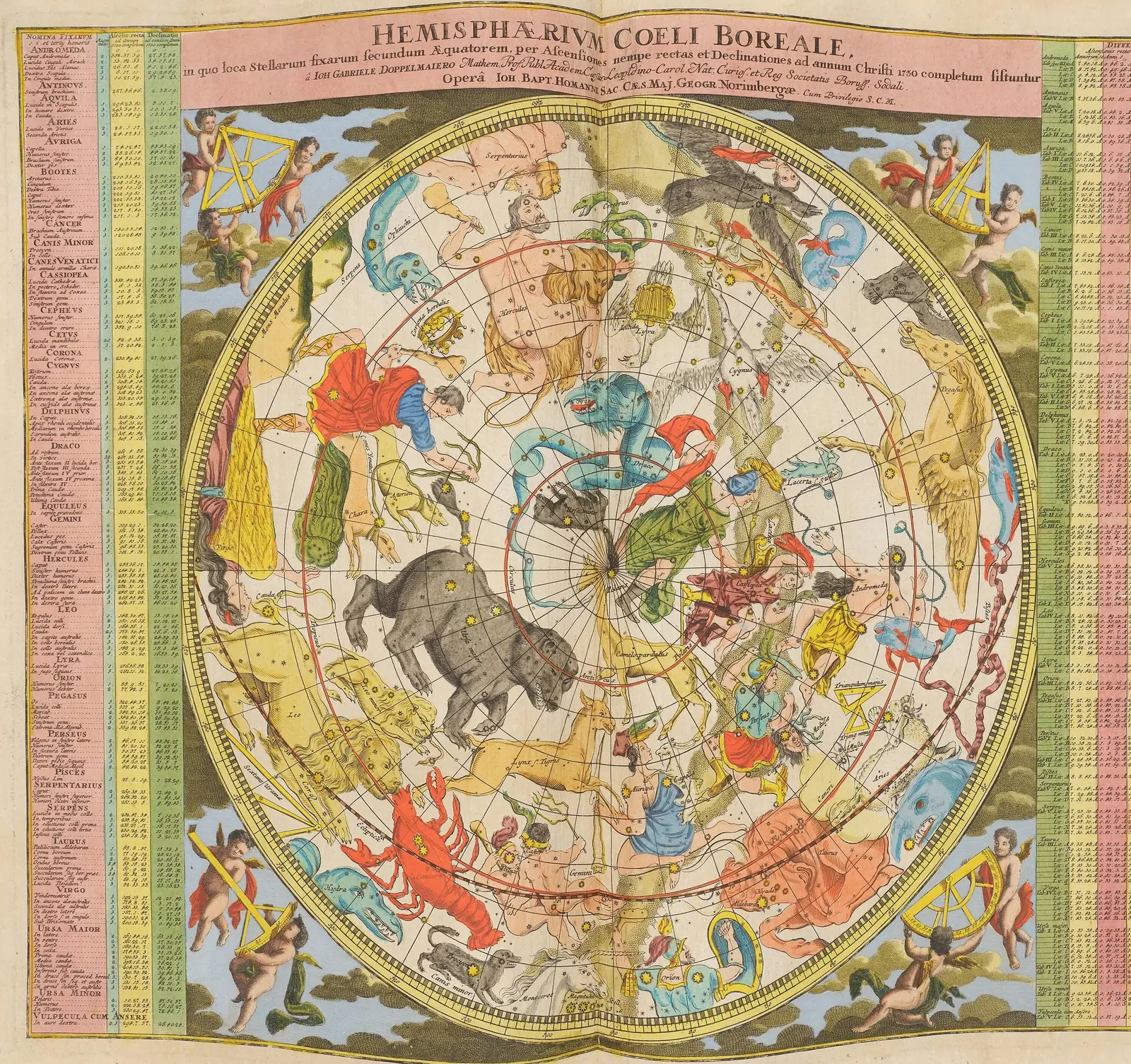
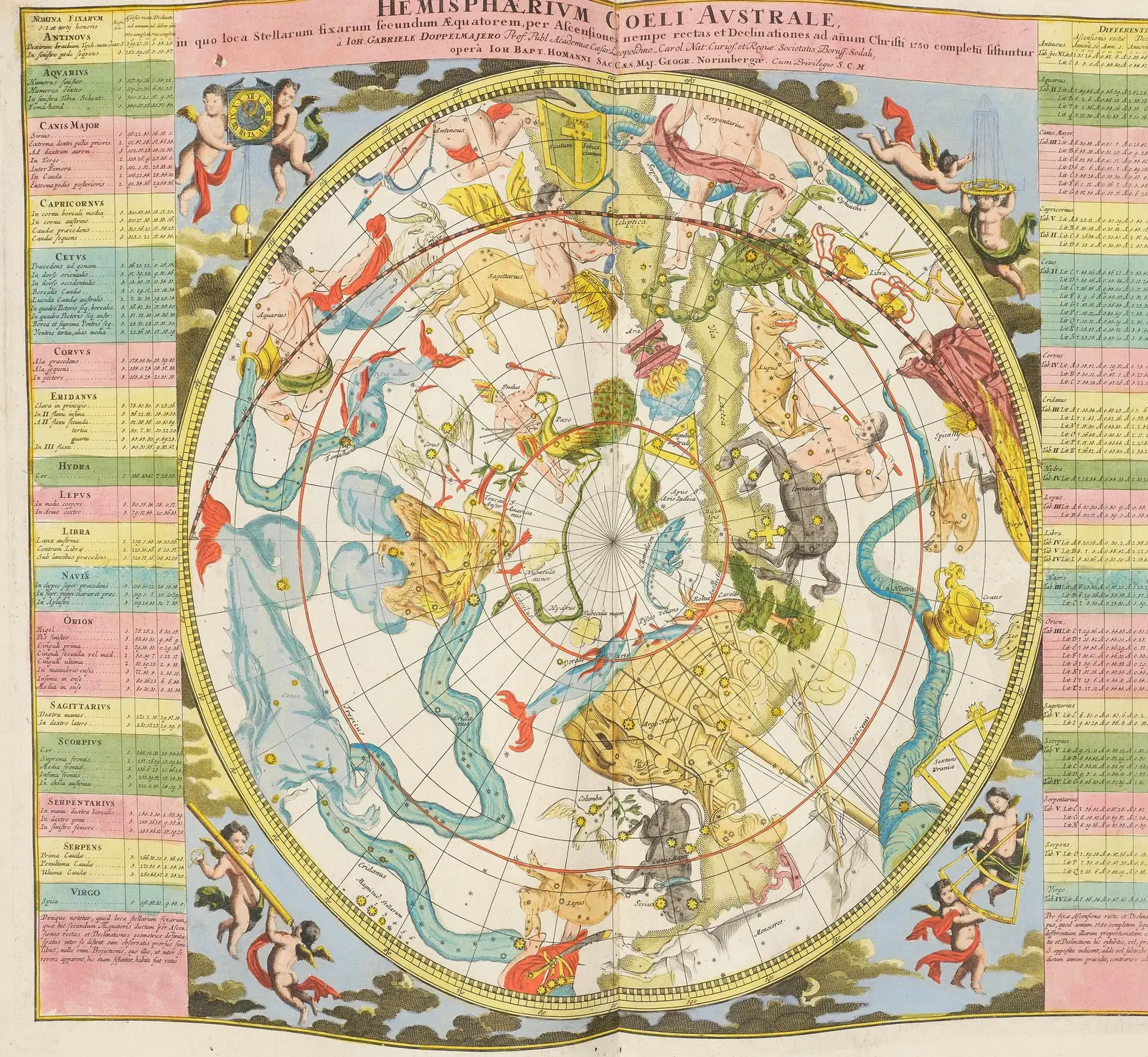
Johann Gabriel Doppelmayr, Atlas Novus Coelestis, 1742
At a glance
The 2026 wheel: Imbolc Feb 1, Ostara Mar 20, Beltane May 1, Litha Jun 21, Lughnasadh / Lammas Aug 1, Mabon Sep 23, Samhain Oct 31, Yule Dec 21.
- Next on the wheel
- Samhain, Nov 7, 2026 · 09:52 UTC The Sun reaches 15°00′ Scorpio; tradition keeps it from October 31 into November 1.
- Solstices and equinoxes
- Ostara Mar 20, Litha Jun 21, Mabon Sep 23 and Yule Dec 21 Set by the Sun, so they drift a day or so year to year.
- Cross-quarter days
- Imbolc Feb 1, Beltane May 1, Lughnasadh / Lammas Aug 1 and Samhain Oct 31 The Sun reaches 15° of Aquarius, Taurus, Leo and Scorpio 2 to 7 days later.
- Southern Hemisphere
- Samhain May 1, Yule Jun 21 Many southern pagans turn the wheel six months.
- 2027 starts with
- Imbolc Feb 1 Exact moment Feb 4, 2027 · 01:46 UTC.
See where the Sun sat when you were bornYour Sun sign is a point on this same wheel. The free chart shows its exact degree.
The 2026 dates
Every turn of the 2026 wheel, in order
Try this today
- Put all eight 2026 dates in your phone calendar now, with a one-line note for each: what you want that season to hold.
- For the cross-quarter days, mark both dates, the traditional one and the Sun's (Feb 3, May 5, Aug 7 and Nov 7), and see which one feels like yours.
- On each solstice and equinox, note the time of sunrise where you live. By the end of the year you will have a small, personal record of the light.
Samhain 2026 in depthWhere the Sun is in every sign: 2026 ingresses
Picture a clock face with eight marks on it, and the Sun as the hand that takes a year to go round. That is the Wheel of the Year. In 2026 the marks fall on Imbolc Feb 1, Ostara Mar 20, Beltane May 1, Litha Jun 21, Lughnasadh / Lammas Aug 1, Mabon Sep 23, Samhain Oct 31, Yule Dec 21.
Half of them are fixed by the sky. Ostara is the equinox, Mar 20, 2026 · 14:45 UTC, Litha is the solstice, Jun 21, 2026 · 08:24 UTC, Mabon is the equinox, Sep 23, 2026 · 00:05 UTC and Yule is the solstice, Dec 21, 2026 · 20:50 UTC. These are the four moments when the Sun crosses 0° of a cardinal sign (Aries, Cancer, Libra and Capricorn), so their dates wobble by a day or so from year to year.
The other half are the cross-quarter days: Imbolc, Beltane, Lughnasadh / Lammas and Samhain. Each sits roughly halfway between a solstice and an equinox. Tradition puts them on fixed calendar dates, mostly the first of a month. Measured by the Sun, the halfway point is 15° of a fixed sign (Aquarius, Taurus, Leo and Scorpio), and in 2026 the Sun gets there 2 to 7 days after the calendar date. So you have a choice: keep the traditional day, or wait for the astronomical one. Plenty of people do both.
Right now the next stop is Samhain, with the Sun reaching 15°00′ Scorpio on Nov 7, 2026 · 09:52 UTC.
The sky behind it
Times are the exact geocentric moments the Sun reaches each longitude, computed from NASA JPL's DE442 ephemeris (tropical zodiac), in UTC. Solstices and equinoxes are 0° of Aries, Cancer, Libra and Capricorn; cross-quarter days are 15° of Aquarius, Taurus, Leo and Scorpio.
The spokes are not evenly spaced in time. The longest stretch in 2026 is Litha to Lughnasadh / Lammas (47.1 days); the shortest is Yule to Imbolc (44.2 days). The Earth moves slowest near its farthest point from the Sun in early July, so the spokes around the northern summer sit farther apart.
Season by season
What each festival feels like, from first light to longest night
Try this today
- Pick one thing you can see from your window and photograph it on each of the eight days. Next December, line the pictures up.
- Cook something in season for each festival: bread at Lammas, apples at Mabon, something slow and warm at Yule.
- If you are new to this, start with the one coming up next. One festival kept well beats eight half-remembered.
Imbolc, Feb 1. Late afternoon, and you notice the sky is still pale at five. That is the whole festival in one moment. Imbolc belongs to the Gaelic calendar and shares its day with the feast of Saint Brigid; some scholars think she carries the lore of an older goddess of the same name. The name's origin is unclear; one common reading takes it from Old Irish for "in the belly", for the pregnant ewes. The Sun reaches 15°00′ Aquarius on Feb 3, 2026.
Ostara, Mar 20. You walk out without a coat and regret it, then don't. The March equinox lands at Mar 20, 2026 · 14:45 UTC, when the Sun crosses 0°00′ Aries: the start of the zodiac and of astronomical spring in the north.
Beltane, May 1. Smoke on the evening air and hawthorn in flower. In Gaelic Ireland and Scotland this was the start of summer, when cattle went out to the summer pastures and bonfires were lit. The astronomical midpoint follows on May 5, 2026, Sun at 15°00′ Taurus.
Litha, Jun 21. Dinner outside, the light refusing to leave. The June solstice falls at Jun 21, 2026 · 08:24 UTC, Sun at 0°00′ Cancer: the longest day in the north, the shortest in the south.
Lughnasadh or Lammas, Aug 1. Dust on the farm track, bread warm from the oven. Lughnasadh takes its name from the Irish god Lugh; Lammas, the English harvest feast on the same date, comes from the Old English for "loaf-mass", when bread from the new grain was blessed. The Sun reaches 15°00′ Leo on Aug 7, 2026.
Mabon, Sep 23. The first evening you reach for a lamp before dinner. The September equinox lands at Sep 23, 2026 · 00:05 UTC, Sun at 0°00′ Libra, and the nights start winning.
Samhain, Oct 31. Cold air at the door, leaves in the gutter, a candle you light without quite saying why. The Gaelic year turned to winter here. The Sun reaches 15°00′ Scorpio on Nov 7, 2026, a full 7 days after the traditional date.
Yule, Dec 21. Lights strung on bare branches, the dark arriving before five. The December solstice falls at Dec 21, 2026 · 20:50 UTC, Sun at 0°00′ Capricorn. Every night after it is a little shorter.
Where it comes from
A modern wheel built from older parts

Try this today
- When someone tells you the wheel is ancient, you can say: parts of it, yes. The festivals are old; the eight-spoke calendar took shape between the 1950s and the 1970s.
- Read the short Bede passage on Ēostre for yourself. It is a few lines, and it is the only early description of her as a goddess.
- Choose one festival and trace it back. Samhain is the best documented, so it is a good place to start.
Samhain 2026: the history and the skyHalloween 2026 night sky
Here is the part people get wrong at dinner parties. The eight-festival wheel, as one calendar, is modern. British neopagans popularized it in the mid-20th century, and the phrase "Wheel of the Year" was in use by the mid-1960s. Its creation is often linked to Gerald Gardner, who brought Wicca to public attention, and Ross Nichols, who brought all eight seasonal ceremonies into modern Druidry.
The story that the two men settled the calendar together is a popular one, but it is not well documented. Gardner's early writings name four festivals: the eves of May, August, November and February. The names Ostara, Litha and Mabon came later, in the early 1970s, and are credited to the American writer Aidan Kelly.
The pieces are much older. Samhain, Imbolc, Beltane and Lughnasadh were seasonal festivals of the Gaels in Ireland, Scotland and the Isle of Man. Samhain appears in the earliest Irish literature, from the 9th century, marking the end of the harvest and the start of winter, the darker half of the year. Yule was a midwinter feast among Germanic peoples, from the Old English ġeol to the Norse jól.
Ostara borrows the name of Ēostre, a goddess described only in a short passage by the English monk Bede, written in the 8th century; related names turn up elsewhere, and what kind of goddess she was is still debated. Mabon borrows the name of Mabon ap Modron, a figure from Welsh mythology, though the festival name itself is modern. So the honest summary is a new wheel with old spokes, and that is part of its charm.
Below the equator
In the Southern Hemisphere, the wheel turns the other way
Try this today
- Use the hemisphere toggle in the birthday finder below to see your southern wheel.
- If you keep the northern calendar, try marking the real local season on the same day too. Two layers, one year.
If you live in Melbourne, Cape Town or Buenos Aires, a December Yule can feel odd: you are lighting candles for the longest night while it is hot enough for the beach. That is why many southern pagans turn the wheel by six months, so each festival moves to the opposite point of the year.
In 2026 that puts southern Samhain around May 1, with the Sun at 15°00′ Taurus on May 5, 2026. Yule moves to the June solstice, Jun 21, 2026 · 08:24 UTC. Litha moves to the December solstice, Dec 21, 2026 · 20:50 UTC. Ostara, the spring equinox, comes on Sep 23, 2026, and Mabon on Mar 20, 2026.
Others keep the northern dates, for tradition or community. Local groups differ, and both choices are in use. The table further down gives every southern moment.
The sky behind it
| Festival (south) | Traditional date | Exact moment (UTC) | Sun at |
|---|---|---|---|
| Imbolc | August 1 | Aug 7, 2026 · 11:42 UTC | 15°00′ Leo |
| Ostara | Around September 22 | Sep 23, 2026 · 00:05 UTC | 0°00′ Libra |
| Beltane | October 31 to November 1 | Nov 7, 2026 · 09:52 UTC | 15°00′ Scorpio |
| Litha | Around December 21 | Dec 21, 2026 · 20:50 UTC | 0°00′ Capricorn |
| Lughnasadh / Lammas | February 1 | Feb 3, 2026 · 20:02 UTC | 15°00′ Aquarius |
| Mabon | Around March 20 | Mar 20, 2026 · 14:45 UTC | 0°00′ Aries |
| Samhain | May 1 | May 5, 2026 · 11:48 UTC | 15°00′ Taurus |
| Yule | Around June 21 | Jun 21, 2026 · 08:24 UTC | 0°00′ Cancer |
Your festival
Which festival is your birthday closest to?
Everyone gets a festival. Pick your birthday and your hemisphere, and we find which of the eight 2026 moments lands closest, down to the day. The dates are real; the bragging rights are entirely yours.
October 31: your festival is Samhain.
Samhain falls 7 days after your birthday. It is a cross-quarter day: the Sun reaches 15°00′ Scorpio on Nov 7 in 2026, and tradition keeps it on Oct 31.
The Gaelic end of harvest and start of winter. Cold air, a porch light, a candle for the people you miss.
Northern wheel. Switch to Southern if your winter comes in June. Measured against the 2026 moments in UTC; in other years these dates drift by a day or so.
- Imbolc · Feb 3
- Ostara · Mar 20
- Beltane · May 5
- Litha · Jun 21
- Lughnasadh / Lammas · Aug 7
- Mabon · Sep 23
- Samhain · Nov 7
- Yule · Dec 21
More to read
Shorter reads. Each opens in place.
Coming up
Samhain 2026: two dates, 7 days apart
Samhain is kept from October 31 into November 1. The Sun reaches 15°00′ Scorpio, the astronomical midpoint, on Nov 7, 2026 · 09:52 UTC. Some people call that later date "astrological Samhain". In 2027 the pair is Oct 31 and Nov 7, 2027. The full Samhain 2026 guide.
Continue readingShow less
A small surprise
The summer half of the wheel is longer
If summer always seems to outlast winter, the calendar half agrees with you. From the March equinox to the September equinox in 2026 is 186.4 days. From that September equinox to the next March equinox is 178.8 days. The Earth's orbit is slightly oval, and it moves slower when it is farther from the Sun, which happens in early July. So the northern spring and summer get about 8 more days than autumn and winter. In the south it is the other way round.
Continue readingShow less
Your chart
Your Sun sign sits on this wheel
Astrologers read the cardinal signs as the start of each season and the fixed signs as its steady middle. If you were born near a solstice or equinox, your Sun is near 0° of Aries, Cancer, Libra or Capricorn. Born near a cross-quarter moment, it is near 15° of Aquarius, Taurus, Leo or Scorpio. Read it as a mirror, not a rule. Find your exact Sun degree.
Continue readingShow less
The Wheel of the Year 2026 and 2027, in full
All eight festivals for both years with the traditional date, the exact moment the Sun arrives and its degree. The 2027 wheel: Imbolc Feb 1, Ostara Mar 20, Beltane May 1, Litha Jun 21, Lughnasadh / Lammas Aug 1, Mabon Sep 23, Samhain Oct 31, Yule Dec 22.
| Festival | Traditional date | Exact moment (UTC) | Sun at | Kind |
|---|---|---|---|---|
| Imbolc | February 1 | Feb 3, 2026 · 20:02 UTC | 15°00′ Aquarius | Cross-quarter day |
| Ostara (March equinox) | Around March 20 | Mar 20, 2026 · 14:45 UTC | 0°00′ Aries | Equinox |
| Beltane | May 1 | May 5, 2026 · 11:48 UTC | 15°00′ Taurus | Cross-quarter day |
| Litha (June solstice) | Around June 21 | Jun 21, 2026 · 08:24 UTC | 0°00′ Cancer | Solstice |
| Lughnasadh / Lammas | August 1 | Aug 7, 2026 · 11:42 UTC | 15°00′ Leo | Cross-quarter day |
| Mabon (September equinox) | Around September 22 | Sep 23, 2026 · 00:05 UTC | 0°00′ Libra | Equinox |
| Samhain | October 31 to November 1 | Nov 7, 2026 · 09:52 UTC | 15°00′ Scorpio | Cross-quarter day |
| Yule (December solstice) | Around December 21 | Dec 21, 2026 · 20:50 UTC | 0°00′ Capricorn | Solstice |
| Festival | Traditional date | Exact moment (UTC) | Sun at | Kind |
|---|---|---|---|---|
| Imbolc | February 1 | Feb 4, 2027 · 01:46 UTC | 15°00′ Aquarius | Cross-quarter day |
| Ostara (March equinox) | Around March 20 | Mar 20, 2027 · 20:24 UTC | 0°00′ Aries | Equinox |
| Beltane | May 1 | May 5, 2027 · 17:25 UTC | 15°00′ Taurus | Cross-quarter day |
| Litha (June solstice) | Around June 21 | Jun 21, 2027 · 14:10 UTC | 0°00′ Cancer | Solstice |
| Lughnasadh / Lammas | August 1 | Aug 7, 2027 · 17:26 UTC | 15°00′ Leo | Cross-quarter day |
| Mabon (September equinox) | Around September 22 | Sep 23, 2027 · 06:01 UTC | 0°00′ Libra | Equinox |
| Samhain | October 31 to November 1 | Nov 7, 2027 · 15:38 UTC | 15°00′ Scorpio | Cross-quarter day |
| Yule (December solstice) | Around December 21 | Dec 22, 2027 · 02:42 UTC | 0°00′ Capricorn | Solstice |
| Festival | Traditional date | Sun at 15° (UTC) | Gap |
|---|---|---|---|
| Imbolc | Feb 1 | Feb 3, 2026 · 20:02 UTC | 2 days |
| Beltane | May 1 | May 5, 2026 · 11:48 UTC | 4 days |
| Lughnasadh / Lammas | Aug 1 | Aug 7, 2026 · 11:42 UTC | 6 days |
| Samhain | Oct 31 | Nov 7, 2026 · 09:52 UTC | 7 days |
All times are UTC. In the Americas the local date can be a day earlier; in Asia and Australia a day later.
Quick answers
What are the Wheel of the Year 2026 dates?
Imbolc Feb 1, Ostara Mar 20, Beltane May 1, Litha Jun 21, Lughnasadh / Lammas Aug 1, Mabon Sep 23, Samhain Oct 31, Yule Dec 21. The solstices and equinoxes use the exact astronomical date in UTC. The four cross-quarter days use their traditional calendar dates; their astronomical midpoints come 2 to 7 days later: Imbolc Feb 3, 2026, Beltane May 5, 2026, Lughnasadh / Lammas Aug 7, 2026, Samhain Nov 7, 2026.
When is Samhain 2026, and when is astrological Samhain 2026?
Samhain is traditionally kept from October 31 into November 1. Astrological Samhain, the astronomical midpoint when the Sun reaches 15°00′ Scorpio, is Nov 7, 2026 · 09:52 UTC. Some people celebrate on the calendar date and some on the astronomical one.
What is next on the Wheel of the Year?
Samhain: the Sun reaches 15°00′ Scorpio on Nov 7, 2026 · 09:52 UTC, and tradition keeps it from October 31 into November 1.
Which 2026 sabbats are the solstices and equinoxes?
Ostara is the equinox on Mar 20, 2026, with the Sun at 0°00′ Aries. Litha is the solstice on Jun 21, 2026, with the Sun at 0°00′ Cancer. Mabon is the equinox on Sep 23, 2026, with the Sun at 0°00′ Libra. Yule is the solstice on Dec 21, 2026, with the Sun at 0°00′ Capricorn.
What is a cross-quarter day?
A cross-quarter day falls about halfway between a solstice and an equinox. Measured by the Sun, that is 15° of the four fixed signs: Aquarius, Taurus, Leo and Scorpio. In 2026 those moments land on Feb 3, 2026, May 5, 2026, Aug 7, 2026 and Nov 7, 2026.
What religion is the Wheel of the Year, and is it ancient?
It is kept mainly in Wicca and other modern pagan paths, including Druidry. As one calendar it is not ancient. British neopagans popularized the eight-festival wheel in the mid-20th century, and the phrase was in use by the mid-1960s. Its creation is often linked to Gerald Gardner and Ross Nichols. It draws on older seasonal festivals, such as the Gaelic Samhain and Beltane and the midwinter feast of Yule. The names Ostara, Litha and Mabon were coined in the early 1970s.
What are the sabbats 2026 dates in the Southern Hemisphere?
Many Southern Hemisphere pagans turn the wheel by six months so it matches their own seasons. Imbolc Aug 1, Ostara Sep 23, Beltane Oct 31, Litha Dec 21, Lughnasadh / Lammas Feb 1, Mabon Mar 20, Samhain May 1, Yule Jun 21. Samhain's astronomical moment is May 5, 2026 · 11:48 UTC and Yule is the June solstice, Jun 21, 2026. Some southern groups keep the northern dates.
What are the Wheel of the Year 2027 dates?
Imbolc Feb 1, Ostara Mar 20, Beltane May 1, Litha Jun 21, Lughnasadh / Lammas Aug 1, Mabon Sep 23, Samhain Oct 31, Yule Dec 22. The 2027 solstices fall on Jun 21, 2027 and Dec 22, 2027; the exact 2027 moments, in UTC, are in the table on this page.