House systems · Compare
Whole Sign vs Placidus: same sky, different houses
Your signs never change. Your houses can. At London's latitude, about 59% of planets land in a different house depending on which system you pick. Here is why, and a toggle to see your own.
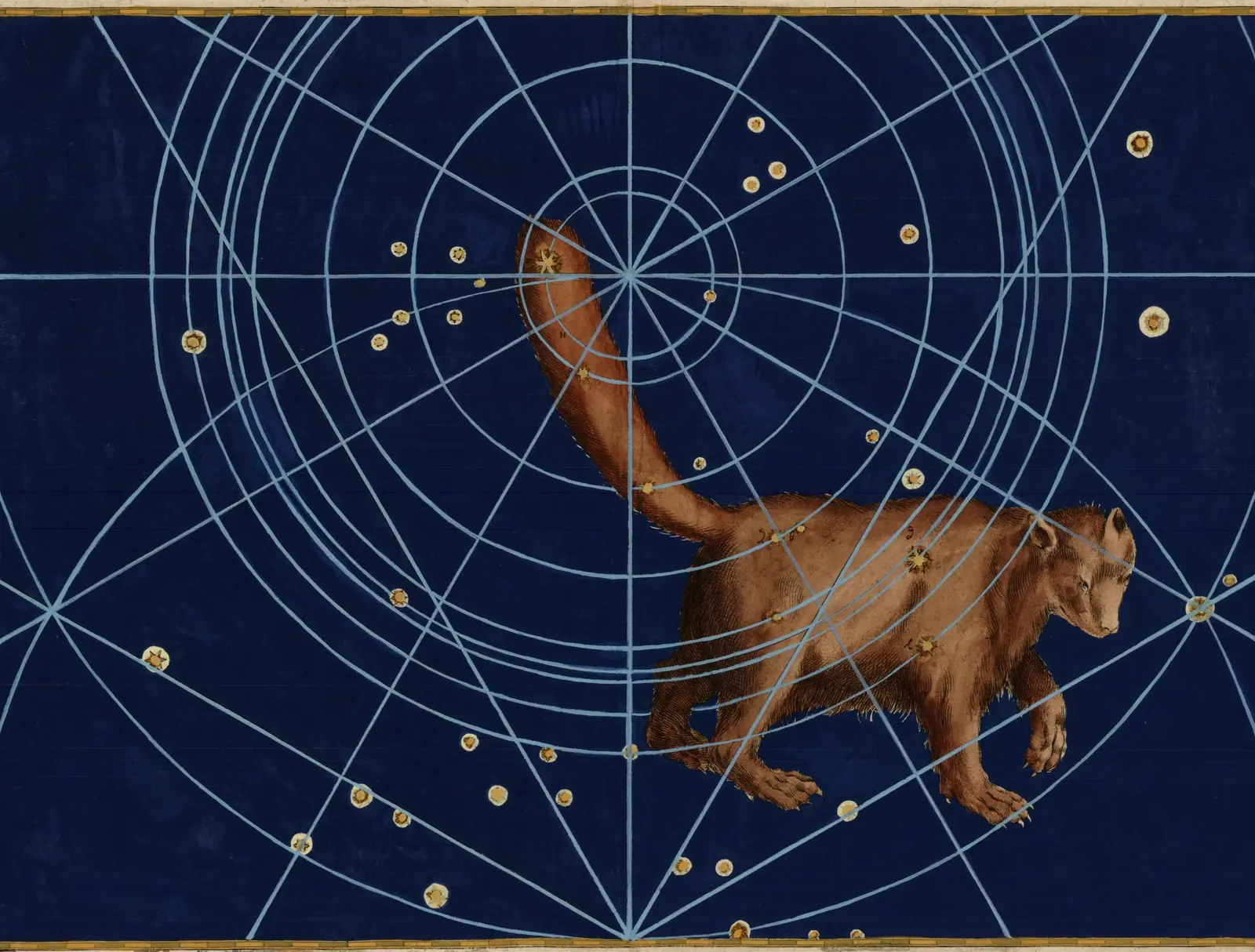
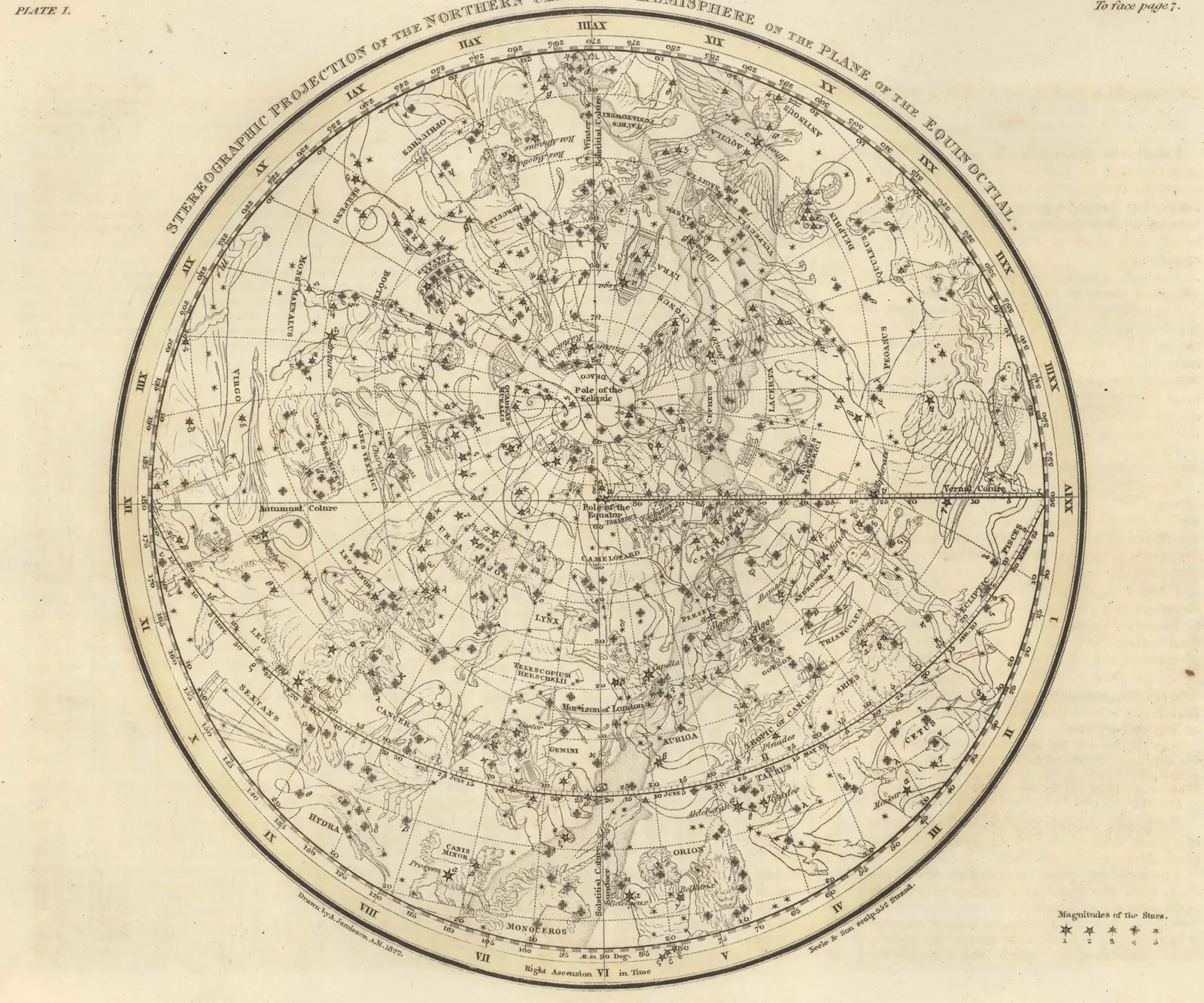
Alexander Jamieson, A Celestial Atlas, 1822 · US Naval Observatory Library
At a glance
Neither is provably more accurate. They disagree on about 51% of planet houses at the equator, 59% at London's latitude, and Placidus stops working above 66.56°.
- Whole Sign
- 1 sign = 1 houseevery house exactly 30°
- Placidus
- Houses by timesizes vary with latitude
- Planets that move, 52°N
- 5.9 of 10 on average3,000 random charts
- Charts with a shift, 52°N
- 99%at least one planet moves
- Placidus limit
- 66.56° latitude90° minus the obliquity
Get your full birth chartFree, with the exact Ascendant degree both systems start from.
The short version
Two ways to slice the same pie

Try this today
- Find your Ascendant degree. The lower it is (say 2° rather than 27°), the more your houses will agree.
- Check which sign your Midheaven is in, then count from your rising sign. If it is not the 10th sign, your career house differs between systems.
House systems explained: Whole Sign, Placidus, KochFree birth chart
You switch a setting in your app, and suddenly your Venus has moved from the 7th house to the 6th. Did your love life just become a work thing? No. Nothing in the sky moved. You changed the knife, not the pie.
Whole Sign is the simple one. Find your rising sign, and that entire sign becomes your 1st house, from 0° to 29°. The next sign is the 2nd house, and so on round the wheel. Every house is exactly 30° wide, and every house is one sign.
Placidus starts the 1st house at the exact degree of your Ascendant, then divides the sky by time: how long each degree of the zodiac takes to climb from the horizon to the top of the sky, split into thirds. The 10th house always starts at the Midheaven, the highest point of the zodiac overhead. The result is houses of uneven size that sprawl across sign lines.
So the two systems disagree in two predictable ways. A planet sitting in your rising sign but before your Ascendant degree is 1st house in Whole Sign and 12th in Placidus. And because Whole Sign does not tie the 10th house to the Midheaven, the MC can float into the 9th or 11th whole sign house.
We counted
How often do they disagree? More than you would guess

Try this today
- In the toggle below, tap Miami, then Edinburgh. Watch the Placidus wheel stretch.
- Count how many of your own planets move. If it is zero or one, the debate barely touches you.
We cast 3,000 random charts at each latitude, at random moments between 1950 and 2030, and counted how many of the ten planets (Sun through Pluto) landed in a different house under each system.
On the equator, where Placidus houses are nearly even, 51% of planet placements still differ. That surprises people, but it follows from the setup: Placidus houses begin at your Ascendant degree, Whole Sign houses at the start of the sign. If you are 15° Leo rising, every Placidus cusp sits about halfway through a sign, so roughly half your planets fall on the other side.
Move north and it climbs: 54% at 40° (New York, Madrid), 59% at 52° (London, Amsterdam, Edmonton is close at 53.55°), 65% at 60° and 69% at 66°. At 52° north, 99% of charts had at least one planet change house.
The Midheaven tells the same story. At the equator it falls outside the 10th whole sign house in 10% of charts. At 52° that rises to 63%.
The sky behind it
Method: Planets: skyfield + JPL DE442 (apparent geocentric, ecliptic of date). Houses: mean sidereal time + mean obliquity, Placidus by semi-arc iteration (60 steps). Stats: 3000 random instants 1950-2030 with random longitudes per latitude, 10 bodies Sun to Pluto. Our Placidus cusps match the Swiss Ephemeris to within 0.004° for London, Toronto and Reykjavik.
North of 50
Placidus at high latitude: the UK, Canada and beyond

Try this today
- Born in Scotland, Scandinavia, northern Canada or Alaska? Compare both systems before you trust a single house reading.
- If your app shows a sign with no cusp in it, that is an interception. Whole Sign never has them.
Placidus measures how long each degree of the zodiac spends above the horizon. Near the poles, some degrees race up in minutes while others hang there for hours, and a few never rise or set at all. That is where the system bends, then breaks.
Take one moment, 12:00 UTC, October 18, 2026, and cast it for different cities. In London (51.51°N) the Placidus houses range from 16° to 48° wide. In Edinburgh (55.95°N) it is 14° to 52°. In Lerwick, Shetland (60.15°N), 11° to 58°. In Reykjavik (64.15°N), 10° to 59°: one house nearly six times the size of another.
Across our random samples the extremes are wilder. At 64° the biggest Placidus house we found spanned 114°, and at 66° it reached 147°, with the smallest just 3°. Signs get "intercepted", swallowed whole inside one house so that no cusp starts in them.
At 66.56°, ninety degrees minus the tilt of Earth's axis, the method fails outright. Above that line, as in Tromsø (69.65°N), we could not produce Placidus cusps for any of our 3,000 sample charts at 68°. Most chart software either refuses or quietly swaps in another system. Whole Sign does not care: a Scorpio rising chart in Tromsø works exactly like one in Miami.
Where they come from
One is ancient, one is early modern, both are traditions
Try this today
- Ask any astrologer you follow which system they use. Their readings make sense only inside it.
- Read your chart in Whole Sign for a month, then Placidus for a month. Keep notes on which descriptions fit.
Whole Sign houses appear in the earliest Western astrology we have. Hellenistic astrologers such as Vettius Valens worked with signs as places, and the historian Robert Hand argued in his 2000 paper Whole Sign Houses: The Oldest House System that this was the original approach. Translation projects of Greek texts in the 1990s brought it back into use, and many traditional and Hellenistic astrologers use it today.
Placidus is named for Placidus de Titis, a 17th-century Italian monk and mathematician who championed it. It spread in England in the 19th century, when tables of houses for it were printed and widely sold, and it became the habit of most modern Western astrologers and then the default in most software.
Neither history makes either system "true". It does tell you why your app probably opened on Placidus, and why a Hellenistic astrologer on social media reads your chart differently.
Choosing
How to choose without a fight in the comments
Here is a fair way to decide.
Pick Whole Sign if you were born far north or south, you want houses that line up neatly with signs and their rulers, you are learning Hellenistic or traditional techniques like profections, or you like a clean system you can count on your fingers.
Pick Placidus if you want the Ascendant and Midheaven degrees to sit exactly on the 1st and 10th cusps, you read modern psychological astrology, or the books and astrologers you learn from use it.
Use both if you are curious. Many astrologers read Whole Sign for the topic of a house and watch the Placidus cusps, or the exact angles, for timing. Planets that sit near a sign line or near your Ascendant degree are the ones that flip, so those are the placements worth reading twice.
And keep it in proportion. A house is a lens on where a planet's story plays out. It is a tradition for reflection, not a measurement of your fate, and no setting change rewrites who you are.
Try it
The house system toggle
Tap a city to cast the same moment in a new place, or enter your birth details. Switch between Whole Sign and Placidus: highlighted rows are the planets that change house.
Flip the house system, watch the planets move
Start with a sample sky (12:00 UTC, October 18, 2026) cast for a city, or enter your own birth details. Nothing is stored.
Sample city
Use my birth chart instead
10 of 10 planets change house when you switch systems.
Rising 24°31′ Sagittarius · Midheaven 28°53′ Libra, which lands in the 11th whole sign house, not the 10th.
Placidus: cusps start at the Ascendant degree and split time, not space.
| Planet | Sign | Whole Sign | Placidus |
|---|---|---|---|
| Sun | 25°07′ Lib | 11th | 9th ↔ |
| Moon | 23°13′ Cap | 2nd | 1st ↔ |
| Mercury | 19°03′ Sco | 12th | 10th ↔ |
| Venus | 4°04′ Sco | 12th | 10th ↔ |
| Mars | 11°33′ Leo | 9th | 8th ↔ |
| Jupiter | 22°29′ Leo | 9th | 8th ↔ |
| Saturn | 10°13′ Ari | 5th | 3rd ↔ |
| Uranus | 5°07′ Gem | 7th | 5th ↔ |
| Neptune | 2°23′ Ari | 5th | 3rd ↔ |
| Pluto | 3°04′ Aqu | 3rd | 1st ↔ |
What changes in the reading
- Sun: 11th house (friends, groups, hopes) in Whole Sign, 9th house (travel, study, beliefs) in Placidus.
- Moon: 2nd house (money, things you own, self-worth) in Whole Sign, 1st house (self, body, first impressions) in Placidus.
- Mercury: 12th house (rest, solitude, what is hidden) in Whole Sign, 10th house (career, reputation) in Placidus.
- Venus: 12th house (rest, solitude, what is hidden) in Whole Sign, 10th house (career, reputation) in Placidus.
- Mars: 9th house (travel, study, beliefs) in Whole Sign, 8th house (shared money, intimacy, change) in Placidus.
The sign and degree of each planet never change. Only the life area it is read through does.
More to read
Shorter reads. Each opens in place.
A worked example
London at 12:00 UTC, October 18, 2026
Rising 24°31′ Sagittarius, Midheaven 28°54′ Libra. The MC sits in the 11th whole sign house. 10 of 10 planets change house: the Sun goes from the 11th (Whole Sign) to the 9th (Placidus), Mercury from the 12th to the 10th.
Continue readingShow less
When they agree
Early-degree rising signs barely notice
Miami at the same moment had 2°53′ Scorpio rising and only 2 planets moved. Edmonton had 2°24′ Libra rising: 2 moved, despite its 53.55° latitude. Toronto, with 28°53′ Libra rising, saw 10. A rising degree near 0° keeps the systems close.
Continue readingShow less
Whole Sign vs Placidus, by latitude
Each row is 3,000 random charts (1950 to 2030, random longitude) at that latitude. Southern latitudes behave the same as their northern mirror.
| Latitude | Planets in a different house | Charts with at least one shift | MC outside 10th whole sign house | Largest Placidus house (max) | Smallest (min) |
|---|---|---|---|---|---|
| 0° | 51% | 91% | 10% | 33° | 28° |
| 15° | 51% | 93% | 16% | 36° | 25° |
| 25° | 52% | 94% | 24% | 40° | 23° |
| 35° | 52% | 97% | 36% | 44° | 21° |
| 40° | 54% | 97% | 43% | 48° | 20° |
| 45° | 55% | 98% | 52% | 52° | 18° |
| 50° | 58% | 99% | 61% | 58° | 16° |
| 52° | 59% | 99% | 63% | 61° | 16° |
| 55° | 61% | 99% | 67% | 68° | 14° |
| 58° | 63% | 99% | 70% | 77° | 12° |
| 60° | 65% | 100% | 72% | 85° | 11° |
| 62° | 66% | 100% | 75% | 96° | 9° |
| 64° | 68% | 100% | 77% | 114° | 7° |
| 66° | 69% | 100% | 80% | 147° | 3° |
| 68° | Placidus fails | n/a | n/a | n/a | n/a |
| 70° | Placidus fails | n/a | n/a | n/a | n/a |
| City | Latitude | Rising | Planets that change house | Placidus house sizes |
|---|---|---|---|---|
| Singapore | 1.35°N | 13°39′ Taurus | 5 of 10 | 28° to 33° |
| Miami | 25.76°N | 2°53′ Scorpio | 2 of 10 | 26° to 32° |
| Los Angeles | 34.05°N | 28°56′ Virgo | 10 of 10 | 27° to 32° |
| Sydney | 33.87°S | 13°31′ Gemini | 9 of 10 | 21° to 37° |
| New York | 40.71°N | 3°55′ Scorpio | 3 of 10 | 23° to 35° |
| Toronto | 43.65°N | 28°53′ Libra | 10 of 10 | 22° to 36° |
| Vancouver | 49.28°N | 25°33′ Virgo | 9 of 10 | 24° to 36° |
| London | 51.51°N | 24°31′ Sagittarius | 10 of 10 | 16° to 48° |
| Edmonton | 53.55°N | 2°24′ Libra | 2 of 10 | 23° to 37° |
| Edinburgh | 55.95°N | 16°34′ Sagittarius | 10 of 10 | 14° to 52° |
| Lerwick | 60.15°N | 11°57′ Sagittarius | 10 of 10 | 11° to 58° |
| Anchorage | 61.22°N | 10°01′ Virgo | 3 of 10 | 18° to 43° |
| Reykjavik | 64.15°N | 23°23′ Scorpio | 10 of 10 | 10° to 59° |
| Tromsø | 69.65°N | 29°17′ Scorpio | Placidus fails | n/a |
All times are UTC. In the Americas the local date can be a day earlier; in Asia and Australia a day later.
Quick answers
Which house system is most accurate?
None can be proven more accurate. Placidus, Whole Sign, Koch and the rest are different ways of dividing the same sky, and astrologers choose between them by tradition and by what works in their readings. What can be measured is how much they disagree, which is what this page computes.
Should I use Whole Sign or Placidus?
Use the one whose readings make more sense of your life. A practical test: open the toggle above, look at the planets that change house, and read both descriptions. If you were born north of about 66.56° latitude, Whole Sign is the only one of the two that works.
Why does my Sun change house in Whole Sign?
Because the two systems start the houses in different places. Whole Sign starts the 1st house at 0° of your rising sign; Placidus starts it at the exact degree of your Ascendant. A planet in the same sign as the Ascendant but behind its degree sits in the 1st house in Whole Sign and the 12th in Placidus.
Is Placidus wrong at high latitudes?
It distorts and then fails. In our sample of 3,000 random charts at 60° north, the largest Placidus house reached 85° and the smallest shrank to 11°. Above 66.56°, where some zodiac degrees never rise or set, Placidus cannot be calculated at all.
Why is Placidus the default on most apps?
Mostly history. Placidus tables of houses were widely printed in the 19th and 20th centuries, including in Raphael's ephemeris, so generations of astrologers learned on it and software followed.
Is Whole Sign the oldest house system?
It is the system found in the earliest surviving Hellenistic horoscopes and manuals, and the historian of astrology Robert Hand argued it was the original approach. Placidus is named after the 17th-century monk Placidus de Titis.
Does the house system change my rising sign?
No. Your rising sign, Sun sign, Moon sign and every planet's degree stay exactly the same. Only the house numbers, and the life areas they are read through, can change.