Part 1: Foundations · Chapter 1 of 36 · 14 min
Why the sky: what astrology claims and what it doesn't
Astrology starts with a simple human arrangement: look up, mark where things are, and compare that pattern with what happens below.
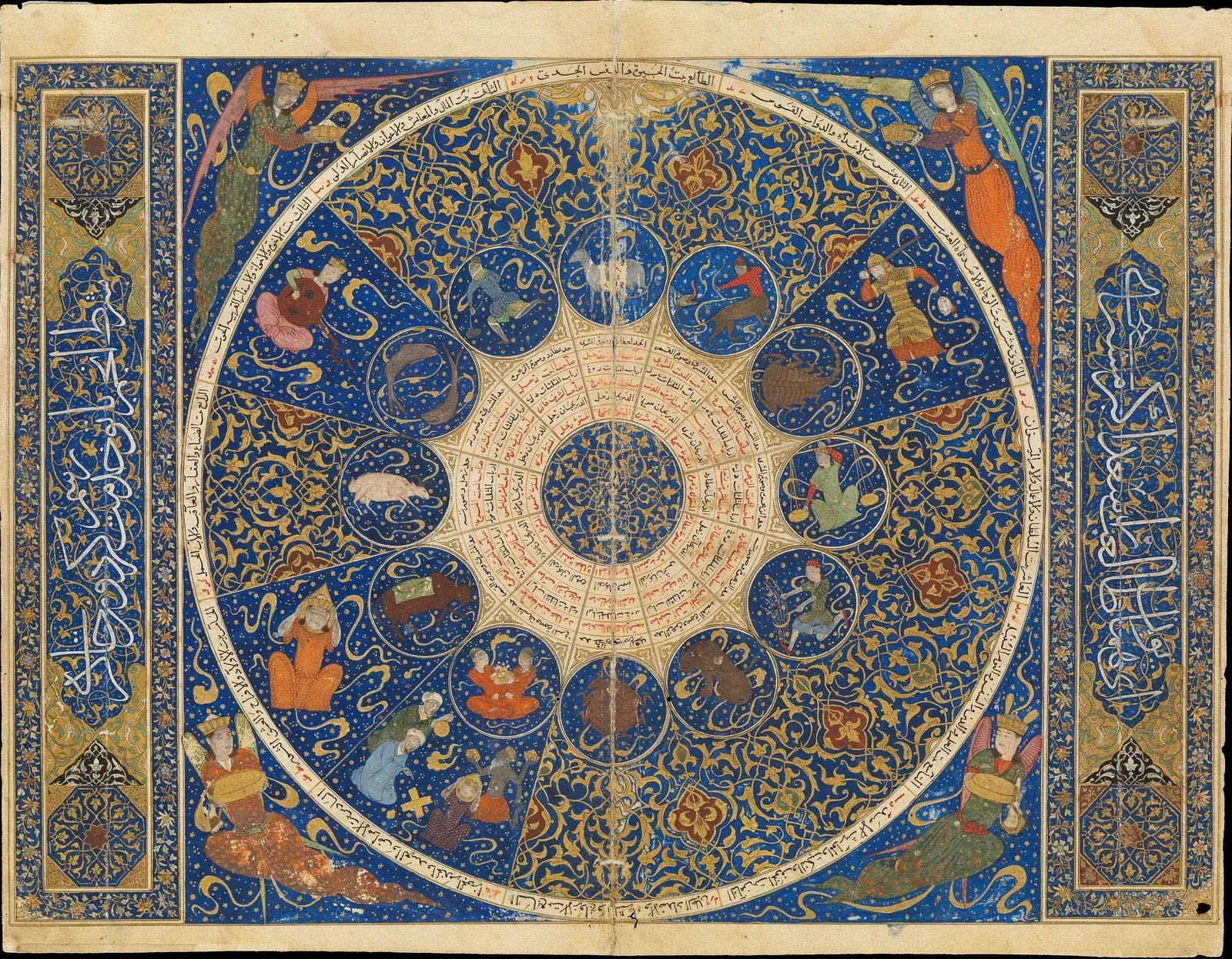
Astrology starts with a simple human arrangement: look up, mark where things are, and compare that pattern with what happens below.
The sky was chosen for a practical reason before it was given a symbolic one. The Sun marked the year. The Moon offered a visible month. The planets moved through the same narrow band of sky, sometimes slowing, stopping, and appearing to turn backward against the stars. These cycles were public. They did not depend on one person’s mood, memory, or private story. A community could watch the same sky and keep time together.
That matters. Astrology is often introduced as though the planets were selected because people had proved that distant bodies transmit personality into a newborn child. They had not. The sky offered a stable reference system, and human beings built meanings around its repeating forms. Western astrology grew through several historical layers: Mesopotamian observation, Hellenistic technical synthesis, later Arabic-language scholarship, medieval and Renaissance practice, and modern psychological interpretation. It is not one frozen doctrine with one unquestionable rulebook.
So the first answer to why the sky is not because the sky has been shown to manufacture character. The answer is that the sky gives astrology a shared clock and a set of measurable angles. Meaning is then placed on those measurements. That distinction will keep us honest.
What a chart is
A birth chart, or natal chart, is a diagram of the sky for a particular date, time, and place. It records where the Sun, Moon, planets, and selected points appeared from Earth at that moment. The calculation can be precise even when the interpretation is uncertain. That difference is the first receipt behind every reading.
Most Western astrology uses a geocentric viewpoint. Geocentric means Earth is treated as the center of the picture because the chart describes what the sky looked like from here. It does not mean that Earth is physically at the center of the solar system. A train timetable can be written from the station’s point of view without claiming that the station moves the train.
The main coordinate is longitude along the ecliptic. The ecliptic is the Sun’s apparent yearly path across the sky, and the other visible planets remain close to it. Picture a circle divided into 360 degrees. The zodiac signs are twelve equal sections of 30 degrees each. A position such as 18° Taurus is therefore not a vague mood or a star cluster. It is a location in a 360-degree coordinate system: 48 degrees from the beginning of the circle.
In the tropical zodiac used by much Western astrology, 0° Aries begins at the northern spring equinox. The signs are tied to the seasonal cycle, not to the present outlines of the constellations. A constellation is an irregular region or pattern of stars as seen from Earth. A sign is a regular 30-degree section of the zodiac. The two once lined up more closely than they do now because Earth’s axis slowly changes its orientation, a motion called precession. If you confuse a sign with a constellation, you are answering a different question from the one your chart is asking.
Some Western astrologers use a sidereal zodiac, which attempts to keep the signs closer to stellar positions. That is a different coordinate choice, not a minor spelling variation. A serious reading names its zodiac, house system, time zone, and any settings that affect the result. Hidden settings make disagreement look mystical when it may be mathematical.
The chart also divides interpretation into four basic kinds of information:
- Planets and luminaries describe functions. The Sun is used for organizing purpose and conscious identity; the Moon for immediate feeling, habit, and bodily rhythm; Mercury for attention and language; Venus for attraction and valuation; Mars for effort and assertion. These are interpretive assignments, not laboratory measurements of separate organs inside you.
- Signs describe style or manner. A planet in Taurus is traditionally read as steady, sensory, and concerned with what can be sustained. The same planet in Gemini is read as quick, verbal, and responsive to variety. A sign does not tell you what a person must do. It suggests how a function may seek expression.
- Houses describe fields of life. The sixth house, for example, is commonly associated with daily work, maintenance, and routines; the seventh with one-to-one partnership; the tenth with public responsibility and visible contribution. A house is not a sealed room in which events are stored. It is a lens for asking where a theme may become concrete.
- Aspects describe angular relationships among chart factors. A conjunction is near 0°, a sextile near 60°, a square near 90°, a trine near 120°, and an opposition near 180°. These angles are treated as relationships: cooperation, friction, amplification, or polarity, depending on the aspect and the tradition.
This gives astrology a grammar. Planet tells you what is active. Sign tells you how it tends to operate. House tells you where it may be experienced. Aspect tells you how different functions relate. Grammar does not write the sentence by itself. Your history, choices, relationships, health, culture, and material circumstances supply much of the sentence.
The Sun in a chart is not your entire self. The Moon is not your entire emotional life. Mars is not a guaranteed sign of aggression. These shortcuts are memorable because they are small, but they are not accurate. A chart is a set of relationships, not a shelf of personality labels.
What astrology can reasonably claim
Astrology makes several kinds of claims, and they should not be mixed.
The strongest modest claim is symbolic: a chart can give you a structured language for noticing patterns in attention, desire, conflict, timing, and meaning. It can help you ask better questions of your life. This does not establish that a planet caused the pattern. A clock can help you notice an hour without causing the hour.
A stronger claim is correlative: people with a certain chart feature reliably show a certain measurable trait. That kind of claim can be tested with samples, control groups, clear definitions, and results that other researchers can repeat. Broad claims of this kind have not received robust, consistent support accepted across psychology and astronomy.
The strongest claim is causal: a planet or angle physically produces a trait or event. There is no well-established physical mechanism that supports ordinary astrological interpretation in this sense. The Moon’s gravity contributes to tides, but that fact does not show that a particular lunar sign produces a particular emotional style. A real physical effect in one area does not certify a symbolic claim in another.
This course works primarily with the symbolic claim. That does not mean symbols are worthless or that every interpretation is equally good. It means the standard of success changes. We ask whether the symbolism is coherent, whether the calculation is correct, whether the interpretation fits the person’s actual life, whether it makes room for alternatives, and whether it can be revised when the evidence does not fit.
A symbolic reading should generate a useful question, not close the case. If someone says, You have difficulty with authority, the statement may be so broad that almost anyone can locate an example. A more responsible version might be: In which settings do you resist being directed, and what kind of direction can you accept? The second statement gives you something to examine. It also allows the answer to be no.
That permission matters. Astrology becomes brittle when every response is treated as confirmation. If a person rejects an interpretation, the reader should not immediately invent a hidden reason why the rejection proves the interpretation. A claim that can absorb every possible answer cannot teach you much.
The receipts: calculation, history, and evidence
There are at least three separate questions when someone presents a chart.
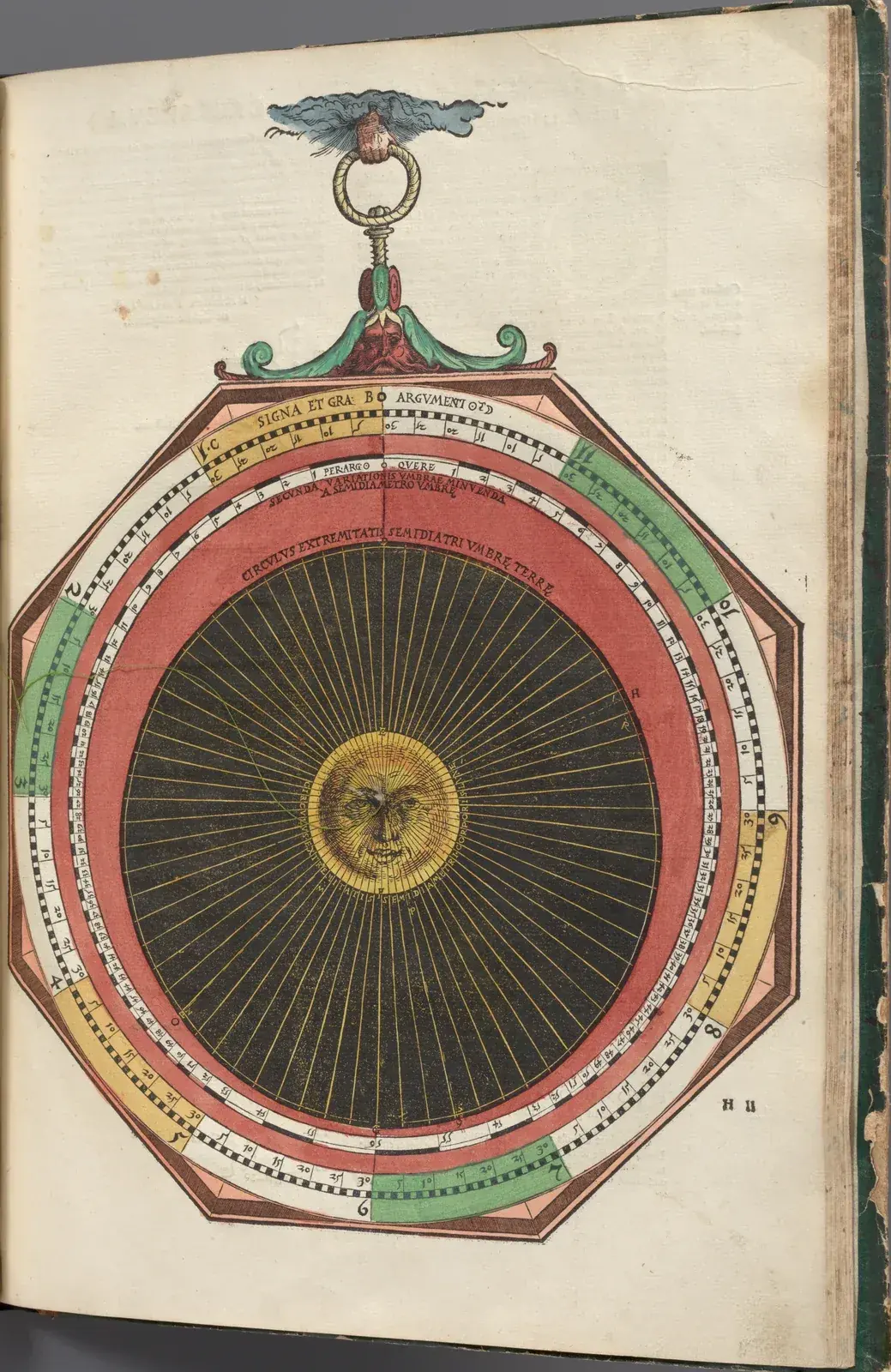
First: were the positions calculated correctly? This is an astronomical question. Ephemerides and software can answer it with considerable precision when the date, time zone, location, and settings are correct.
Second: what does a tradition usually do with those positions? This is a historical and technical question. Different schools give different weights to houses, aspects, planetary bodies, and orbs. A rule can be traditional without being universal.
Third: does the interpretation work as a general claim about people or events? This is an empirical question. It needs evidence beyond the fact that a reading feels recognisable.
One influential test was Shawn Carlson’s double-blind study, published in Nature 318, 419–425 in 1985. Practising astrologers were asked to match natal charts with psychological profiles under conditions designed to prevent ordinary cues from helping. Their overall performance did not exceed chance. The study has been discussed and criticised, as serious studies are, but its result is important: it weighs against treating natal astrology as a validated personality-measurement system.
Bertram Forer’s 1949 demonstration, published in the Journal of Abnormal and Social Psychology, showed how readily people can accept a general description as uniquely personal when they believe it was prepared for them. This is often called the Barnum effect. You may recognise yourself in a statement about wanting both independence and connection because most people have experienced that tension. Recognition is an experience, not yet a receipt.
These findings do not prove that a chart has no reflective value. They do show why a reader must be careful. A reading can help someone organise memory, notice a neglected conflict, or find language for a difficult season. Those benefits may arise from attention, conversation, and a well-structured symbolic system. They do not by themselves prove that the planets produced the insight.
You can make your own practice more accountable. Keep dated notes. Write the exact claim before looking for examples. State what would count as a mismatch. Record misses as carefully as hits. If you only remember the sentences that landed, your memory will quietly become an advocate for the chart.
Time, place, and the limits of precision
The birth time matters most for the Ascendant and houses. The Ascendant is the zodiac degree rising over the eastern horizon at the chosen moment. It changes relatively quickly, often moving through a sign in roughly two hours, though the rate varies with latitude. A difference of several minutes may change a house cusp or move a planet close to an angle. A difference of several hours can change the Ascendant altogether.
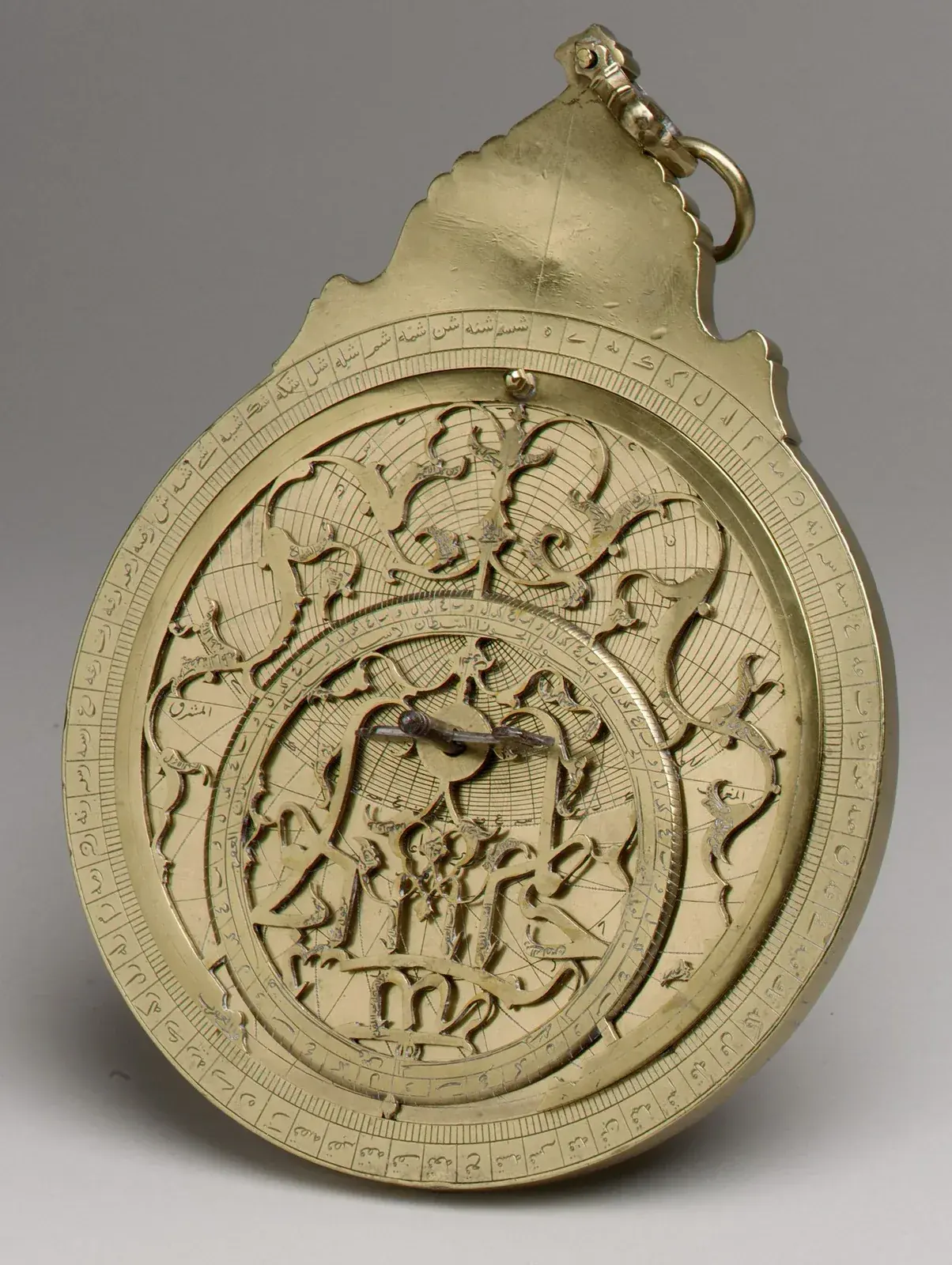
This is not a reason to panic about a missing birth time. It is a reason not to pretend. If your time is uncertain, you can still work with planets by sign and with many aspects. You should be cautious about houses and the Ascendant. Chart rectification, the attempt to infer a birth time from past events, can sometimes be a useful exploratory exercise, but it is especially vulnerable to fitting the story after the fact. It should not be presented as recovered certainty.
House systems make another layer of choice visible. Whole Sign houses assign one entire sign to each house beginning with the rising sign. Quadrant systems, such as Placidus, divide the sky according to time and space around the angles. They can place a planet in different houses, particularly at high latitudes. Neither choice removes interpretation. Each gives you a different set of boundaries, so name the one you are using.
A precise chart is not a precise biography. The sky can be calculated to the minute while the meaning remains open. Your chart cannot directly show the language spoken in your home, the opportunities available to you, the structures that shaped your choices, or what you have decided to keep and change. People born close together do not live identical lives. Similar charts do not erase different families, bodies, communities, and circumstances.
A disciplined way to read
Begin with data, not adjectives. Write the degree of the planet, its sign, its house if the time is reliable, and its closest major aspects. Then rank the patterns. Five unrelated keywords are not a reading. Three factors repeating one theme deserve more attention than one dramatic phrase in a reference book.
Next, state a hypothesis in ordinary language. Not Venus is afflicted, which tells a beginner very little, but: You may notice that pleasure and responsibility are difficult to separate. Then ask for lived examples. When does this happen? With whom? What does it look like when it does not happen?
Context changes expression. A Saturn emphasis may coincide with caution, but it may also show disciplined craft, early responsibility, a demanding profession, or an internal standard that is useful in one setting and exhausting in another. The symbol does not select the biography for you.
Use traditional language as a set of options, not as a sentence handed down from above. A square is often called difficult because the two functions do not settle into easy agreement. That friction can feel like strain, but it can also provide pressure for skill. A trine is often called easy because the functions support one another. Ease can be a gift, or it can mean a talent is taken for granted. No aspect is morally good or bad.
Transits belong to timing rather than identity. A transit is the current movement of a planet in relation to a natal chart. Practitioners may use a Saturn transit as a calendar cue to examine commitments, limits, and long-term work. That is different from saying Saturn will make an event happen. A responsible forecast describes a period of attention and offers choices. It does not hand you an appointment with an unavoidable outcome.
Worked mini-example: one aspect, properly sized
Take this illustrative partial chart:
- Sun at 18° Taurus
- Moon at 21° Aquarius
- Mercury at 2° Gemini
The example is constructed to show method, not to describe a particular person.
Convert the Sun’s position into the full circle. Taurus begins at 30°, so 18° Taurus equals 48°. Aquarius begins at 300°, so 21° Aquarius equals 321°. The two positions are 273° apart in one direction and 87° apart in the other. We use the shorter distance: 87°.
A square is exact at 90°. The difference between 87° and 90° is 3°, so the Sun and Moon form a square with a 3° orb. An orb is the distance from an exact aspect. It is not a rating of how powerful a person is. Different schools use different limits; many allow a wider orb for the Sun and Moon, while others work more narrowly. At 3°, this aspect is comfortably within either common approach.
In the interpretive language used here, the Sun describes the organising sense of identity and intention. The Moon describes immediate needs, habits, and felt responses. Taurus is a fixed sign associated with consolidation, steadiness, and tangible continuity. Aquarius is also fixed, but its style is more concerned with principles, groups, difference, and intellectual independence.
A careful hypothesis might be: the person may repeatedly negotiate between preserving what is dependable and remaining free to revise the larger system around them. That could appear as a stable routine paired with unconventional opinions. It could appear as loyalty to a group until the group violates a principle. It could appear as a private need for predictability alongside a public role that demands experimentation. It could also fail to describe the person. Family conditions, work, and temperament may produce a different expression.
The next step is not to announce, You are stubborn and detached. It is to ask: Where do stability and independence meet in your life? Which one do you protect first? Can you name a situation in which the pattern did not apply?
Mercury at 2° Gemini equals 62°. It is 14° from the Sun, so under a common 8° limit it is not counted as a conjunction. Similar subject matter is not the same as an aspect. Nearness must be measured. If you count every loose relationship, the chart fills with noise and every interpretation can be made to sound supported.
Common mistakes to correct early
Mistaking a Sun-sign column for a birth chart. A short horoscope usually knows only the Sun sign, and sometimes not even that accurately if the birth date is near a sign boundary. It cannot account for the Moon, Ascendant, houses, or the pattern among planets. It may be entertaining. It is not a full natal reading.
Confusing signs with constellations. The sign is a coordinate segment. The constellation is a visible star pattern with uneven borders. When someone says your sign has changed because the constellations have shifted, they may be describing a sidereal framework while you are using a tropical one. Check the coordinate system before arguing about the result.
Treating an orb as a volume knob. A 1° aspect is not automatically three times more important than a 3° aspect. Orb rules help decide whether an aspect is present. They do not measure your worth, intensity, or difficulty. Interpretation still depends on the planets, angle, house, and repeated themes.
Giving one placement total authority. Mars in a sign is not a complete account of how you act. The Moon is not a complete account of how you feel. A single placement can suggest a question, but a strong interpretation usually has several independent supports.
Using houses when the time is unknown. A computer will always produce a house wheel if you enter a time, including a guessed noon. That visual confidence can be misleading. If the time is unknown, mark the uncertainty and restrict the claims.
Turning symbolic language into a label. Terms such as wounded, toxic, bad, or broken flatten a chart and can injure the person hearing it. Traditional words often describe tension, delay, excess, or unfamiliarity. Translate them into observable experience and leave room for development.
Reading a transit as an event sentence. Saturn does not arrive carrying one parcel marked loss, and Jupiter does not guarantee one marked success. A transit can be used to examine a season of responsibility, expansion, revision, or pressure. The choices and conditions around that season remain real.
Ignoring disagreement. If the person says a reading does not fit, do not immediately make the symbolism more elaborate. Ask whether the birth data are correct, whether the rule is being applied consistently, and whether another interpretation fits better. Accuracy is not improved by insisting.
Letting astrology replace ordinary knowledge. A chart cannot tell you what someone privately thinks, whether a relationship is safe, or what action will produce a certain outcome. Speak with the person. Check the facts. Notice the world outside the chart. Astrology has no exemption from ordinary evidence or ordinary kindness.
Your first discipline is not belief. It is precision: name the object, state the rule, offer the hypothesis, and let life answer back.
Practice
Create a one-page chart record for yourself or for the illustrative chart above.
- Write the zodiac used, house system, birth time or time uncertainty, and source of the chart calculation.
- List the Sun, Moon, and three other bodies with exact degrees.
- Choose one major aspect. Calculate its shortest angular distance and its orb. Write the aspect without interpretation first.
- Translate it into one neutral hypothesis beginning with may, can, or tends to.
- List two lived examples that support the hypothesis and one possible counterexample.
- Finish with the sentence: This chart cannot tell me ___.
Keep the page. Later readings are more useful when you can see what you actually observed rather than what you remember being told.
Key terms
astrology · natal chart · geocentric viewpoint · ecliptic · tropical zodiac · sidereal zodiac · sign · planet · luminary · house · Ascendant · aspect · orb · transit · symbolic interpretation
Check your reading
Three questions from this chapter’s worked example and its common mistakes. Two of three marks the chapter complete.
Why was the sky chosen as astrology's reference system, according to the chapter?
Sun at 18° Taurus and Moon at 21° Aquarius. What aspect and orb does the chapter compute?
Which of these is listed as a mistake to correct early?