Part 1: Foundations · Chapter 2 of 36 · 12 min
The wheel: signs, houses, planets, aspects in one map
The wheel is a compression device. One circle holds four different kinds of information at once: planetary positions, zodiac signs, houses tied to a place and time, and angular relationships between planets.
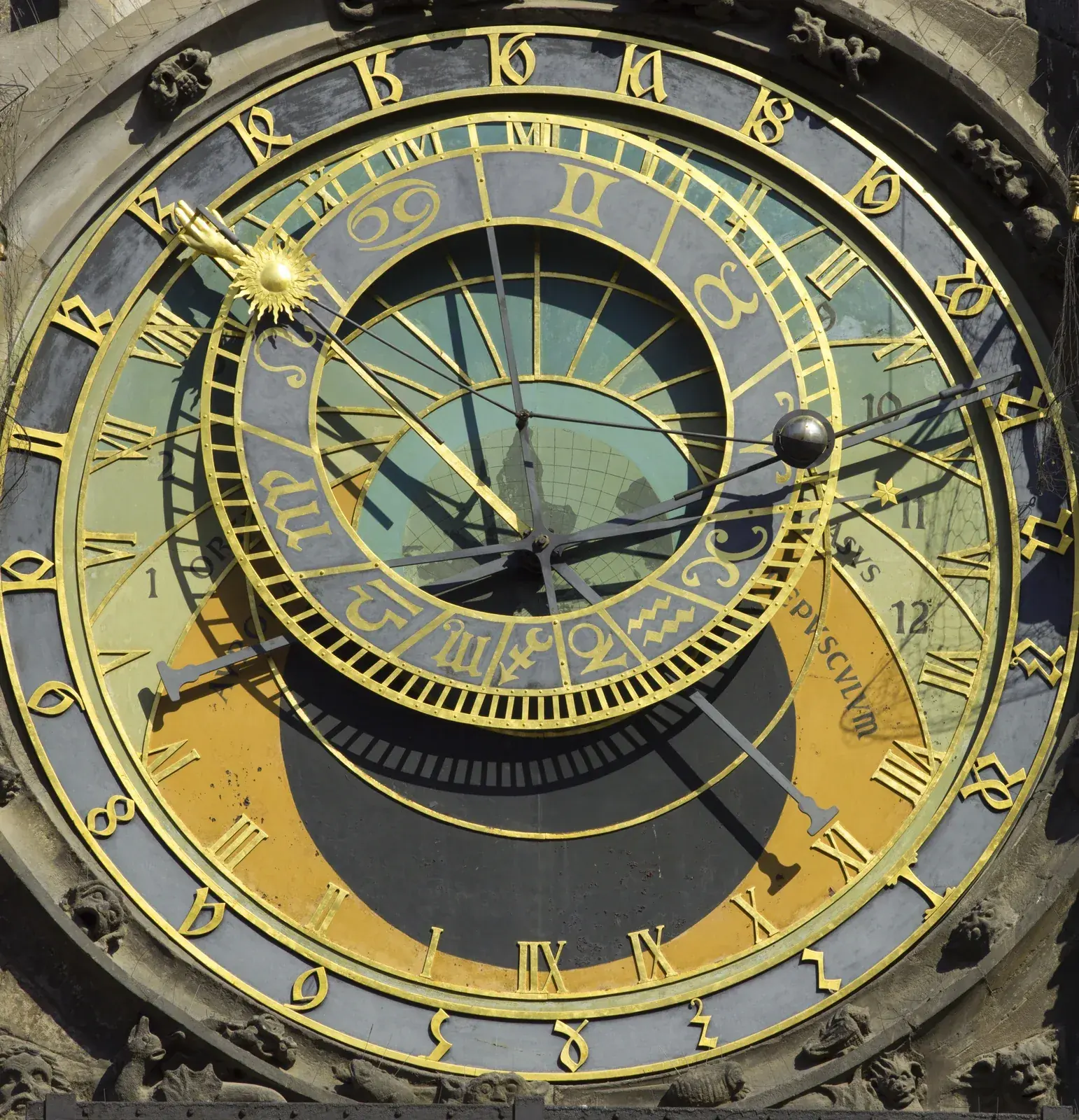
The wheel is a compression device. One circle holds four different kinds of information at once: planetary positions, zodiac signs, houses tied to a place and time, and angular relationships between planets. Because the drawing overlays them, beginners often let one layer impersonate another. A sign gets mistaken for a house. A house gets mistaken for a planet. A line across the chart gets treated as a verdict.
Keep four questions separate:
- What function is active? That is the planet.
- In what manner does it operate? That is the sign.
- Where does it become noticeable or consequential? That is the house.
- What does it have to negotiate with? That is the aspect.
A chart gives you positions and angles that can be calculated. Interpretation comes afterward. The calculation is reproducible; the symbolic reading is not a measurement in the same sense. Astrology has no agreed scientific mechanism that turns a placement into a fact about a person. Its useful discipline is transparency: show the degrees, name the system, state the orb, and keep the reading proportionate to what the map actually contains.
Four layers, one circle
The zodiac is a 360-degree circle divided into twelve equal signs of 30 degrees each. In the tropical zodiac used here, 0° Aries begins at the March equinox. The signs are coordinate sectors, not the visible constellations behind the Sun.
Their numerical sequence matters:
- Aries begins at 0°
- Taurus at 30°
- Gemini at 60°
- Cancer at 90°
- Leo at 120°
- Virgo at 150°
- Libra at 180°
- Scorpio at 210°
- Sagittarius at 240°
- Capricorn at 270°
- Aquarius at 300°
- Pisces at 330°
So 14° Gemini is 74° of zodiac longitude: 60° for the start of Gemini, plus 14°. That small piece of arithmetic will save you from a great deal of decorative guessing.
Houses use the same zodiac circle, but they are calculated from the horizon and meridian for a particular location and time. The Ascendant is the degree rising on the eastern horizon. The Descendant is directly opposite. The Midheaven, often written MC, marks the degree near the upper meridian; the IC lies opposite it below the horizon. These four points are called angles because they anchor the chart to local space.
Planets are the moving actors placed in signs and houses. Astrological language includes the Sun and Moon among the planets for convenience, though astronomy classifies them differently.
Aspects are angular distances. A square does not mean two planets are physically near one another in space. It means they are about 90° apart as seen in the zodiacal circle. The chart wheel is a map of symbolic positions, not a miniature solar system.
Signs: the manner of a function
A sign describes the style, tone, and habitual method through which a planet is interpreted. It does not act by itself. There is no such thing as Gemini behavior floating free of a planet, house, or context.
Take Mercury in Gemini. Mercury concerns perception, language, sorting, exchange, and the ways a mind makes links. Gemini gives that function a quick, mobile, comparative style. You might expect an interest in alternatives, names, questions, categories, or the movement between ideas. You cannot responsibly infer how much someone talks, whether they are clever, or what kind of work they do. The sign gives a mode, not a résumé.
Each sign combines an element and a mode. Gemini is mutable air: exchange that adapts, compares, shifts, and redistributes. Virgo is mutable earth: adjustment through sorting, craft, detail, and practical revision. The same mutable quality will feel different when carried by air and earth. That is why a sign name alone is never enough.
A useful sentence structure is this:
Planet is the function; sign is the manner.
Venus in Cancer is not Cancerian romance in the abstract. Venus describes attraction, taste, reciprocity, and what someone tends to value. Cancer gives those Venusian concerns a protective, receptive, memory-shaped manner. Mars in Virgo is not merely energetic Virgo. Mars describes initiative, friction, assertion, and effort; Virgo gives that effort a refining, corrective, discriminating style.
Signs also have polarity, mode, rulership, and relationships with other signs. Those tools matter, but none should erase the first distinction. If you find yourself saying a person is their sign, stop. A sign is one condition placed upon a function.
Houses: the setting where a function lands
Houses answer a different question: where in lived experience does the planet's concern become concentrated? They are not personality styles. A ninth-house Mercury and Mercury in Sagittarius may both involve broad ideas, but they arrive there by different routes. One is a house topic; the other is a sign condition.
The twelve houses are commonly associated with these fields of attention:
- The first concerns immediate approach, presentation, and the way you meet the world.
- The second concerns possessions, values, and what you maintain as your own.
- The third concerns nearby surroundings, basic learning, exchange, and everyday movement.
- The fourth concerns roots, private foundations, home, and inherited atmosphere.
- The fifth concerns pleasure, creative output, play, affection, and children.
- The sixth concerns routines, upkeep, skill, service, and ordinary work.
- The seventh concerns one-to-one encounters, agreements, and significant others.
- The eighth concerns intimacy, shared matters, endings, and processes of change that are not fully under one person's control.
- The ninth concerns study, wide frameworks, belief, publishing, travel, and questions that enlarge the horizon.
- The tenth concerns visibility, public contribution, direction, and reputation.
- The eleventh concerns groups, friends, collective efforts, and long-range aims.
- The twelfth concerns solitude, backstage conditions, withdrawal, and what is difficult to display directly.
These are fields of attention, not event guarantees. A tenth-house placement does not command public recognition. A fourth-house placement does not tell you exactly what happened in a home. It tells you where the symbolic function is being placed in the chart's architecture.
House systems deserve plain speech. Whole-sign houses begin the first house at 0° of the Ascendant's sign, then give each following sign one house. If Libra is rising, Libra is the first house, Scorpio the second, Sagittarius the third, and so on. The Ascendant itself may be several degrees inside the first house.
Quadrant systems, including Placidus, divide the chart differently around the angles. They can place a planet in another house from the one it occupies in whole-sign houses. This is not a minor technical nuisance. It is a genuine interpretive difference. State your house system whenever you discuss houses. That is part of the receipt.
Do not merge the MC with the tenth-house cusp by habit. In some house systems they are close; in whole-sign houses, the MC can fall in the ninth, tenth, or eleventh house. The MC remains a powerful angle wherever it falls.
A planet close to an angle often deserves attention because its relationship to the chart's horizon or meridian is exact and visible in the calculation. But closeness needs a number. Say Venus is 2° from the MC, not Venus is sort of public.
Planets: the active verbs
Planets supply the function that a sign modifies and a house situates. They work best as verbs before they become nouns.
The Sun concerns central purpose, vitality, and the ongoing formation of identity. The Moon concerns receptivity, habit, memory, and immediate response. Mercury notices, names, compares, and communicates. Venus attracts, evaluates, connects, and prefers. Mars initiates, presses, separates, and contests. Jupiter enlarges, trusts, seeks meaning, and gives scope. Saturn structures, limits, tests, and makes demands for form.
The outer planets move slowly, so their sign placements are shared across many people born within the same stretch of years. Uranus disrupts and experiments; Neptune imagines, dissolves boundaries, and heightens sensitivity to atmosphere; Pluto concentrates, intensifies, and exposes struggles around power or control. Their houses, aspects, and contacts to personal planets make the reading more specific.
Use the grammar carefully:
A planet acts. A sign styles the action. A house gives it a setting. An aspect gives it company or tension.
Moon in Virgo in the twelfth house does not equal a shy person. It gives you a more modest proposition: the Moon's receptive and habitual function is filtered through Virgo's sorting instinct and placed in a house associated with private or backstage conditions. You would then ask how that pattern appears, if it appears at all, rather than announce a finished identity.
Aspects: the geometry of relationship
The major aspects are based on simple divisions of the circle:
- Conjunction: 0°
- Sextile: 60°
- Square: 90°
- Trine: 120°
- Opposition: 180°
An aspect is exact at its stated angle. The orb is the amount by which the actual angle differs from exactness. If two planets are 94° apart, they are square by an orb of 4°. The orb is not the total distance between them.
For this course, use these working orbs:
- For conjunctions, squares, trines, and oppositions: up to 8° when the Sun or Moon is involved; up to 6° for other planetary pairs.
- For sextiles: up to 4°.
- For contacts to the Ascendant or MC: begin by noticing planets within about 5°, then judge the whole chart rather than treating that number as a law.
Other astrologers use wider or narrower orbs. There is no universal authority that settles the matter. The practical rule is consistency. A 1° square should carry more weight than a 6° square, all else equal, because the geometry is closer. Exactness is not everything, but it is a meaningful receipt.
A conjunction blends functions. A square creates friction, competing demands, or a need for active adjustment. An opposition sets up polarity, encounter, and the need to hold two ends of an axis in view. A trine allows a more fluent exchange. A sextile offers a workable connection that often needs deliberate use before it becomes noticeable.
None of these are moral categories. A trine can become so easy that it goes unexamined. A square can generate skill because something repeatedly requires attention. Good and bad are lazy labels for living geometry.
You may also hear applying and separating. An applying aspect is moving toward exactness; a separating aspect has already passed exactness. To determine that, you need planetary motion from an ephemeris, including whether a planet is retrograde. A static wheel by itself does not always tell you enough.
Worked mini-example: reading the layers without mixing them
Use this teaching chart in the tropical zodiac with whole-sign houses:
- Ascendant: 8° Libra
- MC: 11° Cancer
- Sun: 14° Gemini, ninth house
- Mercury: 12° Gemini, ninth house
- Moon: 18° Virgo, twelfth house
- Mars: 15° Virgo, twelfth house
- Jupiter: 14° Pisces, sixth house
- Saturn: 13° Sagittarius, third house
- Venus: 16° Cancer, tenth house
Libra rising makes Libra the first whole-sign house. Gemini therefore becomes the ninth, Virgo the twelfth, Pisces the sixth, Sagittarius the third, and Cancer the tenth. The MC happens to fall in Cancer here, but that is a feature of this example, not a rule of whole-sign houses.
Start with arithmetic rather than interpretation. The Sun at 14° Gemini is 74° longitude. Mars at 15° Virgo is 165°. Their difference is 91°, so Sun square Mars has a 1° orb.
Jupiter at 14° Pisces is 344°. The difference between 74° and 344° is 270°; use the smaller arc, 90°. Sun square Jupiter is exact.
Saturn at 13° Sagittarius is 253°. The difference between Sun and Saturn is 179°, making an opposition with a 1° orb.
Now continue:
- Mars at 165° and Saturn at 253° are 88° apart: square, 2° orb.
- Saturn at 253° and Jupiter at 344° are 91° apart: square, 1° orb.
- Mars at 165° and Jupiter at 344° are 179° apart: opposition, 1° orb.
The Sun, Mars, Saturn, and Jupiter form a near-exact mutable grand cross. That label records a repeated geometric pattern across Gemini, Virgo, Sagittarius, and Pisces. It is not an explanation by itself. The houses show where the pattern is distributed: ninth-house questions of study and large frameworks, twelfth-house private processing or backstage activity, third-house exchange and basic learning, and sixth-house routines and service.
An accountable reading might say that the chart repeatedly brings these four areas into negotiation. Gemini gives the Sun a curious, comparative way of orienting toward ninth-house questions. Saturn opposite that Sun from Sagittarius in the third can place pressure on how broad claims are tested, framed, or communicated in ordinary exchanges. Jupiter's exact square from Pisces in the sixth brings questions of scope and meaning into contact with daily methods and obligations. Mars in Virgo adds a corrective, effortful edge from the twelfth.
That is already enough. You do not need to invent a dramatic biography to make the aspect pattern sound important. The chart gives a compact geometry; the interpretation should remain a proposition to examine.
The conjunctions add detail. Mercury at 12° Gemini is conjunct the Sun at 14° Gemini by 2°. The functions of thought, language, and central direction are closely braided. Moon at 18° Virgo is conjunct Mars at 15° Virgo by 3°, tying receptivity and habitual response closely to assertion and effort in the twelfth-house setting.
Venus at 16° Cancer is 5° from the MC at 11° Cancer, so Venus has a close contact with a public-facing angle. Venus also forms a trine with Jupiter: Venus is at 106° longitude, Jupiter at 344°, and the smaller arc is 122°, a trine with a 2° orb. A tentative reading could connect Venusian concerns of preference, relationship, and value with public contribution on one hand and sixth-house routines or service on the other. The trine suggests ease of exchange, not a guaranteed result.
Notice the order. First, identify what is exact. Then name planet, sign, house, and aspect. Only then put the pieces into sentences. Calculate before adjectives.
Common mistakes that blur the map
Mistaking sign for house. Gemini in the ninth house does not make someone Gemini rising. Gemini describes the ninth-house style in a whole-sign chart; the Ascendant sign describes the first house.
Reading lines instead of degrees. A chart may draw two planets near each other, yet they can be 20° apart. Conversely, 29° Pisces and 2° Aries are only 3° apart even though they sit on opposite ends of a printed zodiac ring.
Assuming sign relationships equal degree aspects. Planets in signs traditionally said to square each other may not form a square by degree. A planet at 29° Gemini and one at 1° Virgo are 62° apart: close to a sextile, not a square.
Treating a cusp as shared ownership. A planet belongs to the house assigned by the system you are using. If another system moves it, say so. Do not quietly give it both houses whenever that feels convenient.
Using one orb for everything. A 7° sextile should not be treated with the same confidence as a 1° Sun–Moon square. Your stated orb rule keeps your attention from expanding to fit whatever story you want.
Calling one aspect easy and stopping there. A trine still involves particular planets, signs, and houses. Venus trine Jupiter says something different in the second and sixth houses than it does in the tenth and fourth.
Making absence into emptiness. A planet without a close major aspect is still in a sign and house, may contact an angle, and may matter through rulership or other techniques. No line does not mean no meaning.
Practice
Use a chart cast in the tropical zodiac with whole-sign houses. If the birth time is uncertain, do not guess at houses or angles; work with sign placements and aspects only.
- Copy the literal data for the Sun, Moon, Mercury, Venus, Mars, Ascendant, and MC: sign, degree, and house.
- Choose three possible major aspects. Convert each placement to zodiac longitude, subtract, use the smaller arc, and write the exact orb.
- Select the tightest aspect and write two sentences using the full grammar: planet as function, sign as manner, house as setting, aspect as relationship.
- Find one planet within 5° of an angle, if there is one. State the distance before interpreting it.
- Underline every word in your reading that comes from calculation and circle every word that is interpretive. If an interpretive claim cannot point back to a planet, sign, house, and degree-based aspect, remove it or rewrite it as a question.
Key terms
zodiac longitude · sign · house · Ascendant · Midheaven · whole-sign houses · planet · aspect · orb · conjunction · square · trine · opposition · sextile · applying aspect · separating aspect · mutable grand cross
Check your reading
Three questions from this chapter’s worked example and its common mistakes. Two of three marks the chapter complete.
In the chapter's four-layer model, what do planets, signs, houses and aspects each supply?
A planet at 29° Pisces and one at 2° Aries are how far apart?
Gemini falls in the ninth whole-sign house of a Libra-rising chart. What does that tell you?