Part 1: Foundations · Chapter 3 of 36 · 10 min
The tropical zodiac: seasons, not constellations
The tropical zodiac is a way of measuring positions around the sky.
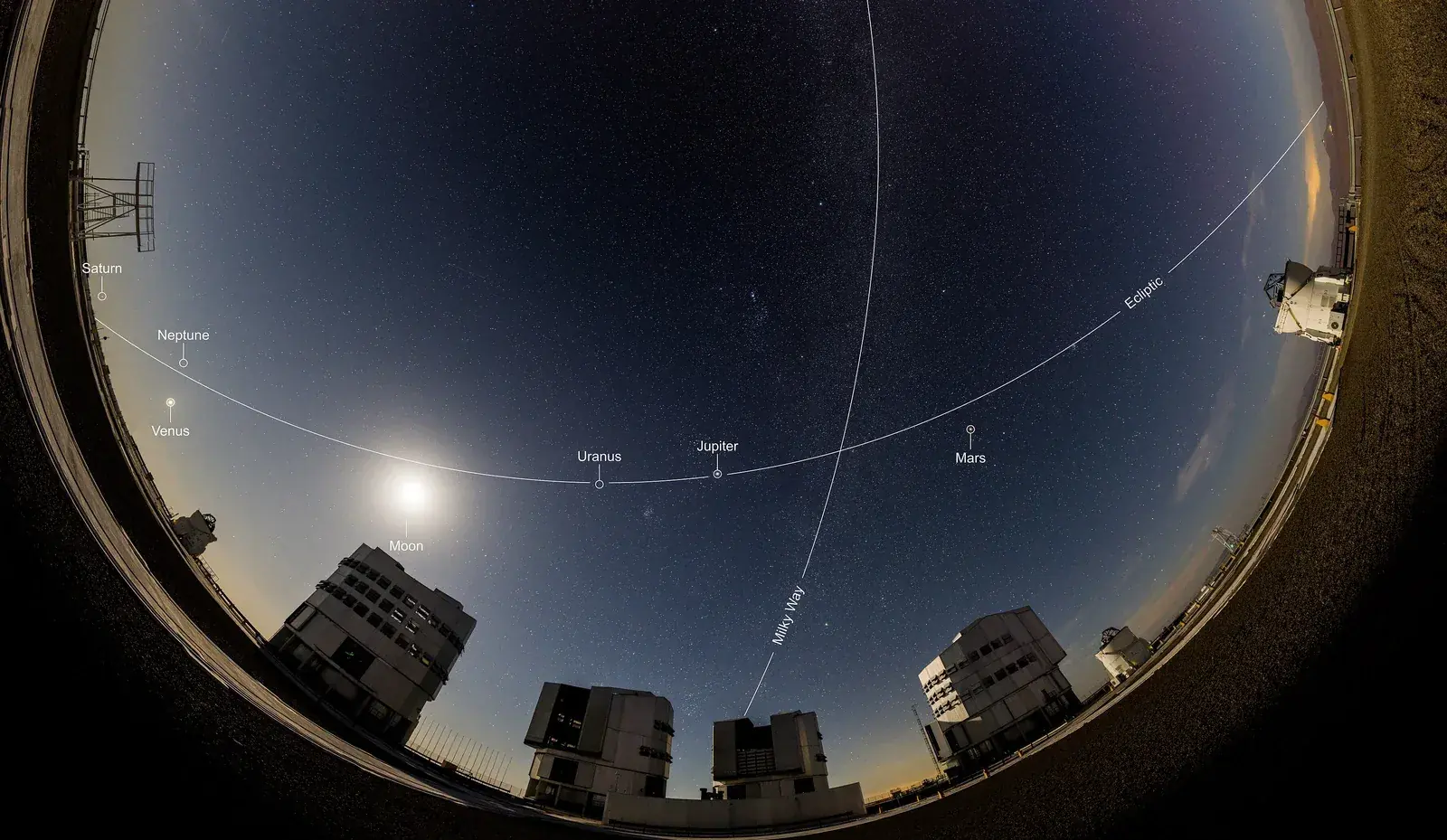
The zodiac is a coordinate circle
The tropical zodiac is a way of measuring positions around the sky. It is a 360-degree circle divided into twelve equal signs of 30 degrees each. Its starting point is the March equinox, not a particular star and not the modern boundary of the constellation Aries.
That distinction carries most of this chapter. The signs borrow their names and imagery from ancient constellations, but they do not occupy the same kind of space. A sign is an equal interval on a ruler. A constellation is a region of visible sky. The ruler and the picture once had a closer relationship; precession has moved them apart.
A coordinate can be exact even when its interpretation remains open to debate.
The ecliptic: the zodiac’s measuring line
Earth orbits the Sun in a plane. Project that plane outward onto the sky and you get the ecliptic. From an Earth-centered point of view, the Sun appears to trace this circle over the course of a year. The Moon and planets remain near it because the solar system is comparatively flat, though they can sit north or south of the line.
Astrological positions are usually given as ecliptic longitude: distance measured eastward around the ecliptic from a chosen zero point. Longitude tells you where a body falls around the circle. A second coordinate, ecliptic latitude, records how far above or below that circle it lies. Most chart interpretation begins with longitude, so Mars at 12° Leo means its longitude falls twelve degrees into the Leo interval. Mars need not be sitting exactly on the ecliptic itself.
The tropical zodiac chooses the March equinox as longitude 0°. Astronomers sometimes call this the First Point of Aries, even though the point now lies within the official constellation Pisces. The old name remains attached to the coordinate origin.
The four quarter points are:
| Tropical longitude | Zodiac position | Astronomical event |
|---|---|---|
| 0° | 0° Aries | March equinox; Sun crosses northward |
| 90° | 0° Cancer | June solstice; Sun reaches maximum northern declination |
| 180° | 0° Libra | September equinox; Sun crosses southward |
| 270° | 0° Capricorn | December solstice; Sun reaches maximum southern declination |
Declination is angular distance north or south of the celestial equator. In lived terms, it helps describe how high the Sun climbs and how long it remains above the horizon at a given latitude. Near 0° Cancer, the Sun is as far north as it gets. Near 0° Capricorn, it is as far south as it gets.
The equinoxes are crossings. The solstices are turnings. These four hinges give the tropical zodiac its frame.
What seasons means here
Tropical comes from a word associated with turning. The zodiac is tied to the solar-seasonal cycle created by Earth’s axial tilt, currently about 23.44°. It is not tied to local temperature, rainfall, harvest dates, or what you happen to see outside your window.
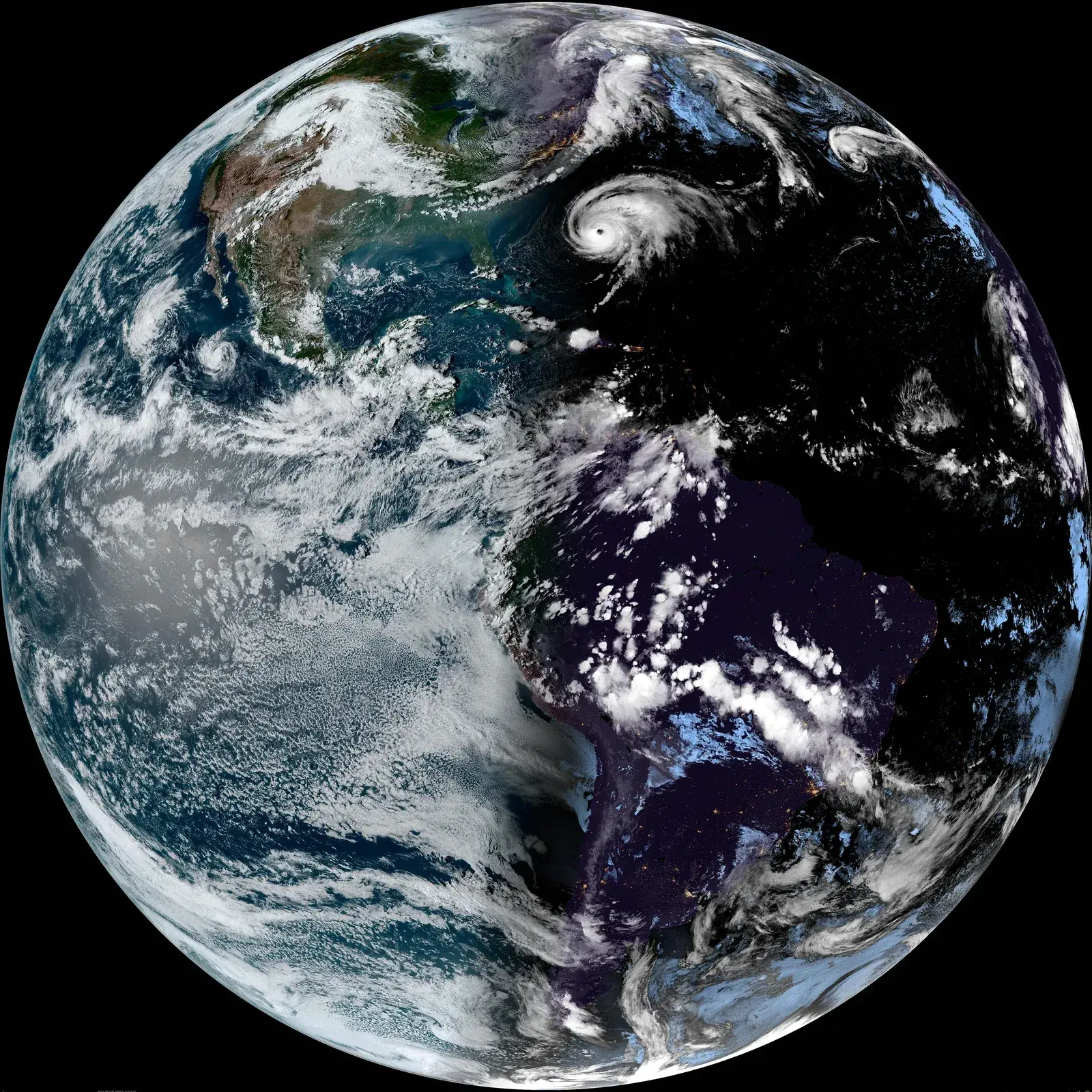
At the March equinox, the Sun’s declination changes from south to north. Northern latitudes move into the lighter half of the year; southern latitudes move into the darker half. At the September equinox, the direction reverses. This geometry is global. Its local expression is not.
Calling 0° Aries the beginning of spring is therefore northern shorthand. In much of the Southern Hemisphere, it begins autumn. Near the equator, four-season language may fit poorly. At high latitudes, changes in daylight can be extreme. Tropical astrology conventionally keeps the signs in the same order everywhere; it does not reverse a chart for southern births. But its inherited seasonal imagery grew largely from northern Mediterranean experience. You should know where the symbolism fits cleanly and where it does not.
Nor are equinoxes always moments of exactly equal daylight and darkness. Atmospheric refraction lifts the apparent Sun, and sunrise and sunset are timed from the edge of the solar disc rather than its center. The astronomical event is defined geometrically. The felt balance of day and night occurs near it, not always precisely at it.
Each sign covers 30° of longitude, but the Sun does not spend exactly the same amount of time in every sign. Earth moves at changing speed along its elliptical orbit. In the present era, the four equinox-to-solstice intervals run roughly from 89 to 94 days. Equal angle does not mean equal duration.
This is why sign ingresses must be timed rather than assigned permanently to calendar dates. The Sun usually reaches 0° Aries around March 19–21, but the exact UTC time shifts with leap years, orbital details, and the calendar. A newspaper date is an approximation. An ephemeris gives the crossing.
Signs are not constellations
A tropical sign is one of twelve equal longitude intervals:
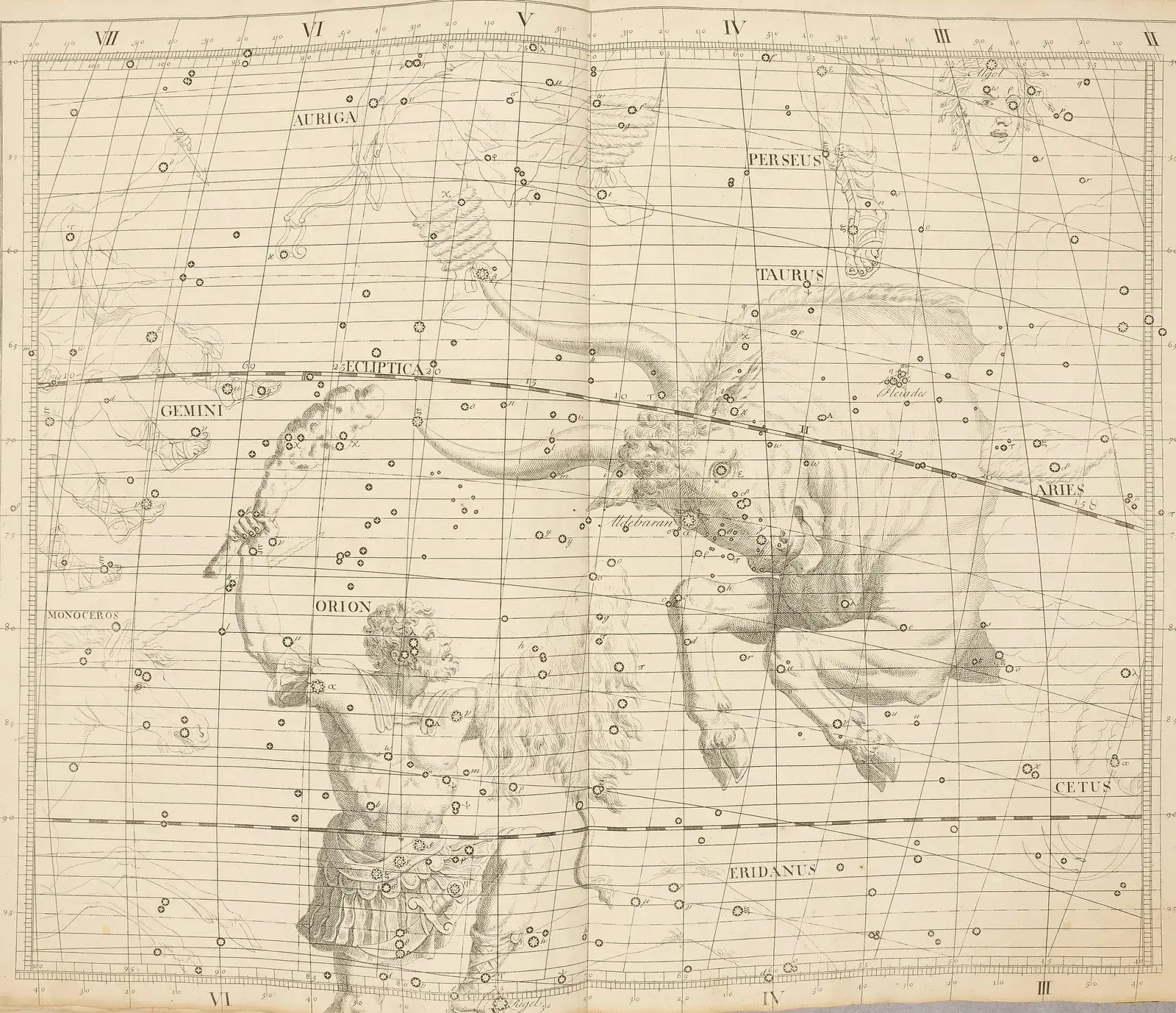
Aries 0°–30° | Taurus 30°–60° | Gemini 60°–90° | Cancer 90°–120° | Leo 120°–150° | Virgo 150°–180° | Libra 180°–210° | Scorpio 210°–240° | Sagittarius 240°–270° | Capricorn 270°–300° | Aquarius 300°–330° | Pisces 330°–360°
The constellations are unequal. Some cover much more ecliptic longitude than others, and their official regions include large areas with no prominent stars. The International Astronomical Union standardized 88 constellations and their boundaries during the twentieth century. Under those boundaries, the ecliptic passes through thirteen constellations, including Ophiuchus.
That does not create a thirteenth tropical sign. Ophiuchus matters when you are naming the official sky region through which the Sun appears to pass. It does not alter a coordinate circle deliberately divided into twelve equal parts. The thirteenth-sign claim treats two different classification systems as though one were a faulty version of the other.
A sidereal zodiac is different again. It also uses twelve equal 30° signs, but it keeps its origin in a stated relationship to the stellar background. Several reference offsets are in use. A sidereal sign is therefore not identical to an official constellation either. Equal signs, star-based signs, and IAU constellations are three concepts, not two.
Suppose an astrology program gives the Sun as 10° Aries while an astronomy application places it in Pisces. Both labels can be accurate. The first means tropical longitude 10°. The second means that the Sun appears against the bounded sky region officially named Pisces. The programs are answering different questions.
Why the two skies separated
Earth’s rotational axis slowly changes orientation, rather like the axis of a spinning top tracing a broad cone. This motion produces precession. As a result, the equinox points move westward against the stellar background at roughly 50.3 arcseconds per year, close to 1° every 71.6 years. A complete cycle takes about 25,700 to 25,800 years; the rate is not perfectly constant.
Precession does not make the tropical zodiac drift away from its own starting point. The March equinox is its starting point. Precession makes that starting point shift relative to the stars.
This motion was identified in Greek astronomy by at least the second century BCE. In the second century CE, Ptolemy explicitly argued that sign beginnings should be taken from the equinoctial and solstitial points (Tetrabiblos I.10). Equal 30° zodiacal sectors had already been documented in Babylonian astronomy centuries earlier. The historical system carries both stellar ancestry and seasonal geometry. It was never as tidy as the modern slogan that signs simply are constellations.
Precession is therefore a valid objection only to the claim that tropical signs are the present-day constellations. Tropical astrology does not need that claim. Its astronomical frame remains coherent; whether its interpretive claims are persuasive is a separate question. A sound ruler does not certify every statement made with it.
Reading sign degrees correctly
A position written as 17°42′ Virgo means seventeen degrees and forty-two arcminutes into Virgo. An arcminute is one-sixtieth of a degree. Virgo begins at absolute longitude 150°, so:
150° + 17°42′ = 167°42′
For calculation, use:
absolute longitude = sign starting longitude + degree + arcminutes ÷ 60 + arcseconds ÷ 3600
Sign notation starts at 0°, not 1°. The interval from 0°00′00″ through 0°59′59″ is often called the first degree of a sign, but its written degree number is zero. At 29°59′59″ Aries, a body is still in Aries. One arcsecond later, at 0°00′00″ Taurus, it is in Taurus.
There is no sign-placement orb. An orb is an allowance around an exact aspect—the amount by which two bodies miss the aspect’s exact angle. Signs have boundaries, not zones of gradual membership.
Worked mini-example: a conjunction across 0° Aries
Take these hypothetical tropical positions:
- Sun: 29°48′ Pisces
- Mercury: 0°22′ Aries
Pisces begins at 330°, so the Sun’s absolute longitude is:
330° + 29°48′ = 359°48′
Mercury’s absolute longitude is 0°22′. Because the circle wraps at 360°, the shortest separation is:
12′ from 359°48′ to 360°00′, plus 22′ to 0°22′ = 34′
The bodies are 0°34′ apart. Under a degree-based method allowing an 8° conjunction orb, this is a close conjunction with an orb of 0°34′. Yet the Sun is unambiguously in Pisces and Mercury is unambiguously in Aries.
Some schools require same-sign co-presence before treating two bodies as fully conjoined; others accept an out-of-sign conjunction by degree. That is a methodological choice. The measured separation remains 0°34′ either way. State which rule you are using instead of letting the software decide silently.
This example corrects a common visual error. If you subtract the written sign degrees without converting them, 29°48′ and 0°22′ can look far apart. On the circle they are neighbors. Always measure through the shortest route.
A planet near a sign boundary is not partly in both signs. If its recorded position could change because the birth time is uncertain, say that the placement is uncertain. That is different from claiming two simultaneous placements. Precision should describe the data you have, not decorate it.
The seasonal grammar of twelve signs
The four signs beginning at equinoxes and solstices are called cardinal: Aries, Cancer, Libra, and Capricorn. Cardinal here means hinged or pivotal. These signs open the four 90° quarters of the tropical circle.
Each quarter then contains three phases:
- A cardinal sign begins the quarter.
- A fixed sign occupies its middle.
- A mutable sign closes it and approaches the next hinge.
Thus Aries, Taurus, and Gemini form the first quarter; Cancer, Leo, and Virgo the second; Libra, Scorpio, and Sagittarius the third; Capricorn, Aquarius, and Pisces the fourth. Beginning, sustaining, and transitioning are interpretive translations of that geometry. They are not physical substances detected in the sky.
This seasonal architecture supports part of the sign system, especially its modalities and its emphasis on starts, peaks, balances, and turns. It does not account by itself for every traditional statement about the signs. Planetary rulerships, elements, myths, agricultural calendars, and centuries of interpretive practice also shaped their meanings.
Avoid making increasing light good and decreasing light bad. Both are necessary phases of a cycle, and the direction reverses by hemisphere. Symbolism loses depth when it becomes a ranking system.
Corrections you will use often
- The Sun does not enter tropical Aries because it reaches the constellation Aries. It enters when its tropical longitude reaches exactly 0°.
- A planet at 29° of a sign is not already becoming the next sign. Late position may receive special treatment in some methods, but it does not create mixed membership.
- Precession does not require tropical charts to be periodically corrected back to the constellations. The equinox is the intended origin.
- Changing the house system does not rotate the zodiac. Houses divide the local sky according to time and place; signs divide ecliptic longitude. They are distinct coordinate structures.
- March 21 is not a permanent ingress time. Use a dated ephemeris and a stated time standard.
- Planet-to-planet aspects do not generally disappear when the zodiacal reference changes. Moving every longitude by the same reference offset changes sign labels but preserves ordinary angular separations.
When checking software, confirm that the zodiac setting says tropical. If two programs differ by nearly an entire sign, inspect whether one is using a stellar reference. If they differ by only a few arcseconds, they may be using different ephemerides, coordinate corrections, or rounding rules. Tiny computational differences do not deserve large interpretive claims.
Receipts
The astronomical definitions and current coordinate conventions can be checked through the United States Naval Observatory’s Astronomical Applications material and the Explanatory Supplement to the Astronomical Almanac. The constellation boundaries come from the International Astronomical Union and Eugène Delporte’s 1930 boundary publication. For precession standards, see the IERS Conventions. For historical evidence, see Ptolemy’s Tetrabiblos I.10 and Francesca Rochberg’s Babylonian Horoscopes.
Practice
- Draw a circle and mark 0°, 90°, 180°, and 270°. Label each point with both its tropical sign position and its equinox or solstice.
- Convert these positions to absolute longitude: Venus at 28°17′ Taurus and Jupiter at 2°05′ Gemini. Then find their shortest separation. Use a 5° conjunction orb and decide whether they qualify under a degree-based method.
- Write one sentence correcting each statement: The equinox always has exactly twelve hours of daylight; Ophiuchus must be the thirteenth sign; a planet at 29°59′ belongs partly to the next sign.
- Check your arithmetic: Venus is at 58°17′, Jupiter at 62°05′, and their separation is 3°48′. They fall within a 5° conjunction orb while occupying different signs.
- Name the season beginning locally at the March equinox. Then describe the same point without season words: the Sun crosses the celestial equator northward and tropical longitude returns to 0°. Keep both descriptions. Notice which one travels better.
Key terms
tropical zodiac · ecliptic · ecliptic longitude · equinox · solstice · declination · sign · constellation · precession · ingress · orb · cardinal sign · sidereal zodiac
Check your reading
Three questions from this chapter’s worked example and its common mistakes. Two of three marks the chapter complete.
Where does the tropical zodiac place 0° Aries?
Sun at 29°48′ Pisces, Mercury at 0°22′ Aries. What is their separation?
Does changing the house system rotate the zodiac?