Part 7: Moon, Nodes & Condition · Chapter 21 of 36 · 10 min
The Moon's phases at birth
The Moon's phase at birth is the angular relationship between the Moon and the Sun.
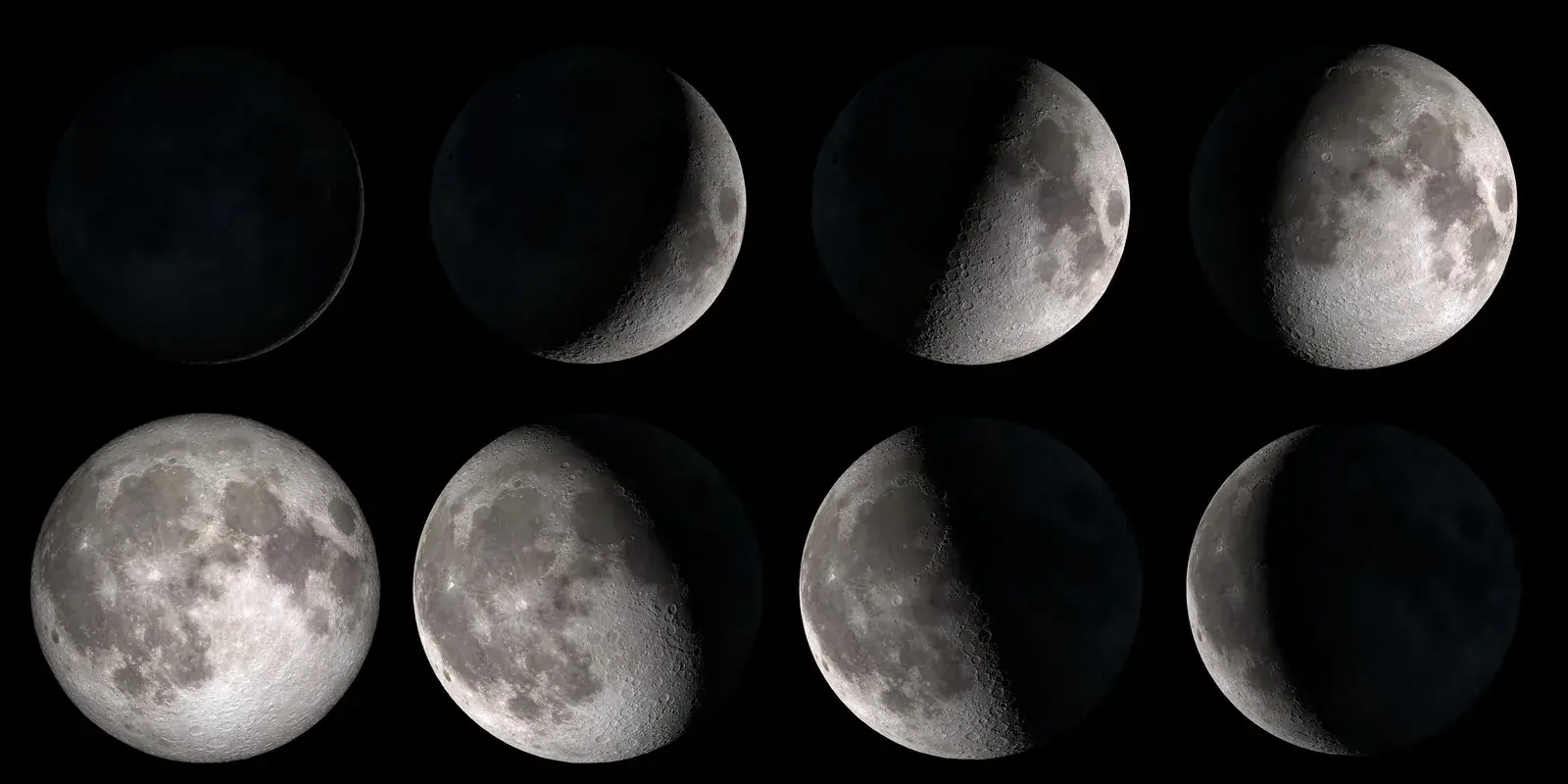
The Moon's phase at birth is the angular relationship between the Moon and the Sun. It is not another name for the Moon's sign. A phase tells you whether the Moon is separating from the Sun, approaching the next conjunction, or standing opposite it. The phase is a relationship, not a property the Moon carries alone.
You can see this relationship in the sky: a dark disk becomes a sliver, the sliver grows to a half circle, the half circle fills, and then the light recedes. In a birth chart, that moving sequence becomes a fixed snapshot. It does not mean your life repeats a 29-day script. It offers a symbolic verb: begin, build, reveal, distribute, revise, complete. Use that verb beside the rest of the chart, not above it.
The calculation: one circle, one direction
Western natal astrology normally uses geocentric ecliptic longitude. Geocentric means measured from Earth's center, as a chart is cast from Earth. Ecliptic longitude means a position along the zodiac circle, measured from 0° Aries through 360°.
Take the Moon's longitude and subtract the Sun's longitude:
D = Moon longitude − Sun longitude, reduced to a number from 0° up to 360°.
If the result is negative, add 360°. The important thing is to preserve direction. A number close to 0° can mean the Moon has just passed the Sun, or that it is almost ready to meet the Sun again. Those are not the same phase.
When D is between 0° and 180°, the Moon is waxing: its angular distance from the Sun is increasing. When D is between 180° and 360°, it is waning: the distance is closing toward the next conjunction. At 0° the bodies are together, the astronomical new moon. At 180° they are opposite, the full moon.
The Moon completes a cycle of phases in about 29.53 days, called the synodic month. Its orbit relative to the stars takes about 27.32 days, so the extra time is the distance the Sun travels while the Moon catches up. On average, the Moon gains roughly 12.2° on the Sun each day, or about half a degree per hour. The actual speed varies, but these figures explain why a small birth-time difference can matter near a phase boundary.
The visible fraction of the Moon is related to D. As a rough geometric guide, illuminated fraction is (1 − cos D) ÷ 2: near 0° it is almost none, at 90° it is about half, and at 180° it is full. The exact astronomical calculation uses the three-dimensional angle between the bodies, including the Moon's latitude above or below the ecliptic. Astrology usually uses the two ecliptic longitudes. These measurements are describing the same relationship, but they are not identical to the last decimal. For natal work, calculate consistently within the chart system you are using.
The eight-phase model
A common Western astrology method divides the 360° cycle into eight equal sectors of 45°. The ranges below are left-inclusive and right-exclusive, so a value of 90° begins the First Quarter sector.
| Phase | Moon–Sun angle D | Sky image | Symbolic emphasis |
|---|---|---|---|
| New | 0°–45° | Conjunction and early separation; little visible light | Beginning from inner alignment; initiating |
| Crescent | 45°–90° | A growing sliver | Differentiating; making a first effort distinct |
| First Quarter | 90°–135° | Half-lit and increasing | Choosing, acting, meeting constructive pressure |
| Gibbous | 135°–180° | More than half-lit, nearing fullness | Refining, testing, improving |
| Full | 180°–225° | Maximum light at the opening of the sector | Seeing through contrast; encounter and visibility |
| Disseminating | 225°–270° | Waning gibbous | Sharing, explaining, distributing what has been learned |
| Last Quarter | 270°–315° | Half-lit and decreasing | Revising, reorienting, changing the container |
| Balsamic | 315°–360° | A thin waning crescent | Completing, distilling, making room for a new cycle |
This is a sequential phase model. It places each named phase after the exact angular point that opens it: conjunction at 0°, a 45° half-square, square at 90°, 135° sesquiquadrate, opposition at 180°, the reverse 135° point at 225°, square at 270°, and the reverse 45° point at 315°. Some astrologers center each label around its exact point instead, producing different boundaries. Neither convention is a physical law. State which one you are using.
The word disseminating is not a demand that someone become a teacher. It names the part of the cycle in which light is being carried outward after the full point. You may also see waning gibbous used for much of the interval from 180° to 270°. In this eight-part astrological vocabulary, that interval is divided into Full and Disseminating.
What the phase describes
These labels are most useful as operations rather than personality types. They describe how the Sun–Moon relationship may work: how intention and felt response meet, separate, challenge each other, or move toward completion.
New phase. The Sun and Moon travel in the same direction. Purpose and immediate feeling may arrive as one stream, which can provide strong inner coherence. It can also take time to distinguish a personal impulse from the atmosphere around you. The question is not whether you are visible enough. It is what is trying to begin before it has broad confirmation.
Crescent phase. The Moon has begun to separate from the Sun. The first sliver is small but unmistakably distinct. This phase can describe the work of giving a private impulse its own name, method, or body. First proof matters. You may be drawn to establish a position rather than wait for a complete map.
First Quarter phase. At 90°, the Sun and Moon form a square, a right-angle relationship. A right angle does not automatically mean conflict; it means the two directions cannot simply occupy the same line. Action and adjustment become ways of making meaning real. Choices may clarify more than prolonged reflection does.
Gibbous phase. The Moon is moving toward opposition and is more than half-lit. The emphasis shifts from starting to refining. You may notice what is incomplete, inefficient, or not yet coherent. That sensitivity can support excellent craft when it serves the work, rather than turning every imperfection into a reason to stop.
Full phase. The Sun and Moon stand opposite each other. Difference becomes visible. Awareness may arrive through encounter, feedback, or the experience of seeing one part of life illuminate another. Full phase does not guarantee sociability or public success. It describes a tendency for contrast to carry information.
Disseminating phase. The light is receding, but much remains visible. What has been seen may want to be translated into language, shared with others, or put into a form that can travel. This could look like teaching, publishing, advising, conversation, or simply explaining a hard-won understanding to one person.
Last Quarter phase. The Moon is again at a right angle to the Sun, but now the cycle is waning. The task is less about building pressure and more about examining the structure already built. This phase can support reform: keeping the living core while replacing an inherited container. Revision is not erasure.
Balsamic phase. The Moon is approaching conjunction, with only a thin crescent of light. Attention may turn toward completion, memory, synthesis, or work that needs privacy before it can be named. This is not an absence of energy. It is energy used selectively, often to finish an old thread or sense what the next one will require.
Waxing and waning are directions, not rankings. Waxing is not automatically better, and waning is not a synonym for loss. Brightness is a visual fact, not a character grade. A beginning can be confused; an ending can be skillful.
Put the phase in the chart
Read the phase in three passes. First, calculate D and name the sector. Second, note how close D is to the exact 45° point that opens the next sector or to an exact Sun–Moon aspect. An orb is the number of degrees an aspect is allowed to be from exact. Third, bring in the signs and houses. Signs describe manner, the tone in which the relationship works. Houses show where life gives it a stage.
The phase also gives direction to a Sun–Moon aspect. A 90° separation in the waxing half is a First Quarter relationship; a 270° separation is a Last Quarter relationship. Both are squares if you measure the shortest distance, but they do not describe the same movement. One is building a response. The other is reconsidering an established form. Likewise, a near-conjunction just after 0° belongs to the New side, while a near-conjunction just before 360° belongs to the Balsamic side.
Let the phase be supported by the rest of the chart. If its emphasis is echoed by sign placements, house emphasis, or several related aspects, it deserves more weight. If it stands alone, keep it as a useful possibility. A chart is not improved by forcing every symbol to agree.
Worked mini-example
Suppose a chart, calculated in the same geocentric tropical zodiac throughout, gives the Sun at 14° Taurus and the Moon at 2° Leo.
Convert the positions to degrees from 0° Aries. The Sun is at 44°: 30° for the start of Taurus plus 14°. The Moon is at 122°: 120° for the start of Leo plus 2°.
D = 122° − 44° = 78°.
The Moon is 78° ahead of the Sun, so the phase is waxing. Because 78° falls between 45° and 90°, this is a Crescent phase in the sequential eight-phase model. It is 33° past the opening of the Crescent sector and 12° short of the exact 90° First Quarter point.
The Sun–Moon separation is therefore an applying square by 12°. If your chosen practice allows an 8° orb for this aspect, you would not count the square; with a 12° orb, it is right at the edge. The phase label does not change either way. This is why orb and phase should not be blurred: the phase locates the birth within the whole cycle, while the orb tells you whether a named aspect is close enough to include.
A responsible reading would begin with emergence and differentiation, then ask how 14° Taurus and 2° Leo describe the style of that emergence. Without houses or the rest of the chart, it should stop there. The degrees support the phase; they do not support a complete character portrait.
Common corrections
Do not use the shortest distance first. A separation of 350° is not a 10° waxing relationship. It means the Moon is 10° short of the next conjunction, so it belongs to the waning Balsamic end. The smaller distance tells you how close the bodies are; the 0°–360° direction tells you where you are in the cycle.
Do not infer phase from the Moon's sign. A Moon in the same sign can be waxing in one chart and waning in another. Degree positions for both bodies are required. Even sign combinations that look like a square may be too far apart for the aspect, while the phase sector can still be named from the full angular difference.
Do not treat the eight sectors as eight sealed boxes. Lunar motion is continuous. A birth close to 45°, 90°, or another boundary may carry imagery from both neighboring phases. Report the actual D value instead of hiding behind a software label.
Do not moralize the light. The Full phase is not more evolved than the Balsamic phase, and a New phase is not deficient because little of the Moon is visible. Each part of a cycle has work to do. Language that ranks them usually reveals the reader's preference, not the chart's evidence.
Do not confuse the phase with local visibility. The Moon can be below the horizon, washed out by daylight, or hidden by weather and still have a calculable phase. The tilt of a crescent also looks different at different latitudes. Natal phase uses the Sun–Moon relationship from Earth, not the shape you happened to see above one horizon.
Do not assume every source uses the same phase boundaries. One author may use the sequential 45° sectors in this chapter. Another may put the label around the exact conjunction, square, or opposition. When software and books disagree, inspect their definitions before deciding that the chart is wrong.
Do not claim more time precision than you have. The relative motion averages about 0.5° per hour. If the birth is several degrees from a boundary, a modest time uncertainty may not alter the phase. If it is within a fraction of a degree, report the uncertainty and avoid false precision.
Do not use a natal phase as a forecast. Your birth phase is a fixed relationship in the natal chart. The phase of the sky today is a transit, another clock. They can be compared symbolically, but they are not the same piece of information.
Evidence and limits
The receipt for the phase itself is geometric: two longitudes, one subtraction, and a stated set of sectors. The receipt for its human meaning is different. It comes from Western symbolic tradition, analogy, and repeated observation, not from a demonstrated mechanism that turns a birth phase into fixed traits.
So phrase interpretations as hypotheses that can be checked against lived experience. Ask whether the described operation appears in choices, work, relationships, and timing. Allow the answer to be no. A phase becomes useful when it sharpens attention, not when it replaces attention. Keep it provisional until the rest of the chart gives it company.
Practice
- Use a chart with a reliable birth time. Copy the Sun and Moon's exact degrees and minutes in the same zodiac system.
- Convert both positions to degrees from 0° Aries and calculate D = Moon minus Sun, reducing the result to 0°–360°. Record whether the Moon is waxing or waning, the eight-phase label, and the distance to the nearest exact 45° point.
- Write 120–150 words beginning with: This phase may describe how I… Then add the Sun's sign, Moon's sign, and their houses. Keep the wording tentative. Name one part that fits, one part that does not, and one question you would ask before giving the phase more weight.
- Repeat the calculation for two charts with known birth times. Compare the actual degree values, not only the labels. Notice how much meaning is lost when Crescent or Full is treated as a complete description.
Key terms
phase angle · geocentric ecliptic longitude · synodic month · waxing · waning · New phase · First Quarter phase · Full phase · Disseminating phase · Balsamic phase · orb
Check your reading
Three questions from this chapter’s worked example and its common mistakes. Two of three marks the chapter complete.
Sun at 14° Taurus, Moon at 2° Leo. What is the phase?
Why not use the shortest distance when finding the phase?
Is the Full phase more evolved than the Balsamic phase?