Part 10: Relationships & Place · Chapter 35 of 36 · 9 min
Relocation and astrocartography: the sky from elsewhere
Place does not alter a natal chart’s planetary longitudes.
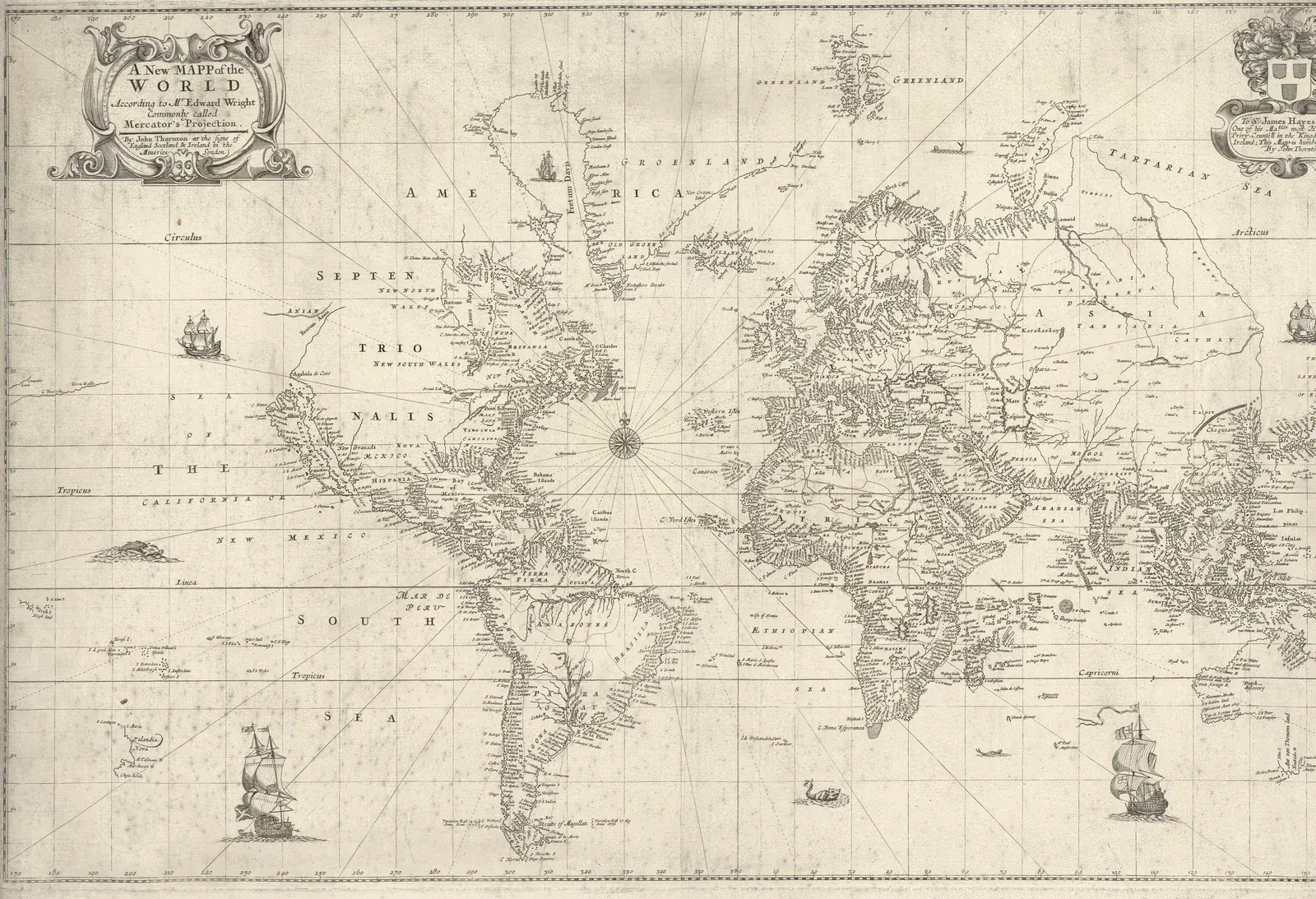
Place does not alter a natal chart’s planetary longitudes. It alters which parts of that chart meet the horizon, rise into public view, settle into private life, or arrive through other people. Earth turns beneath the same sky; your local frame changes.
Relocation astrology uses two related tools. A relocated chart is a full horoscope calculated for another place at the natal instant. Astrocartography is a world map showing where each natal planet was rising, setting, culminating, or anti-culminating at that instant. The map is an index. The relocated chart is the close reading.
The relocated chart
A relocated chart keeps the original moment and substitutes new geographic coordinates. If the birth occurred at 14:20 UTC, every relocated chart uses 14:20 UTC, even where the local clock then read 09:20 or the calendar showed another date. Entering 14:20 as local time in the new city creates a chart for a different instant.
In a standard geocentric calculation, the planets retain their zodiac degrees. Sun at 14°22′ Taurus remains at 14°22′ Taurus. Planet-to-planet aspects also remain. What changes are the Ascendant, Midheaven, other house cusps, planetary houses, and aspects from planets to the local angles. Topocentric calculations, which measure from the observer’s position on Earth rather than Earth’s center, can shift the Moon slightly; this is a software convention to note, not a new natal position.
The relocated chart is therefore not a replacement chart. It shows how the natal pattern is oriented from a particular place. Same cast, different staging.
Use the same zodiac, house system, node calculation, and other settings used for the natal chart. Otherwise you may mistake a settings change for a geographic one. At high latitudes, some quadrant house systems produce extreme cusps or become undefined. The angles still carry meaning, but house-based claims then require restraint and comparison with another system.
What an astrocartography map draws
For each planet, a basic map plots four conditions:

- AC: the planet is rising at the eastern horizon.
- DC: the planet is setting at the western horizon.
- MC: the planet is crossing the upper meridian, the local north–south arc associated astrologically with public position.
- IC: the planet is crossing the lower meridian, associated with private foundations and home life.
For the Sun, you can feel the geometry directly. Its AC line runs through places experiencing sunrise at the natal instant; the DC line marks sunset; the MC line marks local apparent noon; and the IC line marks local apparent midnight. Other planets follow the same angular logic even when daylight does not make it visible.
The astronomical receipt is local sidereal time, a clock based on Earth’s rotation relative to the stars. In simplified form, local sidereal time = Greenwich sidereal time + geographic longitude. A planet culminates when local sidereal time equals its right ascension, its clock-like coordinate on the celestial sphere. This is why MC and IC lines usually appear as north–south lines on a rectangular map. Their condition depends chiefly on longitude.
Rising and setting also depend on latitude and on declination, a planet’s celestial latitude north or south of the equator. Ignoring atmospheric refraction, the horizon equation is cos H₀ = −tan φ tan δ, where H₀ is the rising or setting hour angle, φ is geographic latitude, and δ is planetary declination. In felt terms, the horizon tilts differently against the sky as you move north or south. AC and DC lines therefore curve.
At some high latitudes the equation has no solution because a planet never rises or never sets there. A rising or setting line may stop on the map. That is geometry, not a symbolic warning.
The specific global format is modern. Jim Lewis developed and trademarked AstroCartoGraphy during the 1970s; his work with Kenneth Irving, published as The Psychology of Astrocartography in 1997, documents the system’s interpretive structure. Earlier astrologers connected places with celestial patterns, but the familiar four-line planetary map should not be presented as an unchanged ancient technique.
Combining a planet with an angle
The planet describes the function being emphasized. The angle describes where you are likely to meet it.
- Ascendant: embodiment, initiative, appearance, and how you enter situations. An angular planet here tends to be enacted directly.
- Descendant: partners, rivals, clients, collaborators, and qualities encountered through others.
- Midheaven: vocation, reputation, visibility, authority, and what receives public evaluation. It is not literally the point overhead.
- Imum Coeli: home, family patterns, privacy, land, and the conditions beneath public activity.
Then give the planet its full range rather than a promotional slogan:
- Sun: visibility, authorship, purpose, and exposure.
- Moon: belonging, care, habit, responsiveness, and fluctuation.
- Mercury: speech, study, movement, exchange, and divided attention.
- Venus: affinity, art, pleasure, diplomacy, and possible appeasement.
- Mars: action, competition, separation, heat, and productive friction.
- Jupiter: scope, teaching, confidence, opportunity, and excess.
- Saturn: duty, limits, endurance, credentialing, delay, and solitude.
- Uranus: autonomy, invention, disruption, and unstable routines.
- Neptune: imagination, devotion, permeability, idealization, and unclear commitments.
- Pluto: intensity, power, compulsion, exposure of hidden stakes, and deep reorganization.
A Venus–DC place may support attraction, social access, or collaborative work, while also making approval too important. Saturn–MC can bring sustained responsibility and earned authority, but may also make work feel heavily supervised. Mars–IC can support renovation, decisive separation from family habits, or domestic conflict. Symbolism names a field of experience, not one compulsory event.
A planet does not arrive alone. Its natal aspects remain attached to it. On a Venus line, you also angularize Venus’s square to Saturn, opposition to Mars, or trine to Jupiter. A useful rule is simple: planet names the function, angle names the setting, natal condition names the company it keeps.
Worked mini-example
Consider a hypothetical natal chart with the Sun at 14°22′ Taurus and Saturn at 16°02′ Scorpio. Their angular separation is 181°40′, so they form an opposition with an orb of 1°40′. An orb is the distance from exactness; here the planets are 1°40′ away from a perfect 180° opposition.
At one candidate location, the relocated angles are:
- MC: 15°10′ Taurus
- IC: 15°10′ Scorpio
The Sun is conjunct the relocated MC by 15°10′ − 14°22′ = 0°48′. Saturn is conjunct the relocated IC by 16°02′ − 15°10′ = 0°52′.
The move does not create the Sun–Saturn opposition. It places both ends of that existing opposition close to the local meridian. Public visibility, authorship, and recognition belong to the solar end; private duty, structural demands, or a sober domestic base belong to Saturn at the IC. Reading only the Sun–MC contact as success would discard half the geometry. This place could support serious public work precisely because private life requires structure. It could also make the split between visibility and withdrawal more noticeable.
The MC and IC contacts remain exact regardless of house system. Other house placements may vary, especially when planets lie close to intermediate cusps.
Proximity, orbs, and birth-time precision
An astrocartography line marks exact angularity. A nearby city gives a near-angular planet, but map distance is not itself an astrological orb. One degree of longitude measures about 111 kilometres at the equator and about 85 kilometres at 40° latitude. AC and DC lines curve, and common map projections distort distance further. A universal band of 500 kilometres around every line has no clean astronomical basis.
For chart work, a disciplined convention is to treat contacts within 1° of an angle as very strong, 1°–3° as clearly relevant, and 3°–5° as background rather than the main reason to choose a place. These are working thresholds, not discovered laws. Record the orb instead of calling every nearby line exact.
Many mapping programs calculate angularity from a planet’s actual right ascension and declination. A standard horoscope usually measures conjunctions by projected zodiac longitude. Because planets can have ecliptic latitude, especially the Moon and Pluto, an exact map line and a displayed zodiac conjunction may differ slightly. Check whether the program reports zodiac angular distance or actual-sky angularity.
Birth-time precision sets the ceiling for map precision. Earth rotates about 1° every four minutes. For an MC or IC line, a one-minute time error shifts longitude by roughly 0.25°, about 28 kilometres at the equator. Ten minutes can mean nearly 280 kilometres there. AC and DC shifts are less uniform because latitude and declination enter the calculation.
A time recorded to the nearest quarter hour cannot support street-level claims. Confirm the source record, historical clock offset, daylight-saving status, and whether the time appears rounded. A sharp-looking line cannot repair soft data.
Crossings, parans, and local space
Where two angular lines intersect, two planets are angular at once: perhaps Venus rising while Saturn culminates. Interpret the planetary pair, both angles, and both natal conditions. An intersection is more complex, not automatically more desirable.
A paran is a latitude-dependent relationship in which two planets occupy angles together. Some programs extend that relationship along a latitude rather than showing only a visual map intersection. Conventions differ, so read the map legend before treating a paran and a line crossing as interchangeable.
Local space is another technique. It projects each planet’s azimuth—its compass direction from a chosen location—as a great-circle path across Earth. It answers a directional question rather than showing where planets were globally angular. Combining it with astrocartography can be useful, but only after keeping the two geometries distinct.
A disciplined place comparison
Start with a specific question. Public work, partnership, study, family life, creative production, and quiet consolidation do not call for the same emphasis.
For each candidate place:
- Calculate the relocated chart from the original UTC instant and exact coordinates.
- List planets within 3° of the four angles, giving exact orbs.
- Inspect the natal aspects carried by each angular planet.
- Note house changes, but test cusp-sensitive claims in more than one house system.
- Compare the chart with the astrocartography map and explain any calculation-setting discrepancy.
- Add current timing only after the place signature is clear. Place describes emphasis; it does not act as a clock.
- Write down ordinary conditions: language, climate, social treatment, work availability, housing, accessibility, and existing relationships.
A short visit may reveal atmosphere, pace, and social response. It cannot reproduce the obligations or accumulated ties of residence. No city is a verdict, and no line supplies missing context.
Common corrections
- Using the same wall-clock time in the destination: keep the natal instant in UTC. Only the coordinates change.
- Expecting planets to change signs: standard relocation changes angles and houses, not geocentric zodiac positions.
- Reading only the nearest line: inspect the full relocated chart. A close line may angularize a difficult natal configuration; a quiet map area can still produce meaningful house changes.
- Treating an empty area as inactive: every terrestrial location has an Ascendant, Midheaven, houses, and varying degrees of planetary angularity.
- Calling Venus or Jupiter automatically fortunate: ease can become passivity or excess. Saturn or Mars can support construction, discipline, and decisive action. Context decides how usable the emphasis is.
- Confusing natal and transit maps: a natal astrocartography map is fixed to the birth instant. A map calculated for a later date is a different technique and must be labelled as such.
- Choosing a city from a single flattering phrase: Sun–MC does not guarantee status, Venus–DC does not guarantee partnership, and Jupiter–IC does not guarantee an ideal home.
The evidential boundary
The line calculations are reproducible astronomy given accurate inputs. Their astrological meanings are interpretive claims. There is not a robust body of replicated, controlled evidence showing that residence near a particular planetary line produces the promised outcomes above chance. Retrospective stories are vulnerable to selective memory, loose orbs, and the fact that people choose places for reasons already shaping what happens there.
You can still use the method honestly. Write expectations before a move or visit, make them concrete, and record disconfirming experiences as carefully as confirming ones. A map becomes more useful when it makes your questions sharper, not your certainty louder.
Practice
Choose one accurately timed natal chart and two locations: the current residence and one candidate place. Calculate both relocated charts with identical settings. For each place, list the four angles and every planet within 3° of them. Show the orb arithmetic for the closest contact.
Then find the corresponding astrocartography lines. Estimate how far birth-time uncertainty could shift the nearest MC or IC line, using roughly 28 kilometres per minute at the equator and adjusting for latitude.
Write three paired statements for each place: one constructive expression, one costly expression, and one ordinary real-world condition that could support or obstruct the symbolism. Keep these notes dated. Do not revise them after checking anecdotes about the location.
Key terms
relocated chart · astrocartography · angularity · local sidereal time · right ascension · declination · orb · paran · local space · birth-time sensitivity
Check your reading
Three questions from this chapter’s worked example and its common mistakes. Two of three marks the chapter complete.
When relocating a chart, what changes?
Sun at 14°22′ Taurus and relocated MC at 15°10′ Taurus. What is the orb of the conjunction?
Does a Sun–MC line guarantee status?