Zodiac myths · Aries
Aries is the ram that flew, and left its fleece behind
Before Jason, before the Argo, there was a golden ram, two children on a cliff, and a sea that still carries a girl's name.
Johann Bayer, Uranometria, 1603
At a glance
In Greek myth Aries is Chrysomallos, the golden ram sent to rescue Phrixus and Helle. Its fleece became the Golden Fleece that Jason later sailed for.
- The figure
- The golden ramApollodorus, Library 1.9.1
- Sign dates 2026
- Mar 20 to Apr 20, 2026Sun enters Mar 20, 2026, 14:46 UTC
- Sun in the stars, 2026
- Apr 19 to May 14, 202626 days inside the IAU Aries
- Best seen at midnight
- Oct 22 to Nov 15, 2026best night about Nov 3, 2026
The myth
Two children, one ram, and the Hellespont
Try this today
- Name one person you would show up for, ram-fast, no questions. Then ask if they know it.
- Notice where you hold on through a hard crossing, like Phrixus. What is your fleece, the thing you brought out?
- On a dark November night, find Hamal west of the Pleiades. It is fainter than you expect.
Athamas, a king in Boeotia, had two children with the cloud-goddess Nephele: a boy, Phrixus, and a girl, Helle. When he remarried, his new wife Ino wanted them gone. Apollodorus says she persuaded the women of the land to roast the seed grain, so the fields came up empty. Then she bribed the messengers sent to the oracle, and they came home with a lie: the famine would end only if Phrixus was sacrificed.
Nephele got there first. She sent a ram with a fleece of gold, a gift from Hermes, and both children climbed onto its back. It flew east over the sea. Somewhere over the strait between Europe and Asia, Helle slipped and fell. The water was named for her: the Hellespont, "Helle's sea," today's Dardanelles.
Phrixus held on. The ram brought him to Colchis, at the far end of the Black Sea, where King Aeetes took him in. Phrixus sacrificed the ram to Zeus and gave its fleece to the king, who nailed it to an oak in a grove of Ares and set a sleepless serpent to guard it. That is the Golden Fleece, and the reason Jason and the Argonauts sailed a generation later.
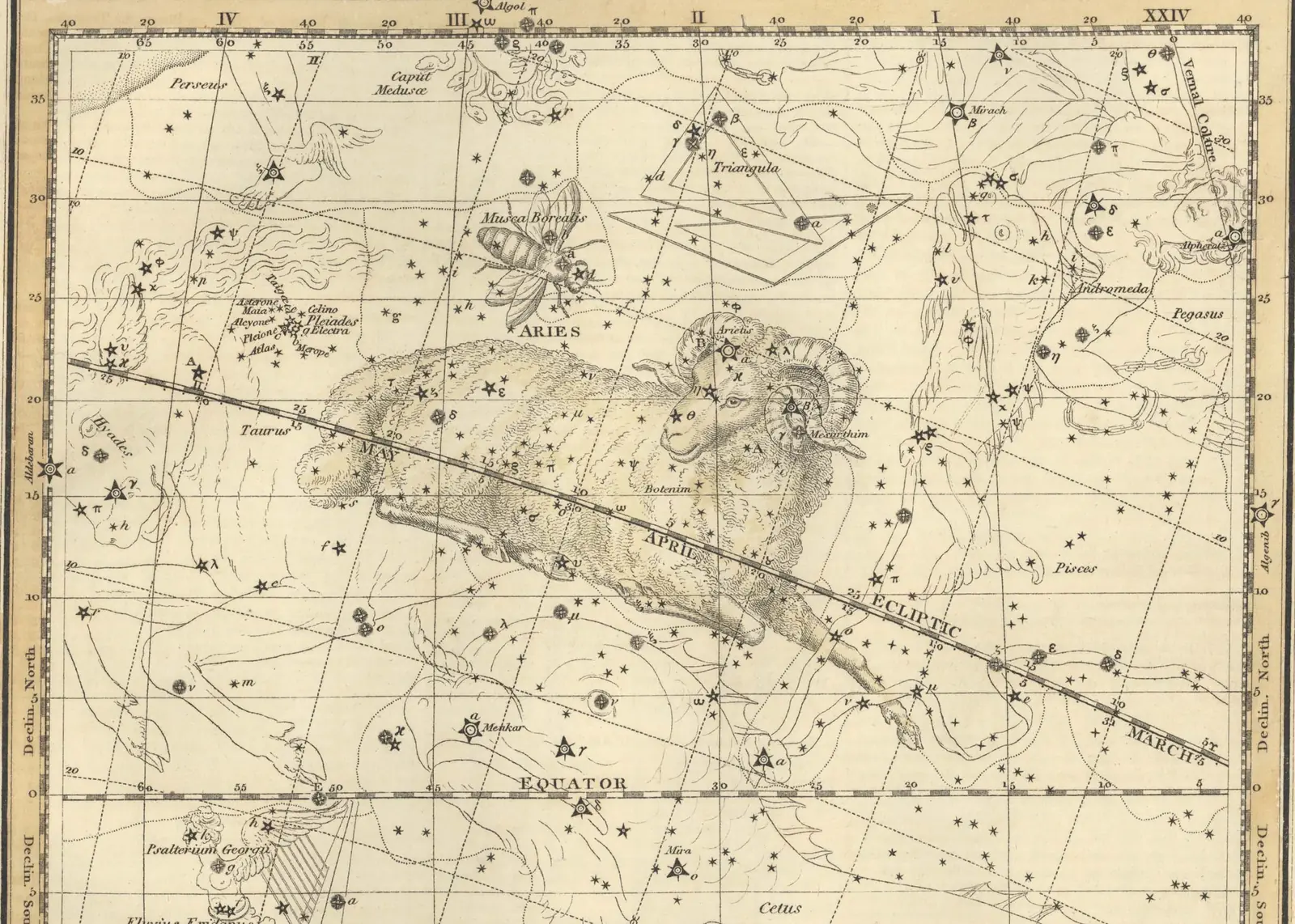
The ram itself went up. Hyginus says it was placed among the stars. Go and look and you will notice something: it is a dim figure, with no very bright stars, as if the gold had gone with the fleece.
Other tellings
The other Aries: a ram in the desert
Hyginus gives a second story. When Dionysus was leading an army through the deserts of Libya and his men were dying of thirst, a ram appeared and led them to water. In thanks, the god asked Zeus to set the ram among the stars, and a temple to Zeus Ammon, the ram-horned god of the Siwa oasis, was built where the water was found.
The shape is older than either Greek story. Babylonian star lists such as MUL.APIN call this patch of sky the Hired Man (LÚ.ḪUN.GÁ), and the ram identification comes later. So the Greeks did not invent the figure. They gave it a biography.
In the sky
Finding Aries: Oct 22 to Nov 15, 2026
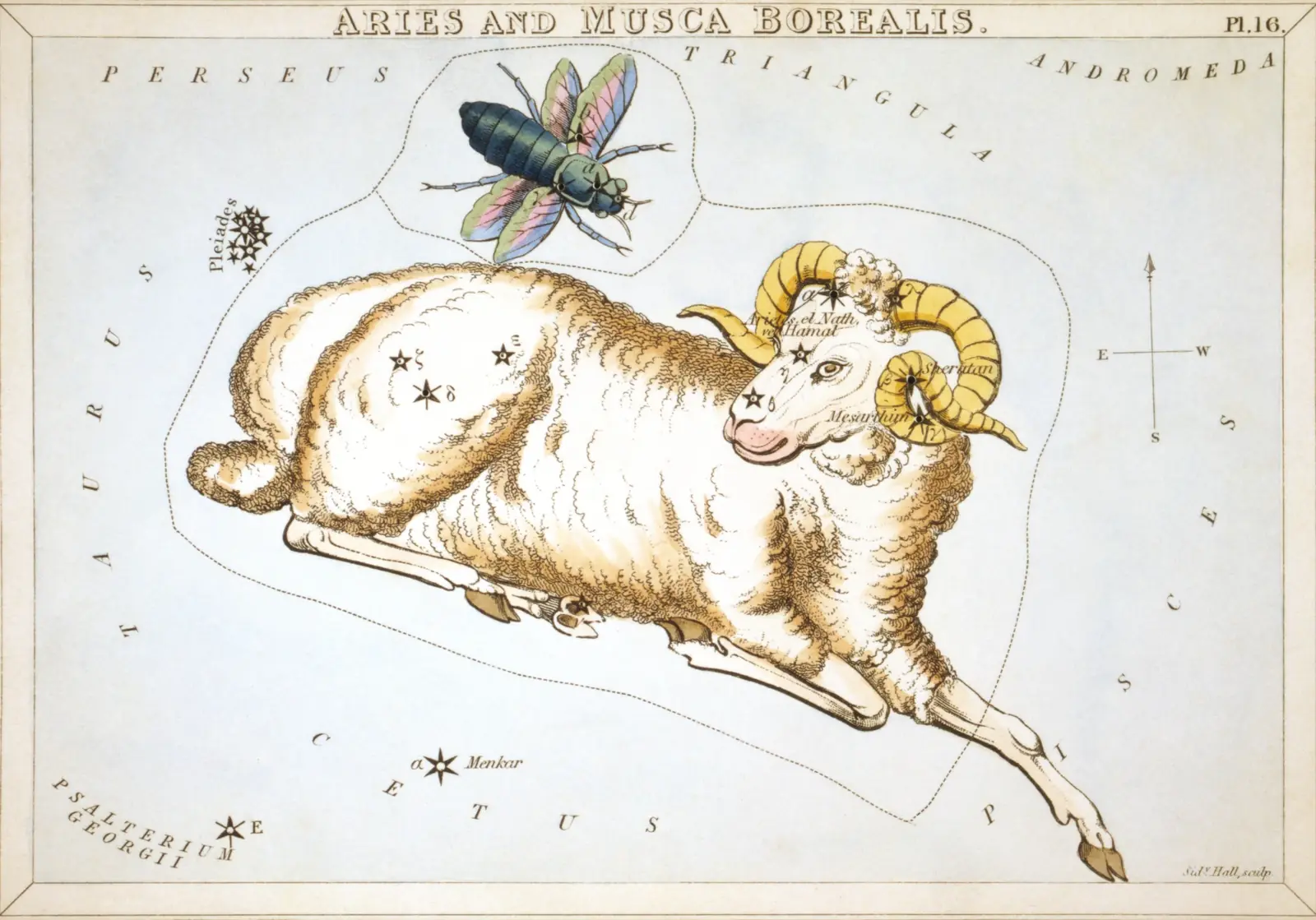
Look for Hamal, Aries' brightest star, and its partner Sheratan: two modest stars in a short, bent line west of the Pleiades. Without a dark sky Aries is easy to miss, which suits a ram that gave its gold away.
2026: sign Mar 20, 2026, 14:46 UTC to Apr 20, 2026, 01:39 UTC. Sun in the stars: Apr 19 to May 14, 2026 (26 days). (Why the 30-day gap.) Aries peaks at midnight near Nov 3, 2026.
Pick your telling
The Greeks did not invent the ram. They gave it a biography.
3 versions of the golden ram.
Aries, 3 ways
The rescue ram
Nephele sends a golden ram to save Phrixus and Helle from Ino's plot. Helle falls into the Hellespont; Phrixus reaches Colchis, sacrifices the ram, and its fleece becomes the Golden Fleece.
Source: Apollodorus, Library 1.9.1; Ovid, Fasti 3.851-876
See it yourself. Aries: Oct 22 to Nov 15, 2026.
More to read
One shorter read. It opens in place.
In astrology
Why astrology starts with the ram
When Greek astronomers like Hipparchus measured the sky in the 2nd century BC, the Sun crossed the spring equinox in the stars of the Ram. Ptolemy's zodiac starts its twelve signs at that point, and so does the tropical zodiac today, even though precession has since slid the equinox into the stars of Pisces. Mars rules Aries in traditional astrology. Read the myth next to your own Aries placements and the theme that jumps out is rescue: the impulse to move first, fast, when someone needs getting out.
Continue readingShow less
Aries by the numbers
| Dates | Days | |
|---|---|---|
| Sign | Mar 20 to Apr 20, 2026 | 30 |
| Sun in the stars | Apr 19 to May 14, 2026 | 26 |
| Midnight season | Oct 22 to Nov 15, 2026 | 25 |
All times are UTC. In the Americas the local date can be a day earlier; in Asia and Australia a day later.
Quick answers
What is the Greek myth of Aries?
Aries is the golden ram, Chrysomallos, that flew Phrixus and Helle away from their stepmother Ino. Helle fell into the sea, now the Hellespont; Phrixus reached Colchis, and the ram's fleece became the Golden Fleece.
Is Aries the Greek god of war?
Not the sign. Ares is the Greek war god (Mars to the Romans). The sign and constellation Aries is the Latin word for ram. The link is astrological: Mars is the traditional ruler of the sign Aries.
What happened to the golden ram's fleece?
Phrixus gave it to King Aeetes of Colchis, who hung it on an oak in a grove of Ares under the guard of a serpent. Jason and the Argonauts later sailed to take it.
Why is the Aries constellation so faint?
Its brightest star, Hamal, is only about magnitude 2, and the rest are fainter. Without a dark sky the ram is easy to miss.
Who put Aries in the sky?
In the Greek telling, Zeus. The sources say the ram was set among the stars after Phrixus sacrificed it to him; in Hyginus's second story Zeus does it at Dionysus's request.