The 10 Planets in Western Astrology
Ten bodies, their speeds, sect, and the dignity table — what is acting, before how.
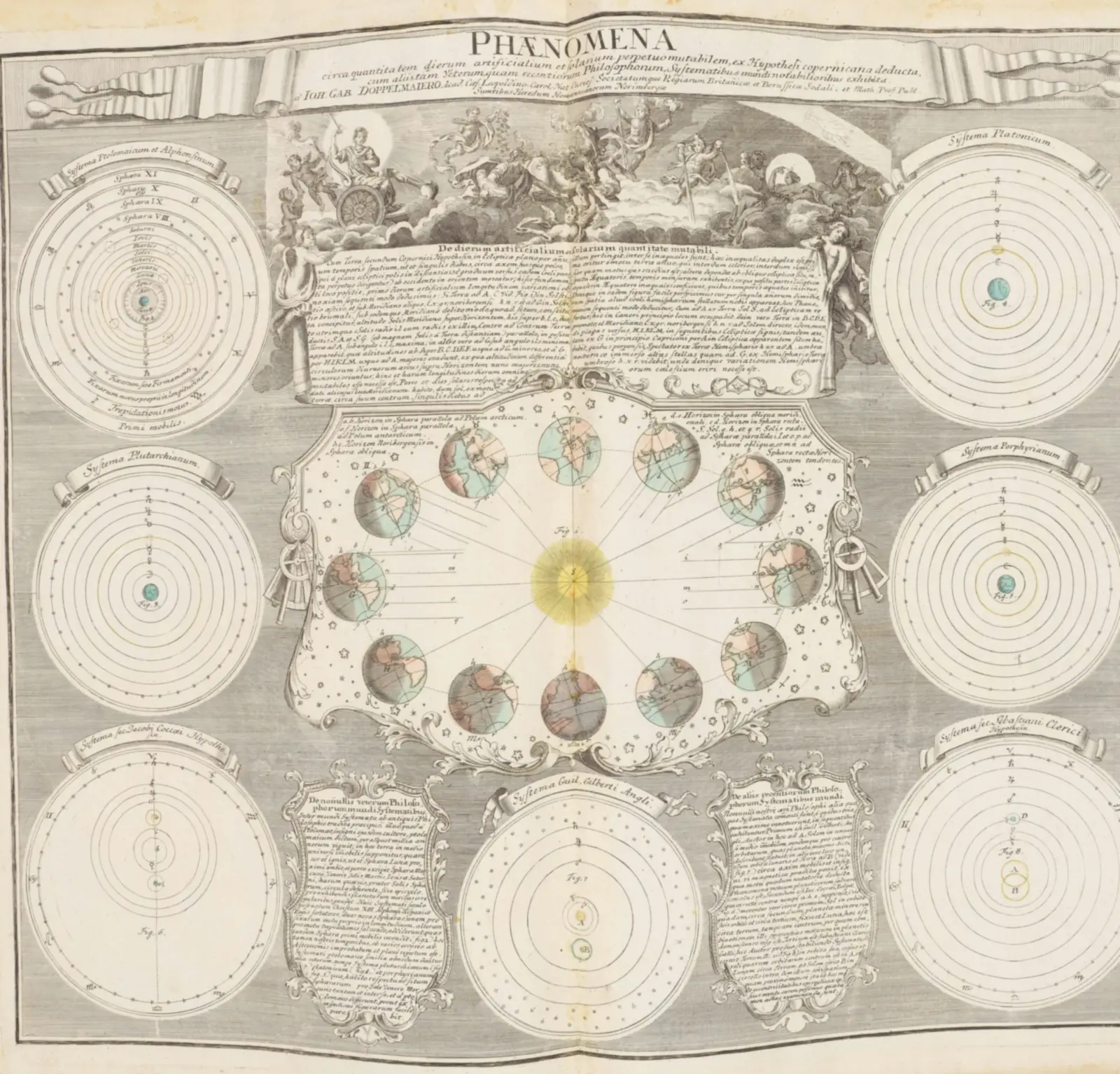
Western astrology treats each planet as a distinct function. The planet shows what is acting; its sign describes how it acts. Houses locate the action, while aspects describe relationships between planets. Keeping those jobs separate prevents vague readings in which every placement supposedly means everything.
The ten planets and their speeds
Astrologers call the Sun and Moon planets for convenience, though astronomically the Sun is a star and the Moon is Earth’s satellite. Speeds below are approximate and geocentric: they describe motion as seen from Earth. For the dated version of this table, see every 2026 ingress, Sun to Pluto.
| Planet | Core meanings | Approximate pace |
|---|---|---|
| Sun | Identity, purpose, creative will, authority, visibility | About 1° daily; crosses the zodiac in one year |
| Moon | Needs, habits, memory, instinct, belonging, daily rhythms | About 13° daily; crosses the zodiac in 27.3 days |
| Mercury | Thinking, language, learning, exchange, connection | Usually 2–4 weeks per sign; always within about 28° of the Sun |
| Venus | Attraction, pleasure, values, harmony, agreements | Usually 3–5 weeks per sign; always within about 47° of the Sun |
| Mars | Action, desire, courage, conflict, severing | Commonly 6–8 weeks per sign, but much longer when retrograde |
| Jupiter | Growth, faith, opportunity, judgment, generosity | About one year per sign |
| Saturn | Limits, duty, structure, time, endurance | About 2.5 years per sign |
| Uranus | Disruption, freedom, invention, sudden change | About seven years per sign |
| Neptune | Imagination, ideals, permeability, ambiguity | About fourteen years per sign |
| Pluto | Power, compulsion, elimination, regeneration | Roughly 12–31 years per sign because its orbit is highly elliptical |
Each row has its own literature. Start with what each planet means in practice, then narrow: Mercury by sign and house, Venus in every sign, and how Mars behaves by sign. The Moon's row hides two very different uses — what a Moon sign asks for and how the Moon's 27.3-day cycle is used for timing. Jupiter's year-per-sign pace is why Jupiter and money is a multi-year question rather than a monthly one, and Saturn's two and a half years per sign is what makes the Saturn return at 29 a return at all. Venus and the Moon together are also why loyalty is a Venus and Moon question, not a Sun-sign one.
Speed changes interpretation. The fast Moon often describes immediate reactions and changing circumstances. Saturn’s slower cycle concerns long development. Uranus, Neptune and Pluto remain in one sign long enough to describe generations — Uranus in Gemini, Neptune's fourteen years in Aries and Pluto's twenty years in Aquarius are all currently in progress; their house positions and close aspects make them more individual.
Retrograde motion is an apparent reversal from Earth. The Sun and Moon never retrograde; the 2026 retrograde calendar covers the rest. A planet slows before stationing, appears to move backward, then stations again before resuming direct motion — Mercury retrograde dates and shadow periods show that sequence with exact times. Retrograde does not mean bad or powerless, as Venus retrograde, specifically makes clear. It can indicate revision, return, delay or a less straightforward expression, depending on the planet and context.
Sect: day planets and night planets
Sect is a traditional way to judge whether a planet is operating in the kind of chart that suits it. If the Sun is above the local horizon, it is a day chart. If the Sun is below the horizon, it is a night chart.
- The Sun, Jupiter and Saturn belong to the daytime sect.
- The Moon, Venus and Mars belong to the nighttime sect.
- Mercury is flexible: as a morning star rising before the Sun, it is diurnal; as an evening star setting after the Sun, it is nocturnal.
Sect modifies how comfortably a planet performs. Jupiter is the benefic most at home by day, while Venus is the benefic most at home by night. Saturn’s cold, restrictive qualities tend to be better contained in a day chart. Mars’s heat and sharpness tend to be better moderated at night.
This is not a good-planet/bad-planet score. An in-sect Mars can still describe conflict, and an out-of-sect Saturn can still build something durable. Sect describes operating conditions, not moral worth. Uranus, Neptune and Pluto have no classical sect assignments.
Essential dignity: a planet’s resources
Essential dignity judges a planet by its zodiacal sign, independently of its house or aspects. A useful metaphor is hospitality:
- Domicile: the planet is in a sign it rules, like an owner at home.
- Exaltation: the planet is an honored guest with elevated status.
- Detriment: the planet is opposite its domicile and must work in unfamiliar conditions.
- Fall: the planet is opposite its exaltation and may struggle to express its preferred qualities.
| Planet | Domicile | Exaltation | Detriment | Fall |
|---|---|---|---|---|
| Sun | Leo | Aries | Aquarius | Libra |
| Moon | Cancer | Taurus | Capricorn | Scorpio |
| Mercury | Gemini, Virgo | Virgo | Sagittarius, Pisces | Pisces |
| Venus | Taurus, Libra | Pisces | Scorpio, Aries | Virgo |
| Mars | Aries, Scorpio | Capricorn | Libra, Taurus | Cancer |
| Jupiter | Sagittarius, Pisces | Cancer | Gemini, Virgo | Capricorn |
| Saturn | Capricorn, Aquarius | Libra | Cancer, Leo | Aries |
Three rows of that table carry most of the everyday questions. Mars is the clearest case of one ruler with two very different domiciles — Aries and Scorpio, the two signs Mars rules. Exaltation is easiest to see in Jupiter in Cancer, its exaltation. And a single sign can hold opposite verdicts for two planets: Pisces, where Venus is exalted and Mercury falls.
These dignities come from the traditional seven-planet system. Modern astrologers commonly associate Uranus with Aquarius, Neptune with Pisces and Pluto with Scorpio, but those associations are not part of the classical dignity table. Either approach can be used if it is labeled clearly and applied consistently.
Dignity is not the same as strength in every sense. A planet may be essentially dignified but hidden in a difficult house, closely afflicted or moving unusually slowly. A planet in detriment or fall may be prominent and effective, yet achieve results through tension, compromise or adaptation. Those other circumstances are forms of accidental condition.
One technique: build a condition stack
Instead of reading a planet from one keyword, stack its conditions in a fixed order:
- Name the function. Mars acts, separates and confronts; Venus attracts and reconciles.
- Check the sign and dignity. Does the planet have familiar resources, elevated status or awkward conditions?
- Check sect. Is the chart diurnal or nocturnal, and is the planet operating with its own sect?
- Check motion. Is it direct, retrograde, unusually fast, slow or stationing? A retrograde planet in the natal chart is a permanent condition of that chart, not a passing transit.
Consider Mars in Capricorn in a night chart, moving direct at an ordinary speed. Mars’s function is action. Capricorn is its exaltation, so that action has access to patience, planning and control. Mars also belongs to the nighttime sect, which can moderate its heat. This combination may describe deliberate, strategic effort. It does not promise success; the house and aspects still show where Mars acts and what helps or obstructs it.
Now place Mars in Cancer in a day chart while retrograde. Mars is in fall, outside its preferred sect and moving non-linearly. Action may become protective, indirect or entangled with old conflicts. That does not make the person weak or aggressive. It describes a function working under friction, perhaps becoming skilled through repeated adjustment.
An exalted planet can perform a difficult task very effectively. A planet in fall can produce valuable work while requiring more negotiation. Dignity describes the planet’s tools, not the goodness of the outcome.
From placements to interpretation
Ask interprets a calculated chart and supports personal statements with placement receipts such as In your chart, Mars is in Capricorn in a night chart. Our engine performs the astronomy; only derived placements—planets, houses and aspects—are sent to Azure OpenAI for interpretation. No personal data leaves our platform — only derived chart placements.
Horary verdicts use a different process. Decide casts a chart for the exact minute of the question and applies rule-based considerations from Lilly’s 1647 method. No AI takes part in its YES, NO or ASK AGAIN verdict.
Common questions
- Are the Sun and Moon really planets in astrology?
- They are called planets by astrological convention. More precisely, they are the luminaries: the Sun is a star and the Moon is Earth’s satellite.
- Does retrograde motion make a planet bad?
- No. Retrograde motion can indicate revision, return, delay or indirect expression. Its meaning depends on the planet, sign, house, aspects and overall chart.
- Does an exalted planet guarantee a good result?
- No. Exaltation gives a planet status and resources, but houses, aspects, sect, motion and the nature of the planet’s task still matter.
- Should Uranus, Neptune and Pluto rule signs?
- Modern astrology commonly links Uranus with Aquarius, Neptune with Pisces and Pluto with Scorpio. Traditional dignity uses Saturn, Jupiter and Mars as the rulers of those signs. State which system you are using and remain consistent.
Sources
- JPL Horizons system — NASA JPL — generates the geocentric positions and apparent motions summarised in the speed table.
- The Astronomical Almanac Glossary — US Naval Observatory — definitions of station, retrograde motion and elongation.
Every technique on this page needs one thing first: a chart computed from your exact birth date, time, and place.