Part 7: Moon, Nodes & Condition · Chapter 25 of 36 · 10 min
Retrogrades: apparent motion and honest meaning
Retrograde begins with a measurement, not a personality trait.
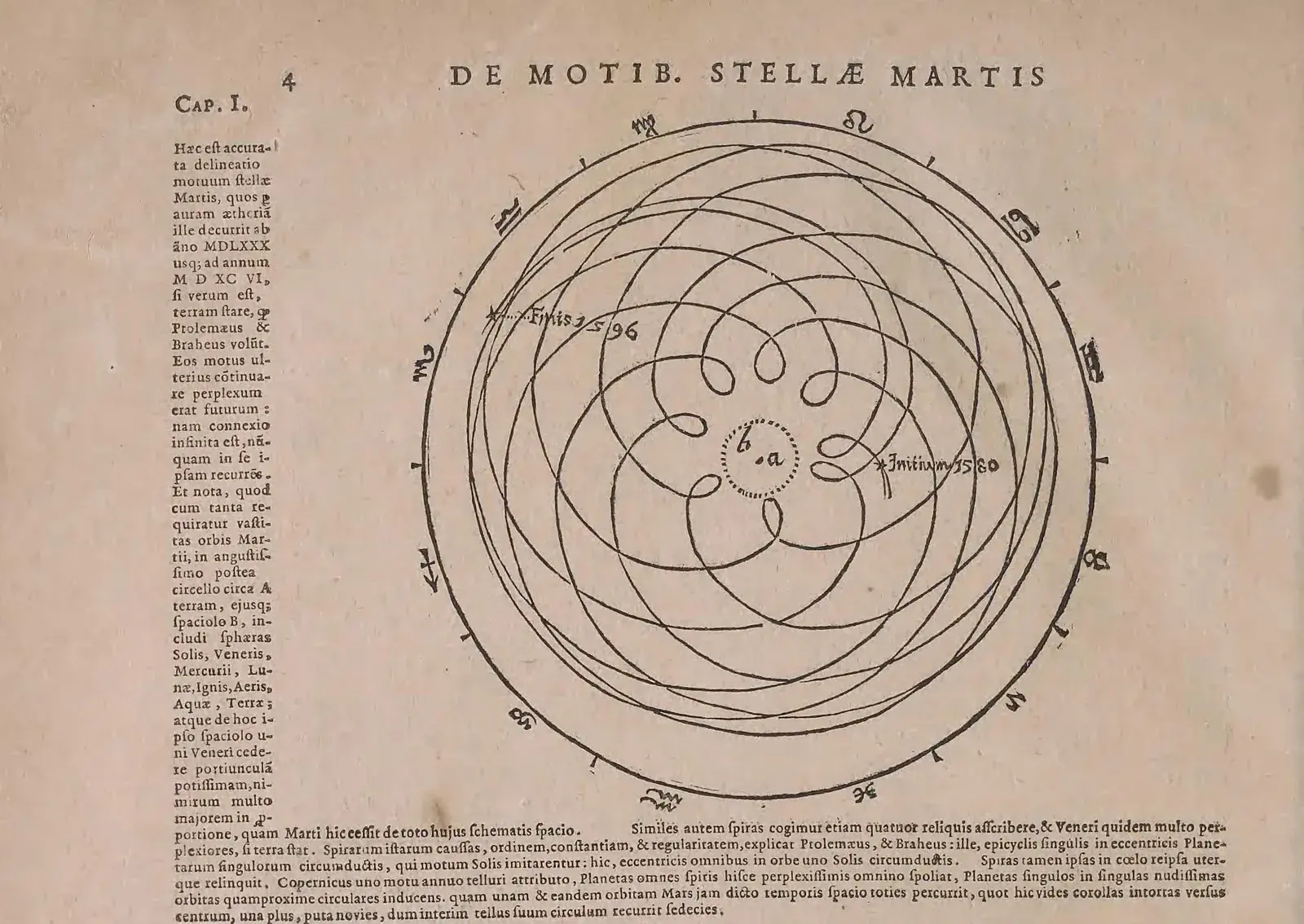
Retrograde begins with a measurement, not a personality trait. In a geocentric chart, a planet's position is measured from Earth along zodiacal longitude. A direct planet is increasing in longitude: 18° Virgo becomes 19° Virgo. A retrograde planet is decreasing: 18° Virgo becomes 17° Virgo. At the turning points, called stations, its apparent longitudinal speed reaches zero before changing direction.
Nothing in the solar system has reversed its orbit for the sake of your chart. The reversal is produced by relative motion and viewpoint. You can see a simpler version from a moving train: another train beside you may seem to slide backward when yours gains speed. It is not illusion in the sense of being false. It is a real observation from a particular position. Retrograde motion is real as a geocentric measurement, while its cause is orbital geometry.
That distinction matters. The ephemeris can establish a planet's degree, direction, speed, and station date. It cannot establish a person's temperament or foretell a specific outcome. Astrology adds symbolic interpretation to verified astronomical positions. Keep those two layers separate and your work stays cleaner.
The geometry of the loop
The Sun and Moon do not retrograde in ordinary geocentric astrology. Their zodiacal longitude keeps moving forward. Every planet from Mercury outward can appear retrograde. So can many asteroids and other bodies used in modern charts.
The lunar nodes need separate handling. They are calculated intersection points between the Moon's path and the ecliptic, not physical bodies. Their customary backward motion does not make them retrograde planets. A chart can show a node moving backward because of the calculation used to derive it; that is a different technical condition.
For planets beyond Earth, retrograde occurs when Earth moves between the Sun and that planet, then overtakes it in orbital speed. From Earth, the slower outer planet appears to drift backward against the zodiac for a time. The midpoint of an outer planet's retrograde period falls near its opposition to the Sun.
Mercury and Venus work differently. Their retrogrades occur around inferior conjunction, when they pass between Earth and the Sun. Their loops are shorter because their orbits lie inside Earth's orbit. Mars also has a comparatively compact retrograde cycle, while the more distant planets remain retrograde for longer stretches.
The rough calendar pattern gives useful perspective. Mercury is retrograde about three or four times in a year, usually for about three weeks at a time. Venus is retrograde for roughly six weeks every nineteen months. Mars is retrograde for around two to three months every twenty-six months. Jupiter is retrograde for about a third of each year; Saturn somewhat longer; Uranus, Neptune, and Pluto for close to five months annually.
Those rates are a receipt against exaggeration. A natal retrograde Jupiter or Saturn is common. A natal retrograde Uranus, Neptune, or Pluto is commoner still. It cannot automatically indicate an unusual destiny, a hidden burden, or an exceptional psychological trait. Mercury, Venus, and Mars retrogrades are less common in natal charts, but rarity alone does not prove greater importance. It gives you a reason to inspect the placement carefully, not permission to inflate it.
Stations: where speed changes sign
A station is the precise point where apparent motion changes direction. At a retrograde station, the planet has been moving direct, slows, stops in longitude, and begins moving backward. At a direct station, it has been moving backward, slows, stops, and resumes forward motion.
Astrologers often give stations extra weight because the planet is moving very slowly over a small span of degrees. The image is understandable: a planetary function may be held in view rather than passing quickly through. But do not turn that image into a law. A station is not automatically louder than every other factor in a chart.
Calculate before you interpret. A planet is stationary because its actual daily motion is unusually small, not because it happens to sit near a degree that looks important. Different planets have different normal speeds, so there is no single daily-motion cutoff that works for all of them. An ephemeris, chart software with speed data, or a reliable astronomical table will show whether a planet is approaching a station.
The station degree deserves particular attention when it closely contacts a natal planet, angle, or other sensitive point. A transiting Saturn stationing at 14°20' Pisces within a few minutes of arc of a natal Moon at 14°12' Pisces is a specific geometric fact. The meaning still depends on the Moon's natal condition, the houses involved, the larger transit picture, and the person's actual circumstances. Precision in calculation does not entitle you to certainty in interpretation.
What retrograde can mean in a natal chart
A natal retrograde describes the planet's apparent direction at birth. The planet does not lose its ordinary function. Mercury still concerns perception, language, sorting information, and exchange. Venus still concerns attraction, taste, value, and relating. Mars still concerns assertion, heat, effort, and pursuit. The outer planets retain their own symbolic territories as well.
Retrograde modifies the manner in which you might read that function. The most useful language is modest and concrete. A retrograde planet may suggest a process that revises itself, returns to earlier material, or checks an internal standard before moving outward. In felt terms: you may not accept the first available answer. You may need to reconsider, reword, remeasure, or test the thing against your own experience.
That is a possible pattern, not a verdict. A retrograde Mercury can belong to someone who speaks readily. A retrograde Mars can belong to someone who acts decisively. A direct Venus can belong to someone whose values are private and carefully guarded. Direction alone never outranks sign, house, aspects, rulership, angularity, speed, and the rest of the chart's condition.
Use a sequence that keeps the modifier in proportion:
- Identify the planet and state its ordinary function.
- Read its sign: the style or texture through which that function operates.
- Read its house: the area of life in which the function becomes visible.
- Assess aspects, especially close and applying ones.
- Note whether the planet is direct, retrograde, or near a station.
- Phrase the retrograde as a question about process, not as a fixed trait.
The last step is where many readings go loose. Saying 'retrograde means internal' is too blunt to be useful. Internal can mean private thought, self-correction, a reluctance to settle too early, repeated engagement with one topic, or simply a process that does not move in a straight line. Your chart work improves when you name the actual planetary topic rather than repeating one word over every retrograde placement.
Worked mini-example: direction, orb, and application
Take this invented natal fragment:
- Mercury at 24°18' Pisces, retrograde, in the eleventh house
- Saturn at 23°46' Pisces, direct, in the eleventh house
- Mercury's daily motion: -0°58'
- Saturn's daily motion: +0°04'
The two planets are conjunct within 0°32'. That is a tight conjunction by any ordinary working orb. Mercury is moving backward through the zodiac while Saturn is moving forward. They are moving toward one another: Mercury descends from 24°18' toward 23°46', while Saturn rises from 23°46' toward Mercury. The conjunction is therefore applying.
This is the first lesson of the example: applying and separating aspects depend on actual motion, not on the assumption that zodiacal degrees always move forward. If you looked only at the printed order of the degrees, you could miss the relationship's direction of development.
The conjunction is the dominant fact. Mercury describes how impressions are named, sorted, and communicated. Saturn describes structure, testing, boundaries, and the demand that something hold up under use. Pisces adds an associative, impression-led style; the eleventh house places the matter among groups, peers, collective aims, and shared projects.
A careful reading might ask whether ideas are repeatedly tested, edited, or held back until they feel structurally sound in group settings. Mercury's retrograde motion could support language about revising thought or returning to an unfinished formulation. It does not justify saying that the person is silent, socially isolated, blocked, or destined to struggle with groups. Those claims do not follow from the geometry.
Notice the hierarchy. The close, applying Mercury-Saturn conjunction carries more interpretive weight than the retrograde label by itself. If Mercury were direct at the same degree, the conjunction would remain close and applying. Retrograde changes the motion pattern; it does not erase the aspect or replace the rest of the chart.
Orbs are working allowances, not physical fields around planets. Begin with exact aspects and tight orbs because they give you the clearest structure. Expand only when the chart's context supports it. A conjunction at 0°32' gives firmer material than one at 7°32', even if a broad orb system permits both.
Retrograde transits and the three-pass pattern
A transiting retrograde is not the same thing as a natal retrograde. A natal placement is part of the birth chart's fixed geometry. A transit is a moving contact measured against that chart. Keep those categories separate.
Retrograde transits often create a three-pass sequence across the same natal degree. Suppose Mercury stations retrograde at 21°14' Virgo, backs up to station direct at 8°36' Virgo, and then moves forward again. If your natal Sun is at 12°00' Virgo, Mercury can contact it three times:
- Once while moving direct toward 21°14' Virgo.
- Again while moving retrograde from 21°14' back to 8°36' Virgo.
- A third time after stationing direct at 8°36' Virgo and returning through 12°00' Virgo.
The three contacts are astronomically distinct. They do not require three dramatic developments, three conversations, or three visible events. They offer three moments within one moving pattern. The first pass may introduce a topic, the second may return you to it from another angle, and the third may show what remains after revision. That is a useful observational frame, not a guarantee.
A narrow transit orb keeps the timing honest. With a one-degree working orb, transiting Mercury becomes noticeable by technique near 11°00' Virgo, is exact at 12°00', and then moves out of orb. Because Mercury's speed changes markedly near stations, calculate the dates rather than estimating from a calendar.
The word shadow is often used for the degrees a planet crosses three times. In the Mercury example, the pre-retrograde shadow begins when Mercury first reaches 8°36' Virgo before stationing retrograde at 21°14'. The post-retrograde shadow ends when Mercury reaches 21°14' Virgo again after stationing direct. Shadow is a useful bookkeeping term. It is not an additional astronomical state, and it does not make every day in that span equally important.
Longer retrogrades from Jupiter through Pluto ask for even more restraint. Their broad retrograde periods can last months, and their natal contacts may remain within orb for extended periods. Look first for exact aspects, station degrees, house activations, and repetition. A distant planet lingering in one sign is background unless it makes a clear contact to something specific in the natal chart.
Common mistakes worth correcting
- Treating retrograde as bad and direct as good. Direction is not a moral rating. Retrograde describes apparent motion. Its symbolic language concerns process, revision, and timing, not virtue.
- Using one keyword for every planet. 'Review' may fit Mercury in some contexts, but it is too thin for Saturn, Venus, Mars, or an outer planet. Name the planet's actual function before you describe how retrograde may modify it.
- Ignoring base rates. Outer planets are retrograde for large portions of every year. A reading that treats natal retrograde Pluto as inherently rare has missed the astronomical context.
- Reading retrograde before reading aspects. A close square, opposition, conjunction, or angular placement often carries more usable information than direction alone. Start with the strongest geometry.
- Assuming lower degree means applying. Retrograde motion can reverse the usual visual shortcut. Check daily motion and calculate whether the distance to exact aspect is narrowing or widening.
- Confusing a station with the whole retrograde period. The station is a turning point. The retrograde is the interval between stations. Slow motion around a station may be notable, but it is not the same condition as every other retrograde day.
- Treating the shadow as a prediction device. The shadow identifies repeated degrees. It does not prove that a hidden event has begun or that a later event must occur.
- Making retrograde prove a story about the past. Charts can invite reflection, but a direction marker cannot verify inherited narratives, unfinished obligations, or any particular history. Do not let a dramatic phrase outrun the evidence.
- Using an ephemeris glyph as proof of meaning. The glyph proves only the motion state. Interpretation remains interpretive. Say what you can calculate, then state your symbolic inference with appropriate limits.
Astrology is strongest here when it is candid. You can observe that a planet is retrograde, calculate its speed, map its contacts, and compare repeated degrees. There is no established scientific account showing that planetary direction causes personal events or character. A chart offers a symbolic framework for attention; it does not compel an outcome. An evocative interpretation is not strengthened by pretending it is a measurement.
Give retrogrades the same discipline you give direct motion: calculate the fact, place it in the chart, and refuse the shortcut. A symbol becomes more useful when its limits remain visible.
Practice
Practice
Choose one natal chart with reliable birth data and one current ephemeris.
- List every natal retrograde planet. For each, write its sign, house, exact degree, daily speed, and nearest aspect within a tight orb.
- Pick one retrograde planet. Write four separate lines: the astronomical fact; the planet's ordinary function; the chart context; one conditional question about revision, return, or self-correction. Do not merge these lines.
- Find the next Mercury retrograde loop. Record its station-retrograde degree and station-direct degree. Check whether any natal planet or angle falls between them.
- If a natal degree lies in the loop, mark each possible exact pass: direct, retrograde, direct. Leave event claims blank. Record only dates, degrees, direction, and orb.
Calculate first. Language comes after the numbers.
Key terms
retrograde · direct motion · geocentric · ecliptic longitude · station retrograde · station direct · daily motion · applying aspect · separating aspect · orb · three-pass transit · retrograde shadow
Check your reading
Three questions from this chapter’s worked example and its common mistakes. Two of three marks the chapter complete.
Mercury retrograde at 24°18′ Pisces moving −0°58′/day, Saturn direct at 23°46′ Pisces. Is the conjunction applying?
Which carries more interpretive weight in that example?
Is natal retrograde Pluto rare?