Part 7: Moon, Nodes & Condition · Chapter 24 of 36 · 11 min
Dignity and debility: a planet's condition
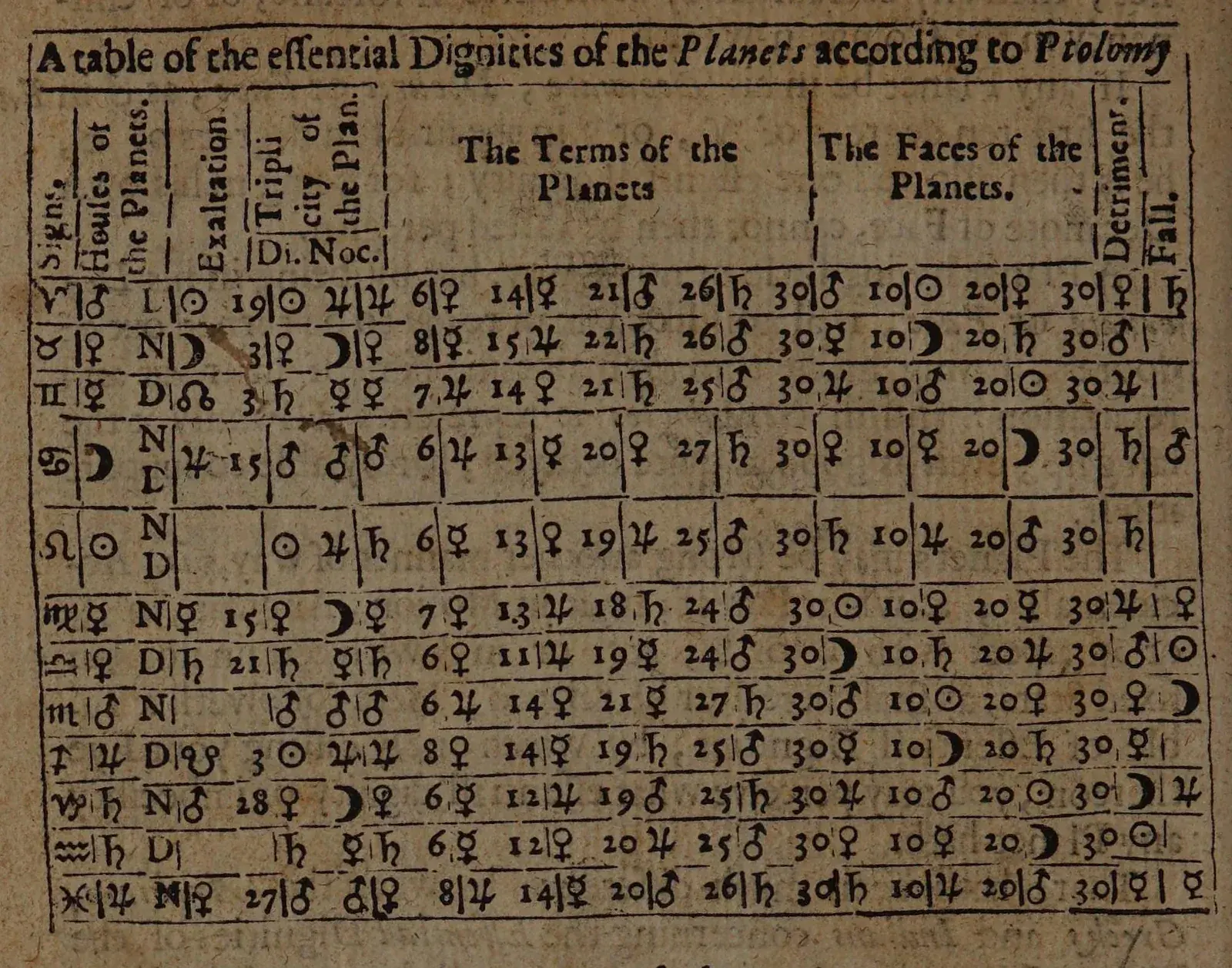
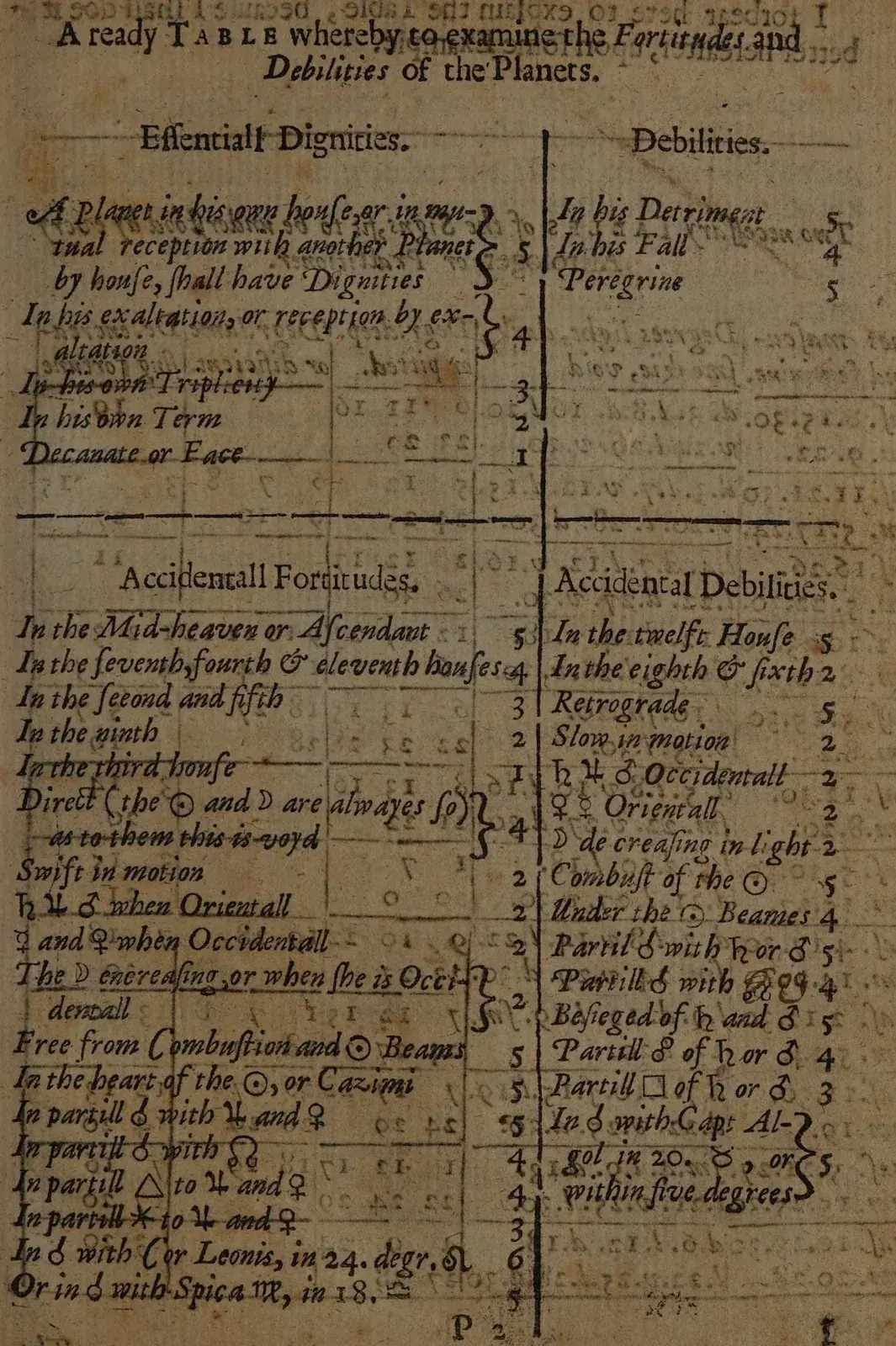
Essential dignity describes how well a planet's sign equips it to work. A planet is strongest in its domicile or exaltation, weakened in detriment (opposite its domicile) or fall (opposite its exaltation), and peregrine with no dignity at all. Lilly scored domicile +5, exaltation +4, triplicity +3, term +2 and face +1; detriment −5 and fall −4.
Condition is not character
A planet’s condition describes the circumstances under which it must do its work. Venus still relates, attracts, values, and reconciles wherever you find it. Its condition tells you whether those functions have familiar tools, reliable support, public reach, or a complicated working environment.
Dignity originally concerns rank or recognized standing. In astrology, an essentially dignified planet occupies zodiacal territory that supports its established nature. Debility means reduced access to that support. Neither term describes human worth, psychological maturity, or moral character. A dignified Mars can execute conflict efficiently; efficiency alone does not make the result kind. A debilitated Venus may need unusual methods of relating and become highly skilled through practice.
The system is inherited rather than scientifically established. Its main structures appear in sources including Ptolemy’s Tetrabiblos, Book I, chapters 17–21; Dorotheus’s Carmen Astrologicum, Book I; and William Lilly’s Christian Astrology of 1647, especially the tables and definitions around pages 104–115 in the original pagination. These texts do not always agree. A responsible reading names the version being used, compares it with charts, and records misses as carefully as apparent hits.
Essential and accidental condition
Essential dignity comes from zodiacal position: the sign and, for the lesser dignities, the exact degree. You can feel it as access to appropriate equipment. The planet knows this workshop.
Accidental dignity comes from circumstance: house placement, visibility, speed, direction, sect, and aspects. You can feel it as opportunity and reach. The planet may have excellent tools but little room to use them, or poor tools and a microphone.
This distinction prevents a common collapse. Dignity is not the same as strength. A planet in domicile but cadent and hidden under the Sun may work competently in the background. A planet in detriment on an angle can become one of the loudest facts in the chart.
The major dignities and debilities
The classical scheme uses the Sun, Moon, and five visible planets:
| Planet | Domicile | Detriment | Exaltation | Fall |
|---|---|---|---|---|
| Sun | Leo | Aquarius | Aries | Libra |
| Moon | Cancer | Capricorn | Taurus | Scorpio |
| Mercury | Gemini, Virgo | Sagittarius, Pisces | Virgo | Pisces |
| Venus | Taurus, Libra | Scorpio, Aries | Pisces | Virgo |
| Mars | Aries, Scorpio | Libra, Taurus | Capricorn | Cancer |
| Jupiter | Sagittarius, Pisces | Gemini, Virgo | Cancer | Capricorn |
| Saturn | Capricorn, Aquarius | Cancer, Leo | Libra | Aries |
Domicile and detriment
Domicile, also called rulership, means that a planet occupies one of its own signs. It sets the terms and has direct access to its usual methods. Mercury in Gemini can compare, name, connect, and revise without first translating itself into another planet’s priorities. Saturn in Aquarius can define structures through principle, distance, and systems thinking.
Domicile does not promise ease. Saturn in Aquarius may construct a coherent system that leaves little room for individual warmth. Mercury in Virgo can analyze so efficiently that attention gets caught on correction. The planet is capable and self-directed; what it does with that capacity depends on the rest of the chart and the choices available to the person.
Detriment, traditionally called exile, occurs in the sign opposite a planet’s domicile. The planet must operate through methods contrary to its default style. Mars in Libra cannot simply push forward; action must account for proportion, response, and negotiation. Venus in Aries relates through candor, immediacy, and declared desire rather than gradual accommodation.
That can feel awkward, but awkward is not absent. Mars in Libra may become a precise advocate because it learns when force will lose the room. Venus in Aries may offer rare honesty about attraction and refusal. Debility describes friction in the mechanism, not failure of the person.
Exaltation and fall
Exaltation gives a planet honored, specialized standing. The planet is treated like a guest entrusted with an important office. Mars in Capricorn directs force through planning, sequence, and measurable effort. Saturn in Libra gives limits a social or ethical frame. Venus in Pisces lets connection move through imagination and permeability.
An exalted planet can overperform its role. Mars in Capricorn may value control more than responsiveness. Venus in Pisces may idealize what compassion should repair. Exaltation raises the platform; it does not regulate every use of the platform.
Fall occurs opposite the exaltation sign. The planet’s honored style is unavailable, so its function meets conditions it cannot manage by prestige alone. Saturn in Aries must make boundaries amid urgency. The Moon in Scorpio processes need through intensity, privacy, and exposure to what others avoid. Such placements can develop depth, but depth should not be romanticized as compensation owed for difficulty.
Exaltation applies throughout the sign. The Sun at 2° Aries is exalted even though the traditional exaltation degree is 19° Aries. Exact exaltation degrees matter in some older techniques, but they are not entry requirements.
The outer planets are absent from this table because the table predates their discovery. Modern assignments such as Uranus with Aquarius, Neptune with Pisces, and Pluto with Scorpio are later conventions. You may use them as co-rulers if that produces clear readings, but switching between modern rulership and classical dignity scores without notice makes the logic impossible to audit.
Triplicity, bounds, and face
The lesser dignities depend on element, sect, and degree. They provide narrower forms of support than domicile or exaltation.
Triplicity dignity means support from the element of the sign. Sect is the chart’s day or night orientation: the Sun above the horizon creates a day chart; below it, a night chart. In the Dorothean arrangement, each element has a day ruler, night ruler, and participating ruler. In that order they are: fire, Sun–Jupiter–Saturn; earth, Venus–Moon–Mars; air, Saturn–Mercury–Jupiter; water, Venus–Mars–Moon. The participating ruler has a secondary share in both sects.
Triplicity feels like belonging to a competent team. The planet may not own the building, but it speaks the working language. Different authors modify the rulers or the weight given to the participating planet, so state your table rather than treating it as natural law.
Bounds, also called terms, divide each sign into five unequal sections governed by Mercury, Venus, Mars, Jupiter, or Saturn. The bound ruler acts like a local manager: it sets practical limits on how a planet can operate at that degree. Egyptian and Ptolemaic bounds differ, sometimes enough to change a judgment. Software settings matter here.
Face, also called decan, divides every sign into three ten-degree sections. This is the smallest traditional essential dignity. A planet in its own face has modest standing: enough familiarity to maintain a recognizable style, not enough to command the whole situation.
For example, Jupiter at 16° Libra has neither domicile nor exaltation there. In the Dorothean scheme, however, Jupiter participates in air triplicity. Under the Egyptian bounds, 14°–21° Libra belongs to Jupiter as well. The exact degree reveals resources that the sign alone would miss.
A peregrine planet has no essential dignity at its exact degree. It is a traveler without formal standing, dependent on hosts and circumstances. Peregrine is not a synonym for detriment. A planet in detriment may still hold triplicity, bound, or face dignity; a planet with no major debility may still be peregrine.
Dispositors and reception
A planet’s dispositor is the ruler of the sign it occupies. The dispositor is the host whose condition tells you what support is available. Venus in Aries answers to Mars. If Mars is coherent and well placed, Venus has somewhere to send its direct desires. If Mars is scattered or constrained, Venus may receive inconsistent backing.
Reception occurs when one planet occupies dignity belonging to another, giving the host a reason to recognize it. Reception by domicile or exaltation is usually treated as stronger than reception by triplicity, bound, or face. Many contemporary astrologers use the word whenever this hosting relationship exists. Medieval practice often expects an aspect as well: recognition becomes useful when the planets can actually make contact.
Mutual reception means that two planets host one another. Venus in Capricorn and Saturn in Taurus form mutual reception by domicile. They exchange keys. This can create cooperation between affection and commitment, pleasure and restraint, but it does not erase retrogradation, difficult houses, severe aspects, or other conditions. Reception provides a route; it does not guarantee what travels along it.
Condition beyond the sign
After essential dignity, examine whether the planet can act.
- House position: Angular houses—first, fourth, seventh, and tenth—give immediacy and visibility. Succedent houses sustain. Cadent houses disperse, prepare, or work indirectly. Apply these meanings through the house framework you are using rather than mixing systems halfway through a judgment.
- Direction and speed: A direct planet tends to express its function in expected sequence. A retrograde planet revises, returns, or redirects it. A station concentrates the function because the planet is barely moving. None of these conditions tells you whether the outcome is desirable.
- Solar visibility: Under the beams means that sunlight obscures a planet; combustion is a closer condition in which the planet has difficulty acting independently from the Sun’s agenda. Lilly used about 17° for the beams and 8°30′ for combustion. Cazimi, the heart of the Sun, was within 17 arcminutes for Lilly and is often treated as fortified. Earlier authors used different limits, sometimes close to one degree. Name the rule you follow.
- Sect: The Sun, Jupiter, and Saturn belong to the day team; the Moon, Venus, and Mars to the night team. Mercury is adaptable and requires closer judgment of its solar relationship. A planet in sect tends to express its nature with greater environmental support. A planet contrary to sect can feel less moderated, especially Mars or Saturn.
- Aspects: Supportive aspects can give a debilitated planet channels for cooperation. Hard aspects can press a dignified planet into relentless activity. Orb, application, reception, and the condition of the aspecting planet all matter.
Strength is volume; dignity is fit. They often cooperate, but they are not interchangeable.
Worked mini-example
Use a day chart with 2° Cancer rising and whole-sign houses. The Sun is at 12° Taurus in the eleventh house. Venus is direct at 21°18′ Aries in the tenth, moving about 1°12′ per day. Mars is direct at 24°02′ Capricorn in the seventh, moving about 0°32′ per day. Saturn is at 15°40′ Aquarius in the eighth.
Venus is in detriment in Aries. Relating must use a Mars-led style: direct initiative, visible desire, sharp decisions. Yet Venus occupies its own face, 20°–30° Aries. That is a small but real resource. It can preserve a Venusian concern for attraction and proportion even while speaking in a blunt dialect. The angular tenth house gives this Venus reach. Whatever its awkwardness, it is not quiet.
Mars is exalted in Capricorn and angular in the seventh. It can organize effort, defend a position, and act through strategy. Capricorn’s ruler, Saturn, is in its own domicile in Aquarius and belongs to the day sect. The dispositor chain therefore gives Mars substantial structural backing, though Saturn’s eighth-house placement may keep some support indirect or tied to obligations shared with others.
Venus and Mars form a square. The distance from exactness is 2°44′: Mars at 24°02′ Capricorn is exactly squared by 24°02′ Aries, while Venus is at 21°18′ Aries. Because Venus moves faster than Mars, the square is applying. At the listed average speeds, the relative motion is about 40 arcminutes per day, so exactness would occur in roughly four days of zodiacal motion. That calculation establishes application; it does not predict a literal event four days after birth.
Mars receives Venus because Venus occupies Aries, a Mars domicile, and the applying square supplies contact. The reception helps Venus’s demand reach a capable host. Still, the route is a square, and both Venus and Mars are night planets in a day chart. Mars in particular may express with a harder edge when contrary to sect.
A careful reading might say: public relating and evaluation are direct, exposed, and sometimes pressed into conflict, yet they can become effective because decisive Venusian action reaches a disciplined Mars. You might see talent for candid advocacy, contract negotiation, artistic direction, or boundary-setting. You cannot infer the quality of the person’s relationships, the presence of harm, or any specific life event from this configuration alone.
Notice what the dignity labels could not do by themselves. Venus is debilitated but angular, received, applying, and modestly dignified by face. Mars is exalted and angular, yet contrary to sect and involved in a pressing square. Neither planet fits a one-word verdict.
Common corrections
- Domicile does not mean virtuous. It means self-directed and well equipped. A planet can pursue an unhelpful aim efficiently.
- Detriment and fall do not erase talent. They describe indirect or effortful access to a planetary function. Do not turn that friction into a diagnosis or a sentence about character.
- Exaltation is not automatically stronger than angularity. A cadent exalted planet may have fine technique but limited reach. An angular planet in fall may dominate experience.
- Point totals are indexes, not verdicts. Lilly’s familiar scoring system gives numerical weight to dignities and debilities. It is useful for comparison, especially in question-based astrology, but arithmetic cannot interpret motive, context, or contradiction.
- Do not ignore the exact degree. Triplicity, bounds, face, combustion, and aspect orb can alter a sign-level judgment. Check the table rather than relying on memory.
- Do not mix rulership systems silently. If Scorpio’s Mars dispositor is used for one part of the reading and Pluto replaces Mars for another, explain why. Consistency lets you test whether the method is actually working.
- Mutual reception is not a repair spell. It creates exchange. Two strained planets may exchange strain as readily as support.
Writing a condition statement
Begin with the planet’s function. Add the sign’s method. Name essential resources or constraints, then the dispositor’s condition. Add house, motion, visibility, sect, and the closest active aspects.
A useful sentence frame is: The planet seeks X through Y; it has these tools, depends on this host, acts with this amount of reach, and meets these other planets. Keep each clause tied to an observable chart factor.
Dignity describes the tools on the bench, not the worth of the hands.
Practice
Choose one chart and make a condition table for the seven classical planets. Record exact degree, house, major dignity or debility, triplicity, bound, face, dispositor, sect, direction, solar visibility, and closest applying aspect.
Select one dignified planet and one debilitated planet. For each, write a four-sentence interpretation without using good, bad, strong, or weak. Include one actual aspect orb. Then answer:
- Which planet has better tools?
- Which has greater reach?
- What does each dispositor provide?
- Did a lesser dignity or reception change your first judgment?
Key terms
planetary condition · essential dignity · accidental dignity · domicile · detriment · exaltation · fall · triplicity · bounds · face · peregrine · dispositor · reception · mutual reception · sect · combustion · cazimi
Check your reading
Three questions from this chapter’s worked example and its common mistakes. Two of three marks the chapter complete.
Venus in Aries is in which essential condition?
Is an exalted planet automatically stronger than an angular one?
What does mutual reception do?