Part 7: Moon, Nodes & Condition · Chapter 23 of 36 · 10 min
Chiron and the minor bodies: what to include and why
A minor body is a convenient astrological umbrella, not one official astronomical class.
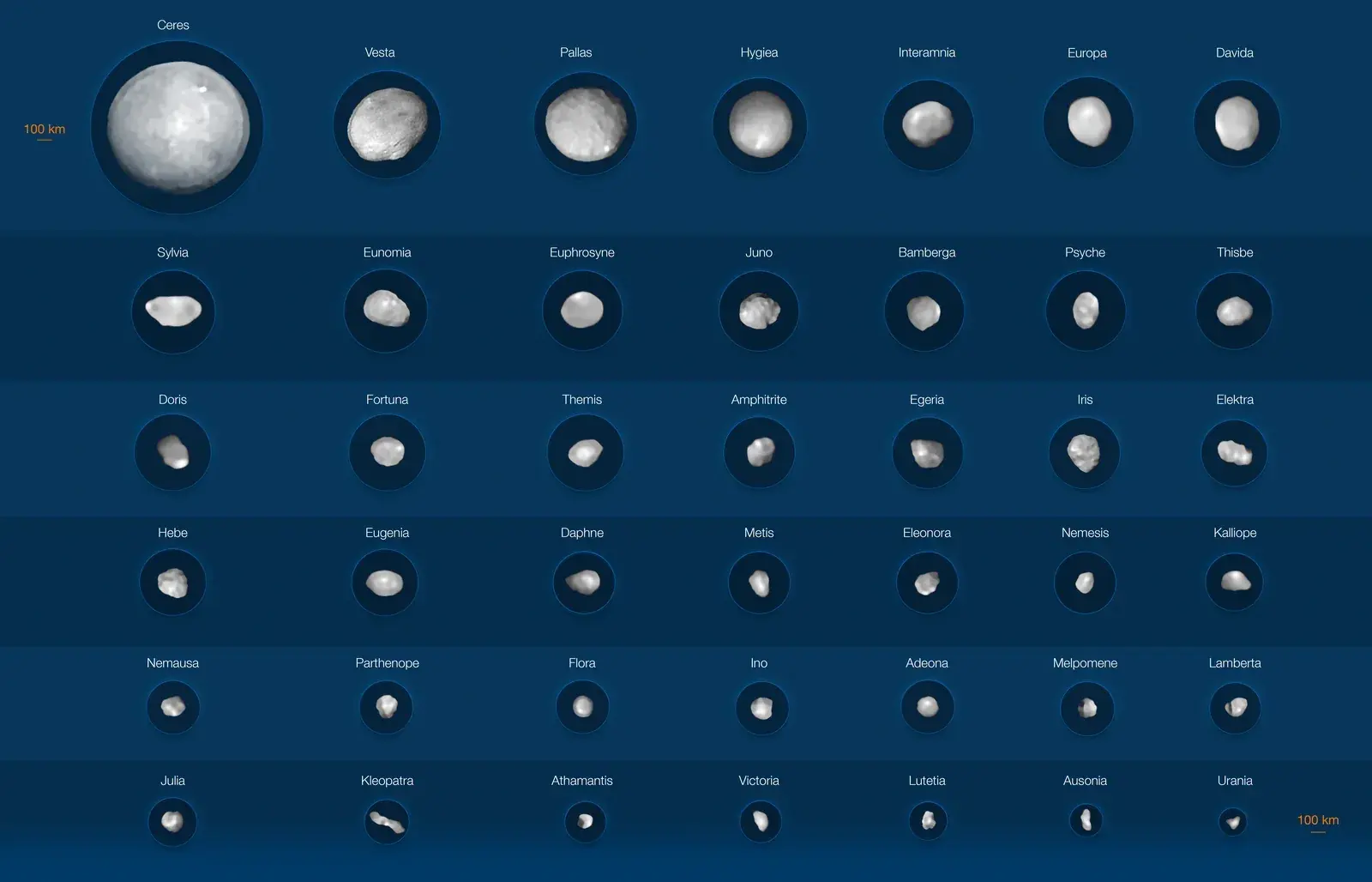
Small bodies, large temptation
A minor body is a convenient astrological umbrella, not one official astronomical class. It can refer to an asteroid, a centaur, a distant object beyond Neptune, a dwarf planet other than Pluto, or an object that also behaves like a comet. These categories describe orbit, composition, and observed behavior. They do not tell you how much astrological weight an object deserves.
That distinction matters. Small does not mean subtle, and large does not mean important. Astronomical size is a fact; symbolic importance is an interpretive claim.
Modern catalogs make overinclusion easy. The Minor Planet Center maintains orbits for well over a million small bodies, with many thousands carrying names. If you use 20 objects, there are 190 possible pairs among them. With 50 objects, there are 1,225. This is the multiple-comparisons problem: the more symbols you test, the more striking-looking matches ordinary chance supplies. A crowded chart can feel precise while becoming less accountable.
There is no widely accepted body of replicated controlled research showing that natal minor-body contacts reliably outperform chance. Most astrological claims here come from mythic analogy, case reports, and accumulated practitioner experience. Those sources can generate useful questions. They do not establish causation.
Why Chiron receives special treatment
Chiron was discovered by Charles Kowal in 1977 and designated 2060 Chiron. Astronomers classify it as a centaur, meaning a small object moving among the giant planets, where repeated gravitational pulls make its orbit unstable over long spans. It travels through the zone between Saturn and Uranus in about 50.7 years. Chiron has also shown cometary activity and carries the designation 95P/Chiron. These facts are available through the Minor Planet Center and JPL Small-Body Database.
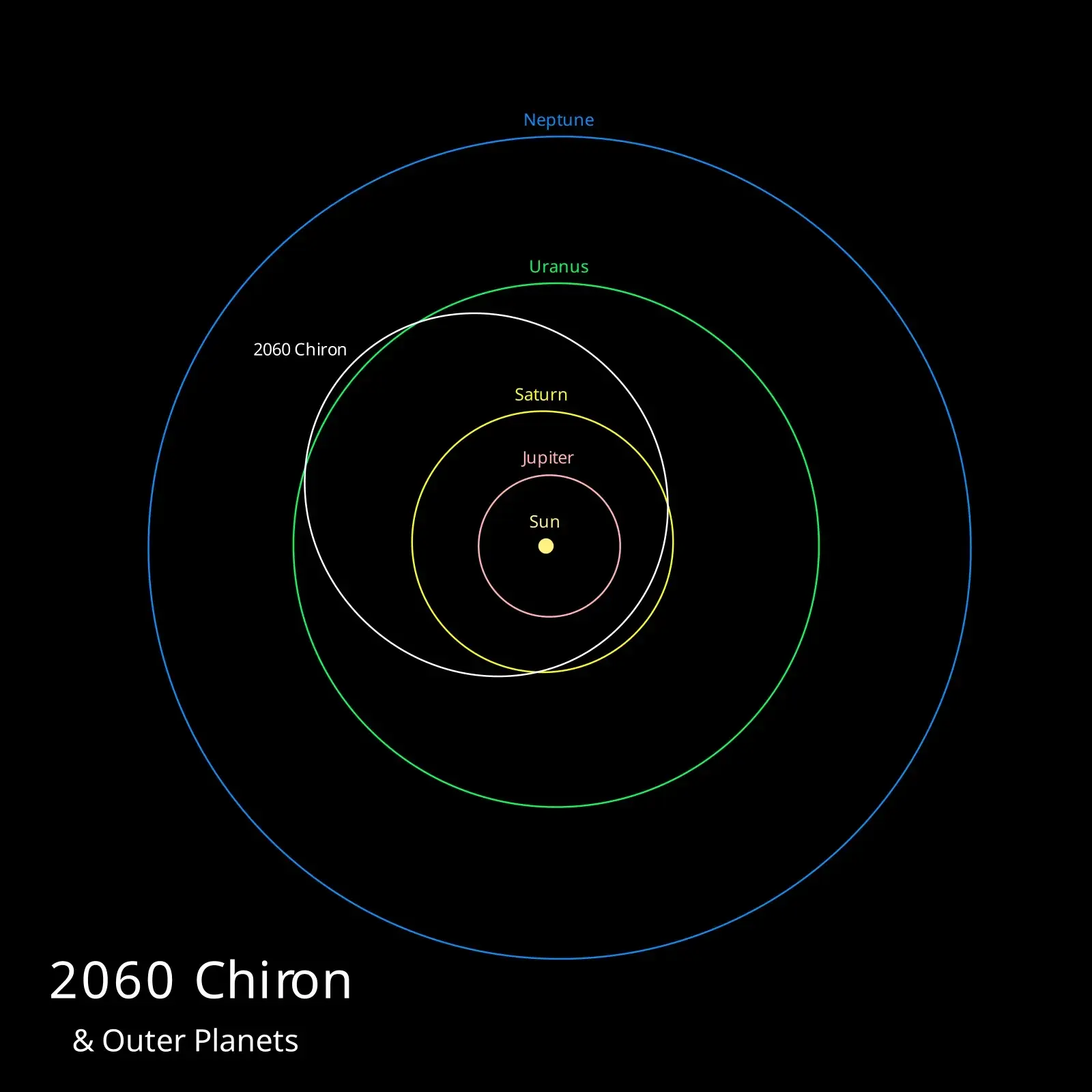
Its mixed status has encouraged astrologers to call it a bridge between categories. That is evocative, not proof. Astronomy gives you the object. Astrology supplies the metaphor.
The Greek Chiron was an unusual centaur: teacher, healer, musician, and tutor to heroes. In prominent versions of the story, he received a poisoned wound that his knowledge could not remove. Because he was immortal, the condition continued until he relinquished immortality in an exchange connected with Prometheus. Astrologers compressed this story into the phrase wounded healer.
Useful phrase, dangerous shortcut. Chiron does not identify your worst suffering, certify trauma, or promise that pain becomes wisdom. No one is required to turn hurt into service.
A more workable definition is this: Chiron marks a subject where exposure and competence may repeatedly meet. You can feel unusually tender about the matter while also developing exact knowledge of it. Skill may grow around the sensitive place without making that place disappear.
With Chiron conjunct Mercury, words, learning, or being corrected may carry extra charge. The person might become a careful editor or patient teacher because loose language costs them something. You would not infer a speech problem. A conjunction fuses the symbols; it does not dictate an event.
With Chiron square Mars, assertion may catch on a tender edge. The person might hesitate, overcompensate, or become highly precise about when and how to act. A square creates friction you can feel. It does not predict violence.
Chiron on the Midheaven can make public competence feel exposed. Some people with this contact become credible guides because they do not pretend mastery is spotless. You still need biography before saying that. An exact angle is an invitation to ask, not a license to announce.
Chiron’s sign supplies style, but its irregular, decades-long orbit means many peers share that placement. The house identifies the life department, provided the birth time is sound. Close aspects to the Sun, Moon, planets, or angles usually individualize Chiron most clearly. A sign description alone is rarely enough.
Position, identity, and orb
Use an ephemeris that identifies the object by number as well as name. Swiss Ephemeris, the Minor Planet Center, and JPL data are reasonable reference points, though very obscure bodies may not appear in every astrology program. Check the date, time standard, zodiac, and geocentric setting. A polished glyph cannot repair incorrect data.
Minor bodies call for narrower orbs because there are so many opportunities for contact. The following is a conservative working protocol, not a discovered law:
- For Chiron in conjunction, opposition, square, trine, or sextile to a planet or angle, begin with 2° or less.
- You may test up to 3° for a conjunction to the Sun, Moon, Ascendant, or Midheaven when the biography strongly supports it.
- For Ceres, Pallas, Juno, and Vesta, begin with 1°30′ or less. Allow 2° for conjunctions to an angle.
- For other minor bodies, begin with 1°. For a named asteroid chosen because of its name, use 0°30′ or less.
- Read a minor-body-to-minor-body aspect only when it completes a tight figure anchored to a planet or angle.
These limits control interpretive noise. They are intentionally stricter than many published asteroid readings. An orb is not a permission slip to speak broadly.
Retrograde motion means the body appears to move backward from Earth’s viewpoint. It does not automatically make Chiron more inward, severe, or important. A station means apparent motion has slowed almost to stillness. In transit work that can prolong contact; natally it deserves attention only with supporting chart factors.
Chiron transits often make several exact passes because of retrograde motion. Treat the whole period as an observation window rather than making one date carry the entire meaning. In relationship comparison, a Chiron contact can describe sensitivity between two functions. It does not establish who heals or harms whom.
A rule for inclusion
Include a minor body when it earns its place through several filters:
- The object is unambiguous. You have the correct astronomical body, number, and position.
- Its meaning is distinct. It adds something more specific than a planet already says.
- Its contact is exact. It closely aspects a planet or angle, rather than merely occupying an interesting sign.
- It serves the question. Juno may matter in a study of commitment; adding it to every vocational reading may not help.
- It survives subtraction. If removing the body makes no difference to the interpretation, leave it out.
- It can be challenged. You can name what evidence would make you drop or revise the reading.
Chiron is a reasonable default addition because it is precisely calculable, has a human-scale return cycle, carries decades of astrological literature, and offers a concept not neatly duplicated by another factor. None of this proves its meaning. It explains why Chiron is more practical to test than hundreds of interchangeable objects.
After Chiron, add bodies in layers. A disciplined chart may contain fewer symbols than your software offers. Restraint is not lack of imagination. It is how imagination keeps its edges.
The four familiar asteroids
The first four numbered minor planets have the longest modern interpretive history. Ceres is now astronomically classed as a dwarf planet, following the International Astronomical Union’s 2006 definition, but astrologers commonly study it alongside Pallas, Juno, and Vesta.
- 1 Ceres concerns giving and receiving sustenance, separation and return, stewardship, and the point where care can become control. Do not reduce it to motherhood. In a work chart, Ceres may describe who maintains the conditions that let others function.
- 2 Pallas concerns pattern recognition, strategic craft, mediation, and solutions that join intelligence with form. It is not female intelligence, as older texts sometimes claimed. Every chart contains it.
- 3 Juno concerns commitment, negotiated obligation, parity, status within a bond, and resentment when agreements become unequal. It does not guarantee marriage or prove infidelity.
- 4 Vesta concerns concentration, dedication, protected attention, and boundaries around what must remain inviolate. It need not mean chastity or withdrawal. A Vesta contact can show where focus becomes sustaining or consuming.
Use these meanings as hypotheses. Myth supplies structure, while lived examples supply correction. Gender stereotypes usually indicate that the interpretation has stopped thinking.
More distant and more speculative bodies
Eris, Sedna, and other distant objects move so slowly that their sign positions belong to very large cohorts. Eris can be tested around contest, exclusion, and disputes over who receives standing, especially when it tightly contacts a personal planet or angle. Its 2005 discovery also helped precipitate the debate that changed Pluto’s classification. That historical association is part of the symbolism astrologers use; it is not evidence of a psychological effect.
Other centaurs include Pholus, Nessus, and Chariklo. Astrologers have associated Pholus with a small release producing a larger chain of consequences, Nessus with poisoned cycles of betrayal, and Chariklo with contained presence and protective boundaries. These meanings remain more tentative than Chiron’s. Never use Nessus to label someone dangerous or to assign a history of harm. Myth is not testimony.
Names drawn from living cultures require particular care. Read reliable cultural scholarship rather than flattening a sacred figure into one keyword. Orbital distance, rings, discovery stories, and unusual physical traits can enrich metaphor. They are not receipts for psychological fact.
Named asteroids can produce startling coincidences, especially around an exact conjunction to an angle or personal planet. Treat these as observations, not foundations. Select the asteroid before examining the chart, record the orb you will accept, and count misses as well as hits. Searching afterward for a matching name is selection bias: you remember the arrow near the center and forget the field.
Keep unlike objects separate. 1181 Lilith is a physical asteroid. Black Moon Lilith is a calculated lunar apogee, the distant point of the Moon’s elliptical orbit, and may be listed in mean or oscillating form. They are not interchangeable merely because the labels match.
Worked mini-example: letting geometry decide
Consider a fictional timed chart, stripped to the factors needed here:
- Sun at 15°02′ Cancer in the first house
- Chiron at 14°18′ Aries in the tenth house
- Ceres at 13°51′ Capricorn in the seventh house
- Vesta at 27°09′ Libra in the fourth house
The Sun and Chiron are separated by 90°44′, producing a square with an orb of 0°44′. The Sun and Ceres are separated by 178°49′, producing an opposition with an orb of 1°11′. Chiron and Ceres have a shortest separation of 90°27′, another square, this time with an orb of 0°27′.
Ceres and the Sun form the opposition. Chiron is the apex of the resulting T-square because it squares both ends. The geometry earns attention before any story is told.
A careful first sentence might be: Questions of personal visibility and negotiated care may place unusual pressure on public competence. The first-house Sun wants direct authorship of a life. Seventh-house Ceres notices how care is exchanged and who carries maintenance. Tenth-house Chiron suggests that being seen as capable may touch a tender, highly instructed place.
You would then ask for evidence. Does public responsibility intensify concerns about needing support? Do partnerships become negotiations over who must remain composed? Has the person developed authority by speaking plainly about what they are still learning? A clear yes allows the interpretation to deepen. A clear no requires revision rather than persuasion.
Vesta is in an angular house, but it makes no qualifying close major aspect to the three points shown. Its fourth-house symbolism may sound appealing, yet it does not earn inclusion in this mini-reading. Omission is part of technique.
Notice what has not been claimed. The configuration does not prove abandonment, prescribe a vocation, or guarantee eventual mastery. It identifies a pattern worth testing against the whole chart and the person’s account.
Common mistakes, corrected
- Treating Chiron as the worst wound. A chart cannot rank suffering. Chiron describes a symbolic pattern, not a pain scale.
- Promising a gift in return. Skill may develop around sensitivity, but insight is not automatic compensation.
- Reading myth as biography. Juno does not prove betrayal. Nessus does not identify an offender. Chiron does not establish trauma.
- Using wide orbs to rescue a preferred story. If a contact needs 6° and several poetic paragraphs to become visible, it probably is not carrying the chart.
- Making the sign overly personal. Slow bodies describe cohorts by sign. Prioritize close aspects, houses, and angles.
- Dramatizing retrograde motion. Apparent backward movement is common. It carries no automatic verdict about hidden pain.
- Adding bodies before reading the planets. A minor body should refine an established structure, not replace one.
- Assuming exactness proves meaning. Exactness makes a contact worth testing. It does not certify the interpretation.
- Ignoring birth-time limits. Without a reliable time, do not claim exact angle contacts or confident house placement.
- Using only successful examples. Keep the charts where a proposed meaning fails. Failed cases teach you where the symbol’s claimed range has grown too wide.
A chart is not improved by population. It is improved by discrimination. Some symbols should remain silent.
Practice
Choose one accurately timed chart and work in layers.
- Add only Chiron. Record its exact degree, house, speed, and major aspects within 2°. Write two plain interpretive sentences and one question that could show the reading is wrong.
- Add Ceres, Pallas, Juno, and Vesta one at a time. Use a 1°30′ orb. Keep a body only if it adds a distinct idea tied to a planet or angle.
- Recalculate every accepted aspect by degree. Do not rely solely on the software’s aspect list.
- Remove one minor body. If the reading remains unchanged, leave that body out.
- For an optional research test, choose one named asteroid before opening a second chart. Set a 0°30′ conjunction orb in advance. Record both the match and the miss.
Finish by marking each statement as astronomical fact, symbolic hypothesis, or biographical confirmation.
Key terms
minor body · centaur · Chiron · wounded healer · multiple-comparisons problem · orb protocol · Ceres · Pallas · Juno · Vesta · named asteroid · selection bias · ephemeris
Check your reading
Three questions from this chapter’s worked example and its common mistakes. Two of three marks the chapter complete.
In the worked example, why does Vesta not earn a place in the mini-reading?
Can Chiron rank how badly someone has suffered?
When should a minor body be added to a reading?