Part 4: Houses & Angles · Chapter 10 of 36 · 12 min
The houses I: angles and the first six
A house is a locally calculated division of the chart.
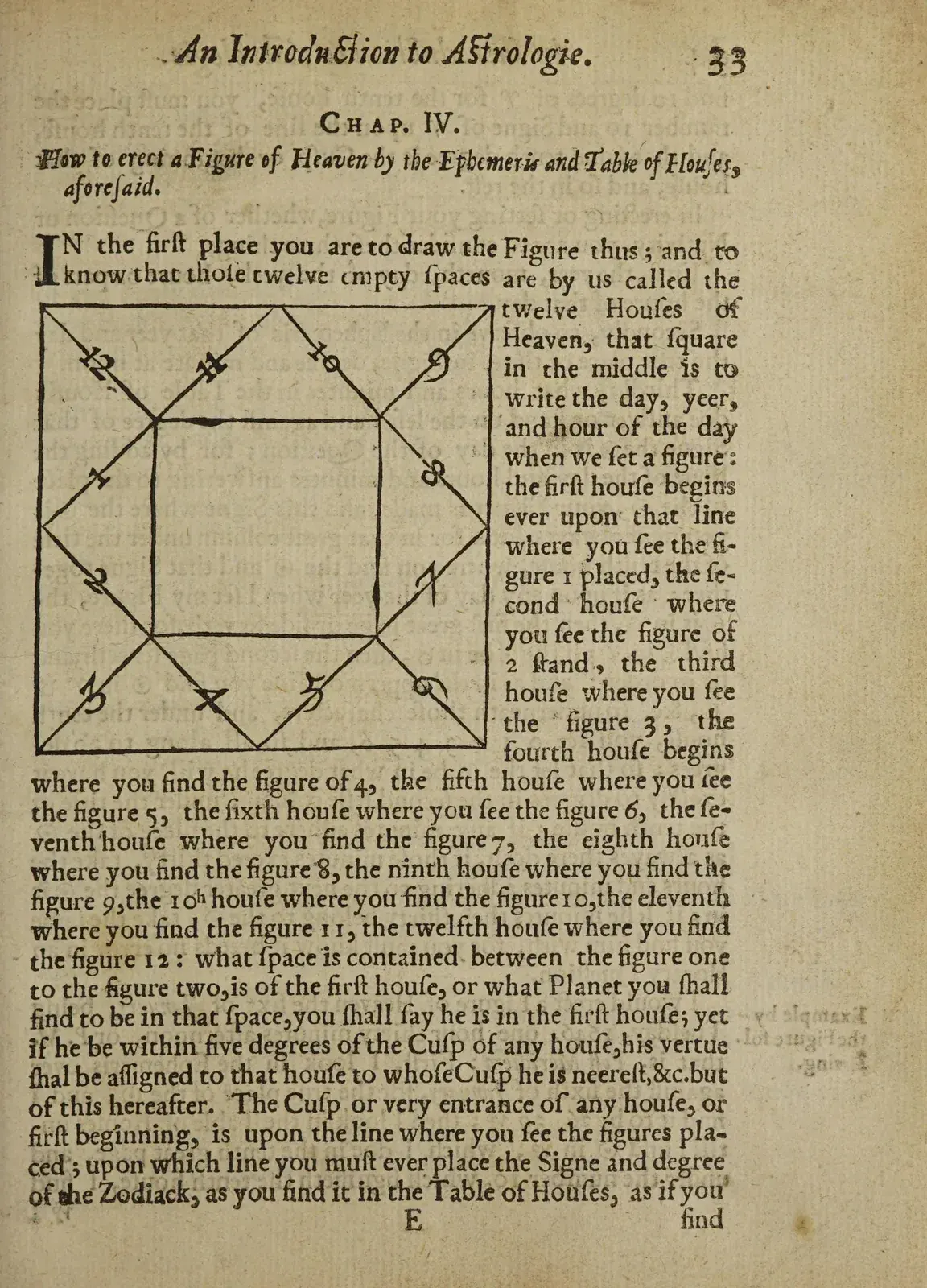
Houses are local
A house is a locally calculated division of the chart. Signs describe the zodiacal belt: the position of a planet along the ecliptic. Houses describe where that belt meets your particular horizon and meridian at a particular time and place. Change the birthplace or birth time, and houses can change even when the planets remain in the same signs.
That is the receipt behind the distinction. A planet at 12° Scorpio is at 12° Scorpio for everyone born in the same short window. Whether it falls in the fifth house, sixth house, or another house depends on local sky geometry. Houses are not extra signs pasted onto the chart. They are a second coordinate system.
A house gives a planet a field of life in which to operate. It does not issue a sentence. The traditional topics of the houses are accumulated interpretive conventions, shaped by long use and argument. No controlled body of evidence establishes that house positions cause biography. What houses can offer is a disciplined way to ask where a planetary pattern may become noticeable, repeated, contested, private, or public.
Each house begins at a cusp, its leading edge. If a planet falls between the cusp of one house and the cusp of the next, it belongs to that house in the system you are using. The cusp is a boundary, not a planet and not a magical switch. Still, a planet close to a cusp deserves a closer look because it stands near a change of setting.
The four angles
The angles are the chart's four structural hinges. They come directly from the local horizon and meridian.
- The Ascendant, or rising point, is the zodiacal degree rising on the eastern horizon.
- The Descendant is the degree setting in the west, exactly opposite the Ascendant.
- The Midheaven, often written MC, is the degree crossing the local meridian at its highest point in the chart's daily arc. It is not simply the point directly overhead.
- The IC is opposite the Midheaven, below the visible side of the chart's public axis.
The Ascendant marks the first-house angle. The IC marks the fourth-house angle. The Descendant marks the seventh, and the MC marks the tenth. These four points are called angular because they establish the chart's orientation. A planet close to one often has more immediate expression: it is easier to notice in how you arrive, settle, meet others, or take up visible roles.
Immediate does not mean better. A quiet planet in the twelfth may matter as much as a planet on the Ascendant; it simply works under different conditions. Angular planets tend to meet the world at the front door. Other placements may work through habit, craft, reflection, proximity, or accumulated consequence. Visibility is not depth.
The old house categories describe this rhythm. The angular houses, first, fourth, seventh, and tenth, initiate and establish. The succedent houses, second, fifth, eighth, and eleventh, preserve, develop, and make something last. The cadent houses, third, sixth, ninth, and twelfth, carry information, adjustment, movement, and transition. A cadent planet is not weak. It may be busy, adaptive, and hard to reduce to one fixed role.
An orb is the degree range within which an aspect or contact is treated as active. For angles, an ordinary working orb might be about 5°, with tighter contacts carrying more interpretive weight. A planet 0°30′ from the Ascendant is much closer than one 4°40′ away. This is not a force field. It is a practical rule for ranking what deserves attention first.
House systems: choose before you interpret
There is no single house system accepted by every astrologer, and no decisive experiment that establishes one as uniquely correct. The major systems are different ways of dividing the same local sky. Their disagreements are most noticeable with planets near cusps, at higher latitudes, or in charts with unequal houses.
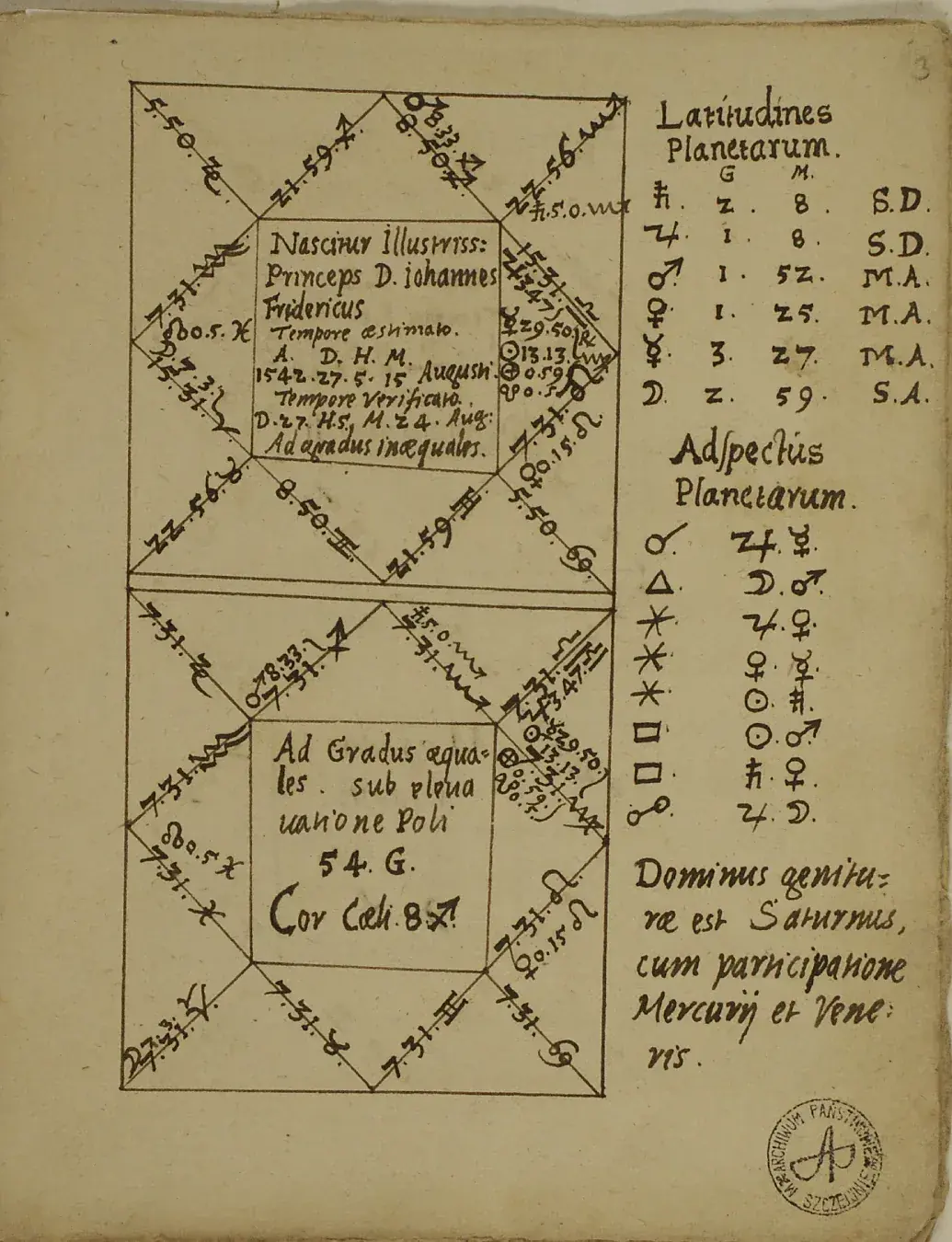
In whole-sign houses, the entire sign containing the Ascendant becomes the first house, the next sign becomes the second, and so on. The Ascendant remains an exact degree inside the first house. In this method, the MC may fall in the ninth, tenth, or eleventh house while remaining an angle.
In equal houses, the first-house cusp is the Ascendant degree, and each following cusp is exactly 30° later. If the Ascendant is 14° Cancer, the second-house cusp is 14° Leo, the third is 14° Virgo, and so forth.
In quadrant systems, including Placidus, the angles establish the first, fourth, seventh, and tenth house cusps. The arcs between them are then divided. This can produce houses of very different sizes. At far northern or southern latitudes, some quadrant calculations become difficult or unavailable.
Use one declared system for a reading. Do not move between systems merely to make a preferred interpretation fit. If you are comparing systems, name the comparison plainly: this planet is fifth house in one method and sixth in another. Agreement across systems may strengthen a line of inquiry. Disagreement may tell you that the chart is sensitive at that boundary.
The grammar of a house placement
A useful working grammar is simple: the planet is the function, the sign is its manner, and the house is the setting. Mercury in Virgo in the third house is not the same statement as Mercury in Virgo in the tenth. The sign remains Virgo in both cases; the setting changes from nearby exchange, learning, and daily movement to public direction and responsibility.
The sign on a house cusp describes the style of entry into that house's concerns. The planet ruling that sign is the house ruler. It links the house to the ruler's own sign, house, and aspects.
Suppose the second-house cusp is in Leo. The Sun rules Leo, so the Sun becomes a key connector for second-house matters. If that Sun is in the first house, questions of resources, standards, and personal self-definition may be tied together. This is not proof of a life story. It is a specific pattern to test against lived experience.
Do not interpret a house from its cusp sign alone. Look at the cusp, its ruler, planets inside the house, close contacts to its angles, and major aspects. A chart is a set of relationships, not a list of isolated labels.
The first house: how you meet the moment
The first house concerns immediate orientation: bodily presence, manner of approach, first impressions, and the way you enter experience. It is the chart's near surface, but not a shallow one. It shows how a person tends to meet conditions before they have had time to edit themselves for an audience.
The Ascendant is the first-house cusp in quadrant and equal systems. Its sign is often called the rising sign. The ruler of that sign is especially important because it acts as a routing point for the chart's overall approach.
A first-house planet may be conspicuous in bearing, style, initiative, or self-presentation. It does not mean someone is self-absorbed. A person may be reserved, generous, or highly responsive to others and still carry strong first-house emphasis. The house speaks to contact with life, not moral character.
The second house: what you sustain and value
The second house concerns personal resources, possessions, capacities, material support, and the standards by which you decide what is worth maintaining. It also has to do with the practical question of what is yours to cultivate, protect, use, or exchange.
This house is often flattened into one narrow topic. That loses its range. A second-house emphasis can show up in skills, tools, attachments, tastes, self-reliance, or the tension between enough and not enough. It is not a verdict on abundance, personal worth, or character.
Look closely at the second-house ruler. If it is in the third house, resources may be bound up with local networks, learning, communication, or routine movement. If it is in the sixth, repeated work and upkeep may become central. The ruler tells you where the house's concerns travel.
The third house: the nearby world
The third house concerns the world within reach: messages, language, basic learning, siblings and peers where those relationships exist, local routes, errands, devices, and everyday exchange. It describes how information moves through ordinary life.
A third-house planet can make communication a major site of action. That may mean speaking, writing, listening, translating, arguing, studying, coordinating, or simply having a mind that stays alert to what is close at hand. It does not score intelligence. It does not guarantee a particular sibling story. The literal topic is only one possible expression.
The third house asks how you make contact with what is near. Small exchanges can shape a life. Most days are made of them.
The fourth house: the base beneath the role
The fourth house concerns home, private conditions, family patterning, ancestry, memory, roots, and the place from which you recover your footing. Its angle is the IC, the lowest point of the chart's vertical axis. If the MC describes a visible direction, the IC describes what holds the weight beneath it.
This house can refer to a physical home, but it is wider than an address. It includes inherited atmosphere, domestic rhythms, belonging, privacy, and the stories that formed your sense of where you come from. It can also show what you need in order to feel settled enough to function.
Do not assign one parent automatically to the fourth house and the other to the tenth. Families are more varied than that formula allows. Read both houses as different dimensions of care, authority, origin, and public expectation, then compare the symbolism with the person's actual history.
The fifth house: making, playing, showing
The fifth house concerns creative output, pleasure, performance, courtship, play, desire, and the act of bringing something personal into view. It includes children and mentoring relationships in some charts, but it cannot count children or establish a future family structure.
A fifth-house placement often asks: what do you make because it is yours to make? What kind of attention feels enlivening? Where do you risk being seen? The answer may involve art, humor, teaching, romance, games, leadership, or a private creative practice that never becomes public.
Pleasure is not trivial here. It is information about what restores animation. Yet the fifth house is not a command to perform constantly. Sometimes its work is learning to enjoy an unfinished draft, a shared joke, or an hour with no productive purpose.
The sixth house: the work of repetition
The sixth house concerns daily work, service, skill-building, schedules, upkeep, coworkers, tools, obligations, and the tasks that keep life functioning. It can include dependent animals and practical care arrangements. It also has traditional links with bodily maintenance, but no sixth-house placement can establish a bodily condition.
This is not the whole of vocation. The tenth house addresses public direction and visible responsibility; the sixth describes what you do repeatedly, often without applause. A sixth-house emphasis may show a strong relationship to systems, methods, troubleshooting, routines, or the need to make work more workable.
The sixth house can be exacting. It often asks where a process needs adjustment, where a craft needs practice, and where service has become unevenly distributed. Its best questions are concrete: what is repeated, who depends on it, and what does it cost to keep doing it this way?
Worked mini-example: reading boundaries without forcing them
Use this hypothetical chart in Placidus houses. The relevant cusps are:
- Ascendant and first-house cusp: 14°22′ Cancer
- Second-house cusp: 8°00′ Leo
- Third-house cusp: 4°18′ Virgo
- IC and fourth-house cusp: 2°10′ Libra
- Fifth-house cusp: 5°44′ Scorpio
- Sixth-house cusp: 10°36′ Sagittarius
Now place these planets:
- Sun: 16°00′ Cancer
- Mercury: 7°50′ Leo
- Moon: 3°12′ Virgo
- Mars: 28°40′ Virgo
- Venus: 2°10′ Libra
- Jupiter: 12°00′ Scorpio
- Saturn: 11°02′ Sagittarius
The Sun is in the first house. It is 1°38′ from the Ascendant, comfortably within a 5° angular orb and close enough to deserve priority. A reading would treat solar themes of intention, attention, and self-expression as strongly tied to first-house presence. That does not mean the person must be conspicuous. It means the Sun's condition is central to how they meet situations.
Mercury at 7°50′ Leo is also formally in the first house. It is only 0°10′ before the second-house cusp at 8°00′ Leo. Do not silently move it into the second house. The boundary says first house. Its closeness to the second cusp gives it a secondary relation to second-house concerns, especially in interpretation and timing work later on.
The Moon at 3°12′ Virgo is in the second house, because it falls after 8°00′ Leo and before 4°18′ Virgo. It is 1°06′ before the third-house cusp. Again: second house by placement, with a clear proximity to third-house terrain. A useful reading might ask whether habits of security and support are closely tied to learning, communication, or daily exchange. It would not turn that question into a certainty.
Mars at 28°40′ Virgo belongs to the third house. Venus at 2°10′ Libra sits exactly on the IC, a 0°00′ conjunction to an angle, and therefore carries exceptional fourth-house and angular weight. Jupiter at 12°00′ Scorpio belongs to the fifth house. Saturn at 11°02′ Sagittarius is in the sixth house, only 0°26′ after its cusp. It is not fifth house simply because it stands close to the line.
The second-house cusp is Leo, ruled by the Sun. That Sun is in the first house and close to the Ascendant. This creates a readable chain: second-house questions about resources and values are routed through first-house self-definition and presence. Mercury, nearly on the second cusp, adds another thread involving naming, negotiating, sorting, or exchanging. The chart gives you a structure for inquiry. The person's account supplies the lived detail.
Notice the distinction between an orb and a house boundary. The Sun's 1°38′ distance from the Ascendant is an angular conjunction measured by orb. Mercury's 0°10′ distance from the second cusp does not change its house assignment. Both facts matter, but they answer different questions.
Common mistakes and corrections
- Treating signs and houses as interchangeable. A Scorpio planet is not automatically eighth-house-like. Scorpio describes style; the house tells you where the planet is operating.
- Using a hidden next-house rule. Some astrologers read a planet within a few degrees of a cusp as influencing the next house. You may use that as a nuance, but state the formal placement first. Do not erase the actual boundary.
- Assuming the MC must be in the tenth house in every system. In whole-sign houses, the MC can fall in the ninth or eleventh. It remains an angle. A planet can be ninth house by system and closely conjunct the MC at the same time.
- Switching systems to obtain a preferred answer. If a planet changes houses across systems, let that ambiguity remain visible. Precision includes admitting where the map has more than one plausible division.
- Giving every planet equal volume. Planets on angles, rulers of angles, tight aspect patterns, and planets close to cusps often deserve attention before a lightly connected placement in an otherwise quiet house.
- Making literal claims from family or children houses. The fourth and fifth houses hold important topics, but they do not replace a person's actual history, relationships, or choices.
- Reading the sixth house as a bodily verdict. It is better read as a house of maintenance, repeated labor, systems, and practical strain or adjustment. A chart cannot establish a condition.
- Forgetting birth-time uncertainty. A recorded time rounded to the nearest hour can move cusps substantially. When the time is uncertain, say so. A clean-looking chart is not the same as a precise one.
- Stopping at the house label. A house is a setting. The planet's sign, its aspects, the cusp ruler, and its closeness to an angle tell you what is actually happening in that setting.
Practice
- Take one chart with a recorded birth time and write down the Ascendant, IC, and the cusps of houses two through six.
- Place every planet from the first six houses into its formal house. Do not interpret yet.
- Mark any planet within 2° of an angle or cusp. Calculate the exact distance in degrees and minutes. Label whether it is an angular contact or merely close to a house boundary.
- For each of the first six houses, write one question rather than one conclusion. For example: What repeated task asks for more skill? What part of daily life feels most private?
- Identify the ruler of each cusp and note its house. Follow the connections before writing a paragraph about any one placement.
Key terms
house · cusp · angle · Ascendant · Descendant · Midheaven · IC · angular house · succedent house · cadent house · house system · house ruler · orb
Check your reading
Three questions from this chapter’s worked example and its common mistakes. Two of three marks the chapter complete.
Mercury at 7°50′ Leo sits 10′ before an 8°00′ Leo second-house cusp. Which house is it in?
Can the MC fall outside the tenth house?
How should the sixth house be read?