Part 8: Timing · Chapter 28 of 36 · 10 min
Timing II: profections and time-lords
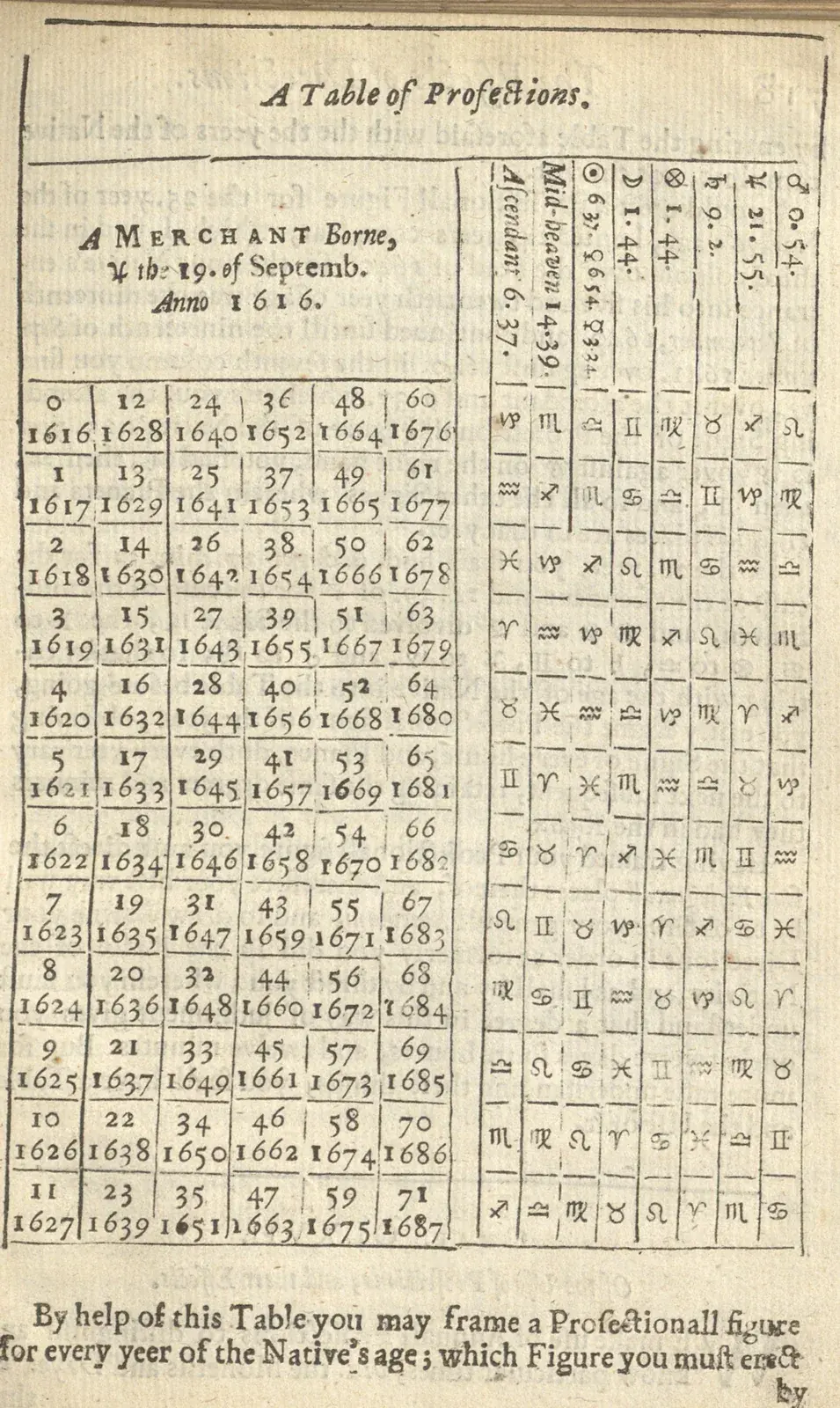
An annual profection advances the Ascendant one whole sign for each completed year of life.
What actually moves
An annual profection advances the Ascendant one whole sign for each completed year of life. The technique gives each year a house, a sign, and a planetary ruler. That ruler becomes the Lord of the Year: the planet temporarily asked to carry more of the chart’s story.
Nothing physical is moving through the zodiac. A profection is a symbolic clock, not a transit. At birth, the first house is active. At the first birthday, the second becomes active. At the second birthday, the third. After twelve years, the sequence begins again.
The method has a substantial textual history. Annual profections and planetary time-lords appear in Vettius Valens’s Anthology, Book IV, in Paulus Alexandrinus’s Introductory Matters, and in later annual techniques such as Abu Ma’shar’s On the Revolutions of the Years of Nativities. Those authors did not preserve one perfectly uniform procedure. Some profected multiple points; some combined profections with solar returns and other distributions. The whole-sign Ascendant profection taught here is the clearest common foundation.
Historical continuity establishes provenance. It does not establish predictive accuracy.
Counting the year correctly
Use completed age, beginning at the birthday:
- Age 0 activates the first house.
- Age 1 activates the second.
- Age 11 activates the twelfth.
- Age 12 returns to the first.
- Age 24 returns to the first again.
- Age 30 activates the seventh.
- Age 31 activates the eighth.
- Age 35 activates the twelfth.
- Age 36 returns to the first.
The compact formula is:
Profected house = age modulo 12, plus 1.
At age 31, divide 31 by 12. The remainder is 7; add 1, and you have the eighth house. The eighth-house year begins on the thirty-first birthday and lasts until the thirty-second.
Use whole-sign houses. If Taurus rises, Taurus is the first sign, Gemini the second, Cancer the third, and so on. A quadrant cusp running through a sign does not change the annual profection. Interceptions do not enter this calculation.
The year begins at the solar return near the birthday, not on January 1. Ordinary phrases such as your thirty-first year can be ambiguous, so write the actual age and birthday span: age 31, from the thirty-first birthday to the thirty-second.
The time-lord
A time-lord is a planet given temporary authority by a timing method. The phrase is generic. Different methods can assign different time-lords at the same moment. In annual profections, the Lord of the Year is the domicile ruler of the profected sign.
Use the seven traditional rulers for the historical method:
- Mars rules Aries and Scorpio.
- Venus rules Taurus and Libra.
- Mercury rules Gemini and Virgo.
- The Moon rules Cancer.
- The Sun rules Leo.
- Jupiter rules Sagittarius and Pisces.
- Saturn rules Capricorn and Aquarius.
Outer planets may still matter through natal placement, solar returns, and transits. They do not become Lords of the Year in this version. If you test a modern co-ruler, label that as a separate experiment rather than changing systems whenever a preferred planet looks more compelling.
A time-lord is an emphasis, not a monarch. It does not govern every event, erase the rest of the chart, or promise that all its house topics will become literal. Read the year in this order:
- The profected house names the agenda. A fourth-house year may emphasize home, family, land, privacy, ancestry, or foundations. It need not produce every one of them.
- The Lord of the Year shows how the agenda is carried. Its natal sign describes its working style. Its natal house shows where the work tends to gather.
- The houses ruled by the Lord connect additional topics. If Mercury rules the profected sign and also rules another natal house, that second house may become part of the year’s linkage.
- Natal planets in the profected sign become more noticeable. They participate in the year, but they do not replace the sign ruler.
Then examine the time-lord’s natal condition. Dignity asks whether the planet can act in its own idiom or must work through unfamiliar tools. Sect describes how well the day or night environment suits its style. Angularity describes whether its concerns tend to arrive directly and visibly or through less obvious channels. Retrogradation often makes action iterative: revision, return, renegotiation. Visibility describes whether the planet can operate openly. Reception shows whether another planet has standing to host or assist it.
None of these factors is a verdict. A planet in difficult condition may describe demanding, skilled, slow, private, or highly specific work. A well-supported planet can bring opportunity along with excess. Jupiter may offer more than you can carry. Saturn may make a boundary useful.
Worked mini-example
Take an illustrative chart with a Taurus Ascendant at 18°. Use whole-sign houses. Sagittarius is therefore the eighth house, Pisces the eleventh, and Virgo the fifth.
Natal Jupiter is at 24° Virgo in the fifth house. Mercury is direct at 21° Virgo, applying to Jupiter by conjunction with a 3° orb. Saturn is at 27° Pisces in the eleventh, opposing Jupiter with a 3° orb.
At age 31, the eighth house is profected. Sagittarius occupies that house, so Jupiter becomes Lord of the Year.
Begin with the agenda. The eighth house concerns shared money, debt, inheritances, dependency, other people’s support, endings, and the practical consequences of loss. It is not automatically a year of crisis. In ordinary life, it can be the year when you combine resources, administer a shared budget, repay an obligation, or become more conscious of what you owe and what others owe you.
Now locate the ruler. Jupiter sits in the natal fifth house, connecting the eighth-house agenda with children, pleasure, performance, creative production, and chosen risks. Jupiter also rules Pisces, the natal eleventh, linking friends, groups, patrons, and collective plans.
Jupiter is traditionally in detriment in Virgo. That does not make it useless. Jupiter’s broadening impulse must answer to measurement, craft, editing, and practical detail. Growth comes through correction rather than grand gestures. Mercury’s applying conjunction within 3° supports analysis, writing, calculation, and negotiation. Saturn’s opposition within 3° adds limits, schedules, accountability, or unequal weight between personal creativity and group obligations.
You can now form a bounded hypothesis: shared resources may become important through a creative project, a child’s needs, or a group undertaking. You cannot honestly choose among those outcomes from the profection alone.
Suppose the solar return has Capricorn rising at 11°. Return Jupiter is at 7° Taurus in the return fifth house. Return Venus, which rules Taurus, is at 9° Libra in the return tenth. Return Mars is at 25° Gemini in the sixth, making a cross-chart square to natal Jupiter at 24° Virgo with a 1° orb.
The repetition is coherent. The natal time-lord occupies the fifth; return Jupiter also occupies the fifth. Its return dispositor, Venus, is in its own sign and in the tenth, giving the creative topic a more public setting. Mars in the sixth adds labor, production pressure, and contested scheduling. Its 1° square to natal Jupiter puts immediate heat on the planet carrying the year.
Suppose the lived event is an invitation to join a group exhibition with a pooled production budget. The symbolism fits without strain: the group belongs to the eleventh, the exhibition to the fifth and tenth, the pooled budget to the eighth, and the production workload to the sixth. A disagreement near the birthday also fits Mars closely square the time-lord.
That fit does not show that every Jupiter year must produce an exhibition. Another person could meet the same linkage while arranging shared costs for a child or funding a performance with friends. Astrology supplies a structured vocabulary, not a single compulsory event.
Notice where degrees matter. The annual profection itself has no orb. Nothing must reach 18° Sagittarius just because the natal Ascendant is at 18° Taurus. The conjunction of Mercury and Jupiter has a 3° orb; the Jupiter–Saturn opposition has a 3° orb; return Mars squares natal Jupiter within 1°. Orbs belong to aspects and transits, not to the basic whole-sign profection.
There are continuous degree-based profections in the historical record. They are separate procedures. Do not quietly import their degrees into the annual sign method and then claim extra precision.
Combining the clocks
Keep the hierarchy clean:
- The natal chart provides the underlying pattern.
- The annual profection identifies the emphasized house and planet.
- The solar return describes the year’s temporary setting.
- Transits provide narrower activation windows.
In the solar return, inspect the Lord of the Year’s sign, house, aspects, motion, and visibility. Note its dispositor, meaning the ruler of the sign it occupies. Compare return placements with natal houses. A return planet landing in the profected natal house is worth noting, as is a return angle falling on the natal time-lord.
Repetition matters more than isolated symbolism. If the profected house, natal time-lord, and solar return all point toward creative work, that topic deserves more weight than a lone transit through the ninth. Repetition raises confidence in emphasis, not certainty about events.
For narrower timing, watch transits to the natal degree of the Lord of the Year, transits through the profected sign, and transits made by the time-lord itself. In the example, Mars reaching 24° Gemini would square natal Jupiter exactly. Venus reaching 24° Taurus would trine it exactly. These are testable windows. They might coincide with conflict and agreement, urgency and support, or simply days when the project requires more attention.
Use the same orb policy you use elsewhere. For fast triggers, exactitude and a narrow orb usually produce cleaner records than a wide span. Retrograde motion can create several passes, making the topic recur rather than producing three unrelated events.
Monthly profections
A monthly profection subdivides the annual year. Begin with the annual profected sign at the birthday, then advance one sign per month. In an age-31 Sagittarius year, the first month is Sagittarius and Jupiter-ruled, the second Capricorn and Saturn-ruled, the third Aquarius and Saturn-ruled, and the fourth Pisces and Jupiter-ruled.
Practitioners use different month boundaries. One method advances on the same numerical date each month. Another divides the exact interval between two solar returns into twelve equal portions, each averaging about 30.44 days. These methods will sometimes give different changeover dates. Choose one before examining events and keep it for the full year.
The Lord of the Month does not replace the Lord of the Year. It modifies the annual emphasis. A Mars month inside a Jupiter year may bring action, severance, competition, or concentrated effort to Jupiter’s ongoing topics.
Evidence and limits
Annual profections have a long record of use, but controlled research has not established them as a reliable event-timing method. No accepted causal account explains why advancing a sign by age should correspond with lived events. Textual history shows that astrologers used the technique; practitioner reports remain vulnerable to selective memory, flexible interpretation, and attention to hits over misses.
Prospective records are therefore more valuable than polished stories assembled afterward. Write the expected topics and activation dates first. Preserve what did not fit.
Common mistakes
- Starting the count at age one. Birth begins the first-house year. The first birthday begins the second-house year. An off-by-one error changes every time-lord.
- Using the calendar year. The annual profection changes at the birthday or solar return, not on January 1.
- Mixing house systems. Whole-sign profections require whole signs. Do not use a quadrant cusp to choose the profected house and then whole signs to rescue the interpretation.
- Changing rulers after seeing events. Decide beforehand whether you are using traditional rulers. A consistent imperfect method teaches more than a flexible method that can never lose.
- Treating an empty house as inactive. The sign ruler carries the year even when no natal planet occupies the profected sign.
- Calling the time-lord good or bad. Its condition describes resources, constraints, pace, visibility, and style. It does not issue a verdict on the year.
- Giving the profection an orb. The annual whole-sign method activates an entire sign. Degree-based contacts enter through natal aspects, solar returns, and transits.
- Reading every transit as decisive. Prioritize contacts involving the Lord of the Year, the profected sign, return angles, and repeated natal configurations. More symbols do not automatically create more accuracy.
- Ignoring uncertain birth data. The Ascendant’s degree need not be exact, but its sign must be dependable. If the Ascendant may cross a sign boundary, calculate both candidates and test them prospectively.
- Repairing the method after the fact. If every outcome can be explained, nothing has been tested. Record misses with the same care as hits.
Practice
For your next birthday year:
- Write the completed age and calculate the profected house using age modulo 12, plus 1.
- Name the whole sign and its traditional ruler.
- Record the Lord of the Year’s natal sign, house, closest major aspects, and the other natal house it rules, if any.
- Write three observable ways the profected house and the time-lord’s house could connect. Keep them specific enough to be wrong.
- Cast the solar return and note repetitions involving the time-lord, profected house, and return angles.
- Mark three exact transit dates to the natal time-lord. Review the record quarterly, including quiet windows and misses.
Key terms
annual profection · profected house · profected sign · Lord of the Year · time-lord · domicile ruler · whole-sign houses · solar return · monthly profection · activation window · orb
Check your reading
Three questions from this chapter’s worked example and its common mistakes. Two of three marks the chapter complete.
When does the annual profection change?
Which house is active at birth, and which at the first birthday?
If no natal planet occupies the profected sign, is the year inactive?