Part 8: Timing · Chapter 29 of 36 · 14 min
Timing III: progressions and directions
Progressions and directions are clocks made from the birth chart.
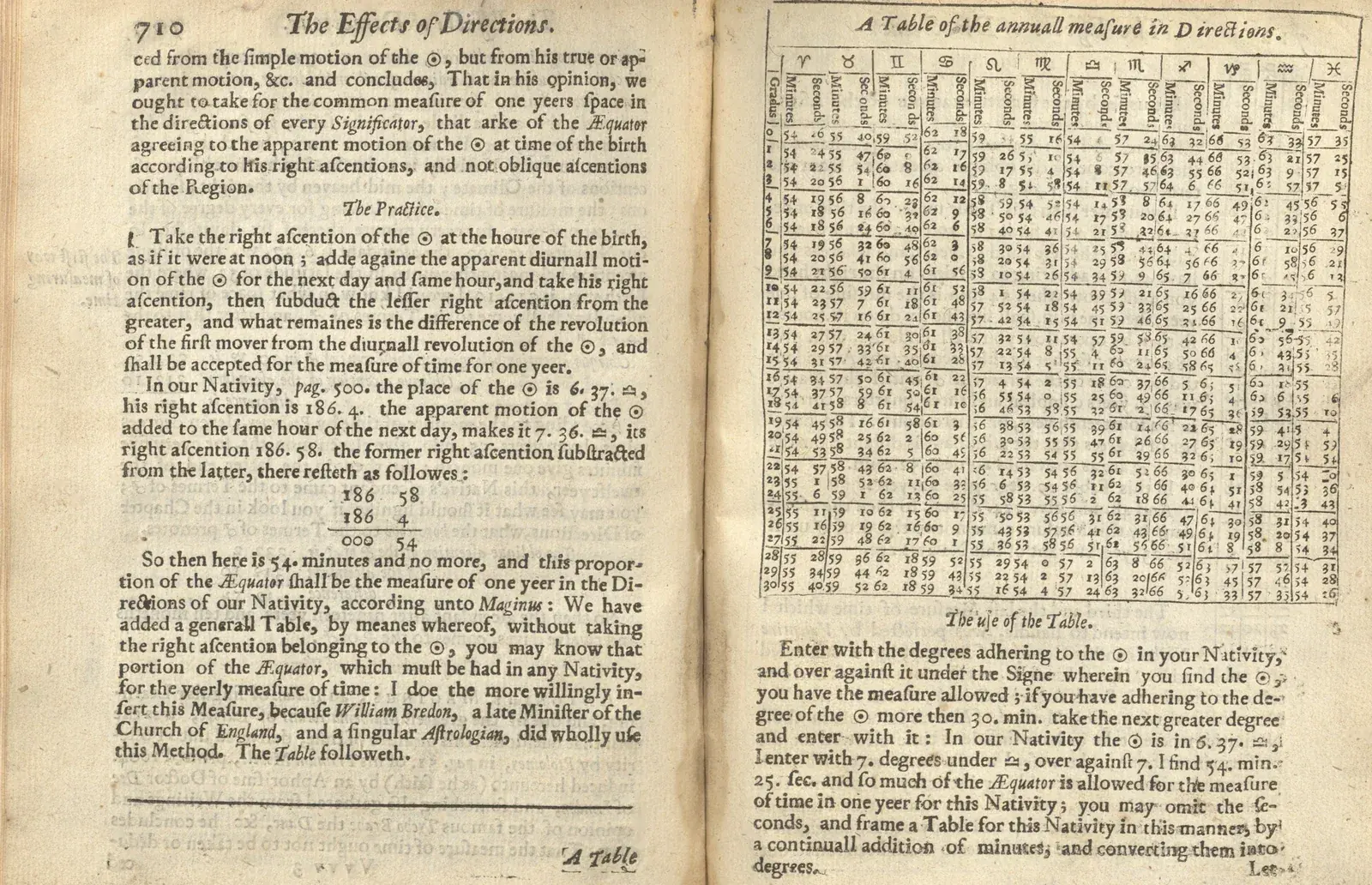
Progressions and directions are clocks made from the birth chart. They do not describe the sky in the present moment. They measure symbolic change inside the natal pattern as your life moves forward. That makes them good at showing slow shifts in emphasis and easy to overread. A clock can tell you when the hands meet; it cannot tell you what room you will enter.
A progression advances selected chart factors according to a time proportion. A direction moves a point by a measured arc. In this chapter, progression means chiefly the secondary progression, and direction means solar arc directions and primary directions. The names are not decorative. Each method uses a different kind of motion, so the same date can produce different kinds of evidence.
Astrology has no established causal mechanism for these clocks, and controlled research has not shown that they reliably predict specific events. You can still use them as a disciplined symbolic language: state the calculation, set the tolerance, make a modest hypothesis, and check it against lived records. Timing gives conditions, not commands. Keep that sentence beside your ephemeris.
Secondary progressions: the day-for-a-year clock
The secondary progression uses one day after birth to represent one year of life. The second day represents the second year, the thirtieth day the thirtieth year. If you are 29 years and 7 months old, you inspect the ephemeris for approximately 29 days and 7 hours after your birth. Astrology software performs the conversion, but the principle should remain visible to you. It is a proportion, not a claim that the sky literally moves at a different speed for a person.
The Sun usually advances about 1° per year in a secondary progression. The Moon moves roughly 12° to 15° per year, depending on the days being used. That difference gives the method two very different scales. A progressed Sun aspect may describe a broad period of a year or more. A progressed Moon aspect can describe a concentrated period of several weeks. Mercury, Venus, and Mars may move forward, slow, or appear to reverse because the corresponding post-birth ephemeris may contain a station or retrograde motion. The outer planets can remain near one degree for years, making their secondary positions less informative unless a station or close contact gives them a particular edge.
The progressed Sun changing signs is therefore a rare change in emphasis. It can coincide with a new way of expressing purpose, but the sign alone is not a diagnosis of your personality. The natal Sun remains the natal Sun. A progressed Sun in Gemini does not turn a Taurus Sun into a Gemini Sun; it may describe a period in which language, variety, study, or exchange becomes a more active way of carrying the existing solar pattern.
The progressed Moon changes signs every two to two and a half years. This is long enough to give an emotional period a recognizable tone, and short enough to make the change tangible. You might notice that your attention moves from private consolidation to visible participation, or from social contact toward quieter restoration. Those are useful observations only when tied to the natal houses, rulers, aspects, and actual circumstances. A progressed Moon sign is a climate, not a script.
The most dependable first use of secondary progressions is to compare progressed planets with natal planets and angles. A progressed Moon applying to the natal Venus may mark a time when attachment, pleasure, money, aesthetics, or relational agreements become emotionally immediate. Which of those meanings becomes visible depends on the natal Venus and its house relationships. A progressed Sun approaching the natal Ascendant may describe a stronger need to occupy space as yourself, but it does not specify whether that becomes a new role, a change in appearance, or a private decision to stop hiding a priority.
Progressed-to-progressed aspects can also matter. The angle between the progressed Sun and Moon is the progressed lunar phase. A conjunction is a meeting of the two symbolic lights; an opposition places them across from one another. In felt terms, the phase describes whether purpose and emotional attention seem to be gathering in one direction, or asking to be negotiated. The phase becomes more useful when you connect it to the natal houses occupied by the progressed lights and to close contacts with natal points.
Do not treat the progressed chart as a replacement natal chart. It is not a second birth identity. A progressed planet in a sign does not erase its natal sign, and a progressed house cusp is not equally reliable in every case. Progressed angles require a dependable birth time and a stated calculation method. Begin with progressed planets to natal angles and planets. Add progressed houses and angles when the birth data and software settings justify the extra precision.
Solar arcs: one shared measure
Solar arc directions begin with the progressed Sun. Find the distance the progressed Sun has moved from its natal position. Then add that same distance to every natal planet, angle, and other point you have chosen to direct. If the natal Sun has moved 29°38′, the directed Ascendant advances 29°38′, the directed Midheaven advances 29°38′, and directed Venus advances 29°38′. Longitudes wrap around the 360° circle when necessary.
This is why solar arc directions are often described as one degree per year. The phrase is a useful approximation, not the calculation itself. The Sun's actual secondary movement varies slightly, so use the ephemeris-derived arc when you want a narrower window. Solar arc directions do not mean that every planet physically occupied its directed position in the sky. They are a uniform symbolic movement built from the Sun's progress.
The method is especially clear when an angle reaches a natal planet. A directed Midheaven contacting natal Mars can coincide with a period of greater public effort, direct action, competition, or conflict over authority. That list is intentionally broad. Mars may describe the person acting, another person pressing hard, a work demand, or the need to set a clean boundary. The natal house and condition of Mars decide which language is most responsible.
A directed planet to a natal angle can be read in the same way. Directed Venus to the Ascendant may bring relationship, taste, money, or self-presentation into greater visibility. It does not promise a relationship or a purchase. The contact names a field of attention; your choices and circumstances give it form.
Solar arc directions and secondary progressions are related because both use the progressed Sun. Do not count a progressed Sun contact and its matching solar arc movement as two wholly independent witnesses. A progressed Moon contact, a primary direction, or a well-timed transit provides a more separate line of comparison.
Primary directions: the rotation clock
Primary directions use a different image. Instead of examining the planets on the days after birth, they model the celestial sphere turning after birth as the symbolic clock advances. The familiar Earth rotation is the basis: roughly 15° of right ascension passes in an hour, so 1° corresponds to about four minutes of clock time. A traditional time key then converts that arc into years, commonly using 1° for 1 year.
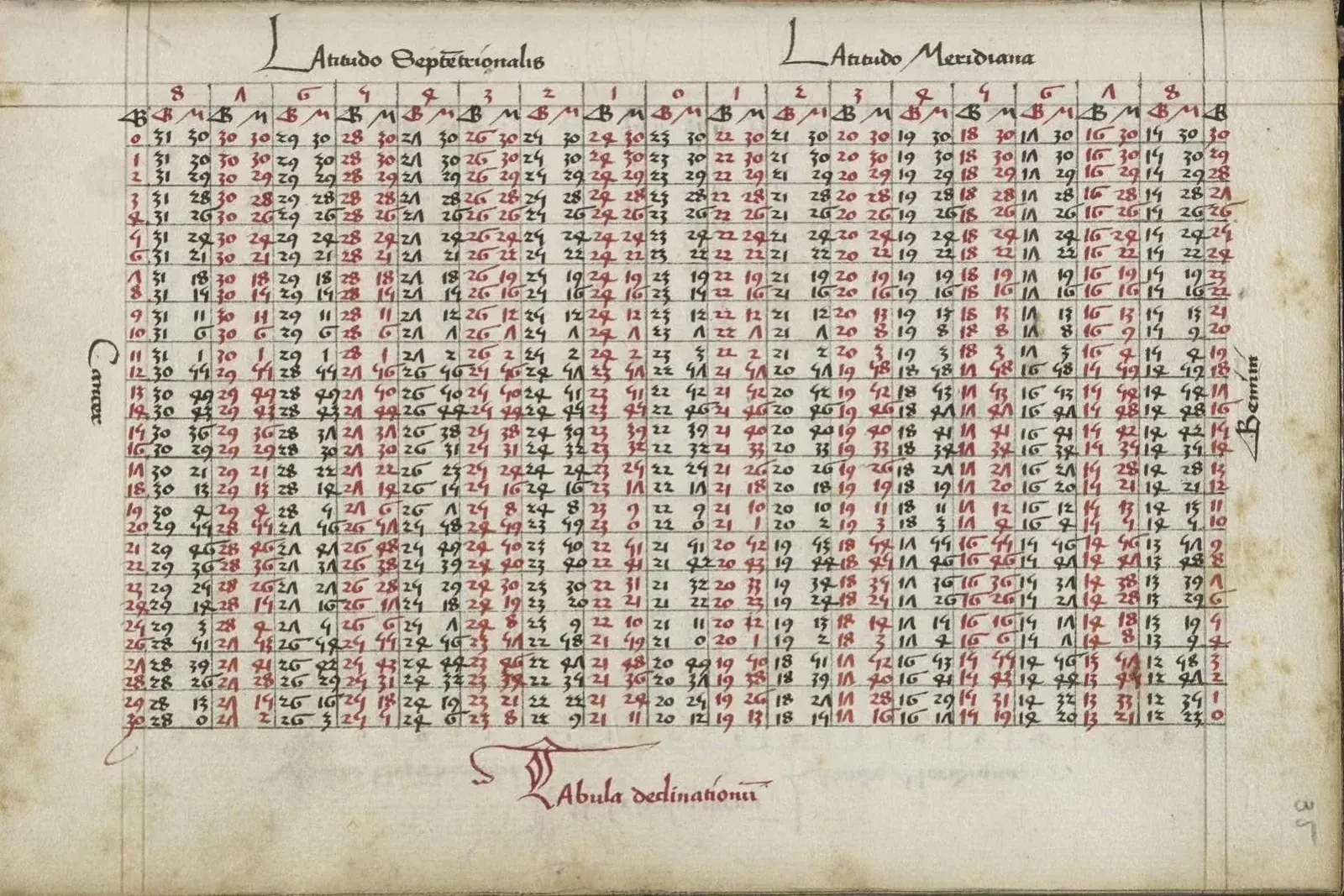
Right ascension measures a position along the celestial equator. Oblique ascension adjusts the motion for the local latitude and the horizon. You do not need to calculate either by hand to read a result well, but you do need to know that primary directions are not simply planets moving through zodiac signs. The geometry is different, and the calculation can be sensitive to house system, latitude, aspect method, and time key.
Older texts use the terms promissor and significator. The promissor is the point being directed; the significator is the point that receives the direction. In a direction of Mars to the Midheaven, Mars supplies the directed motion and the Midheaven receives it. The contact can be read as a period in which action, effort, contest, or assertion meets public role and visibility. That is a symbolic description, not a guaranteed external event.
Mundane primary directions measure the contact through the diurnal circle and houses. Zodiacal primary directions measure it through longitude. Different schools prefer different combinations, and software may offer several settings without explaining their consequences. Record the method, key, house system, and whether latitude was included. A primary direction dated without those details is difficult to reproduce.
Birth-time accuracy matters most here. Four minutes of clock error is approximately one degree of rotation, which can shift an angular direction by about a year under a one-degree-per-year key. This does not mean that a birth certificate rounded to the nearest hour makes every timing method useless. It means you should not make narrow claims about an angular primary direction from uncertain data. Rectifying a chart from one dramatic event usually creates more confidence than evidence. If you test a birth time, use several dated events, include misses, and keep the proposed time separate from the confirmed record.
Orbs are windows, not permission
An orb is the distance from exact aspect. In timing work, it is a tolerance for a window, not an invisible substance that makes every nearby contact active. The useful orb is usually narrower than the orb used for natal interpretation.
A practical starting standard is 0°30′ to 1°00′ for progressed planets to natal planets or angles. For the progressed Moon, 1°00′ can describe roughly four weeks on either side of exact, because the Moon moves about 13° per progressed year. For a progressed Sun or solar arc angle, 1°00′ can describe roughly a year on either side. Primary directions are often read within 0°30′ to 1°00′, with exact angular contacts receiving the most attention. These are working conventions, not laws of nature.
Applying means the directed or progressed point is moving toward exact aspect. Separating means it has just passed exact aspect. Applying contacts are often used for the build-up of a period, while separating contacts may describe the period in which the meaning is being integrated or made visible. Do not turn that distinction into a rigid rule. A life event can be recognized late, and an internal shift can begin before the aspect is exact.
Set your orb before you inspect the biography. If a 5° orb is allowed only after a story appears, the method has become a way of decorating hindsight. A broad natal aspect may describe a lasting trait; it does not automatically create a broad timing window.
Reading the clocks together
Start with the natal point being contacted. Ask what it actually signifies in this chart: its sign, house, ruler, angularity, and close natal aspects. Then name the moving clock. A progressed Moon to natal Venus is not the same statement as a solar arc Midheaven to natal Venus, even if both involve Venus. The first puts emotional attention in contact with Venus; the second brings public position or direction into contact with Venus.
Next, state the time scale. A progressed Moon contact may be useful for weeks. A progressed Sun or solar arc contact may describe a year-long period. A primary direction may be dated more narrowly by a particular software method, but its reliability cannot outrun the birth-time precision. The numbers tell you how wide the window should be.
Then ask what would count as an observable expression. Instead of writing relationship change, write a more testable range: renegotiating an agreement, meeting someone, changing the terms of an existing bond, reassessing pleasure or spending, or becoming more public about a value. A good hypothesis leaves room for the person to tell you which expression occurred.
Use transits as shorter triggers when appropriate. A transit to a progressed degree can bring a slow symbolic theme into a brief, noticeable interval. This does not make the transit a judge that confirms the progression. It simply gives you another clock with a different speed. Keep the clocks named in your notes.
A useful hierarchy prevents interpretive noise. Give first attention to close contacts involving the Sun, Moon, Ascendant, Midheaven, personal planets, and relevant house rulers. Give less attention to a minor point making a wide aspect to an outer planet. If twelve contacts are presented as equally important, none of them has been interpreted.
Finally, keep an outcome log. Record the date, the contact, the orb, the predicted range of meanings, and what actually happened. Record quiet periods too. Astrology becomes more honest when it has to survive the days that do not produce a memorable story.
Worked mini-example
Take this deliberately simplified teaching chart. The positions are invented for the example, and the ephemeris entries below are assumed to have been calculated consistently. The point is to show the arithmetic and the limits of the reading.
| Natal point | Position |
|---|---|
| Sun | 14°20′ Taurus |
| Moon | 2°18′ Scorpio |
| Ascendant | 22°10′ Leo |
| Midheaven | 5°40′ Taurus |
| Venus | 28°45′ Gemini |
| Mars | 4°55′ Virgo |
At age 29 years and 7 months, the secondary positions we need are:
| Progressed point | Position |
|---|---|
| Sun | 13°58′ Gemini |
| Moon | 28°22′ Sagittarius |
First, compare the progressed Moon with natal Venus. Natal Venus is 88°45′ of absolute longitude. The progressed Moon is 268°22′. The difference is 179°37′, which is an opposition with an orb of 0°23′. Because the progressed Moon is moving forward toward 28°45′ Sagittarius, the contact is applying. At roughly 13° of motion per progressed year, exactness is close to two weeks away, with the wider one-degree window lasting several weeks on either side.
What can this mean? Emotional attention is meeting Venus themes: attachment, pleasure, values, agreement, attraction, and the way care is exchanged. If Venus rules a relationship house, the relational language may be prominent. If Venus rules a work or money house, the same contact may concern conditions of employment, pricing, or a valued skill. Without the houses, no narrower claim is justified.
Now calculate the solar arc. Convert the two Sun positions to absolute longitude. Natal Sun at 14°20′ Taurus is 44°20′. Progressed Sun at 13°58′ Gemini is 73°58′. The solar arc is therefore 29°38′. Add that arc to the natal Midheaven at 5°40′ Taurus, or 35°40′. The directed Midheaven becomes 65°18′, which is 5°18′ Gemini.
A square to natal Mars at 4°55′ Virgo is exact when the directed Midheaven is at 4°55′ Gemini. The current contact is 0°23′ past exact. It is separating, and it remains within a narrow working orb. The symbolism puts public role, visibility, or vocation in contact with Mars: action, effort, pressure, contest, or the need to act plainly.
Suppose the person reports that around this age they accepted a demanding public role while renegotiating a close relationship and the use of their time. The two contacts describe that report with reasonable economy. The progressed Moon to Venus speaks to the emotional and relational valuation. The directed Midheaven to Mars speaks to public effort and assertion. Neither aspect says promotion, breakup, argument, or success. Those outcomes would be stories added after the fact.
The contacts also do not count as two completely independent confirmations. The solar arc is built from the progressed Sun, while the progressed Moon contact comes from a different moving body. A transit to 5° Gemini or 28° Sagittarius might provide a shorter trigger, but it would still be a third symbolic layer, not proof. The responsible conclusion is modest: around age 29 years and 7 months, a period of emotional negotiation and public exertion deserves attention. The chart cannot supply the person's account; the person does.
Common mistakes and their corrections
Reading a progressed sign as a replacement identity. A progressed sign describes a changing emphasis. Keep the natal placement in view. The new style works through the old structure; it does not cancel it.
Using natal orbs for timing. A 6° natal aspect may be part of a broad constitutional pattern. A 6° progression-to-natal contact is usually too loose to date anything. Narrow the orb and write the rule before you interpret.
Treating exactness as an appointment. A slow aspect can be exact while the life event is being prepared, recognized, or completed. Use a window appropriate to the moving body, and allow for fuzzy event dates.
Calling every direction a solar arc. Solar arc directs every selected point by the progressed Sun's distance. Primary directions use diurnal geometry and a time key. If the method is not named, the result is not yet transparent.
Ignoring stations and retrograde motion. A progressed Mercury or Venus that slows or changes direction may deserve attention because its symbolic movement changes character. Do not assume that a station automatically produces a major event. Check the natal planet and the contacts around it.
Overusing progressed houses. A progressed house cusp can be sensitive to birth time and calculation method. If the recorded time is approximate, prioritize planetary contacts that do not depend on a narrow angle.
Rectifying from one memorable date. One event can fit several proposed times. Test a proposed birth time against many dated events and quiet periods. If the time changes every time a new story appears, the procedure is fitting the chart to the biography.
Counting every possible contact. A chart can produce dozens of aspects if minor points, wide orbs, and several aspect families are included. Rank contacts by closeness, relevance, and independence. A short list is easier to test and kinder to the person reading it.
Confusing symbolic resonance with proof. A beautiful interpretation can still be wrong. Keep the arithmetic, the settings, and the failed calls. The discipline is not coldness; it is respect for the life being interpreted.
The best use of these clocks is precise and humane. You name what moves, how far it moves, what natal point receives it, and how long the contact can reasonably last. Then you listen for the person's actual experience instead of forcing the experience to obey the chart.
Practice
- Recalculate the mini-example by converting each longitude to absolute degrees. Verify the 0°23′ orbs and the 29°38′ solar arc.
- Use a chart with a reliable birth date and time. Record the data source, time zone, house system, and software settings. Calculate secondary positions and solar arcs for one age connected to a dated life event.
- Make a table with four columns: moving point, natal target, exact orb, and plausible time window. Keep the orb under 1° unless you can explain why a wider one is justified.
- Write one plain-language hypothesis for each close contact. Describe a field of experience, not an outcome. Then check your notes against the person's account, including what did not occur.
- Repeat the same process for a quiet period. Compare the number and quality of contacts. Keep the method that remains clear when the story is ordinary.
Key terms
secondary progressions · day-for-a-year principle · progressed Moon · progressed lunar phase · solar arc directions · primary directions · promissor and significator · orb · applying and separating · birth-time sensitivity · ephemeris · symbolic timing
Check your reading
Three questions from this chapter’s worked example and its common mistakes. Two of three marks the chapter complete.
Natal Sun at 14°20′ Taurus, progressed Sun at 13°58′ Gemini. What is the solar arc?
Can you use natal orbs for timing contacts?
What is the risk of rectifying a birth time from one memorable date?