Part 9: Horary & Electional · Chapter 31 of 36 · 11 min
Lilly's method: significators, dignities, the trials
Lilly's horary method reads a question chart in a fixed order. Decide which house the question belongs to, take the ruler of the Ascendant for the person asking and the ruler of that house for the thing asked about, weigh each planet's dignity, then look for an applying aspect between them. No applying contact, no perfection.
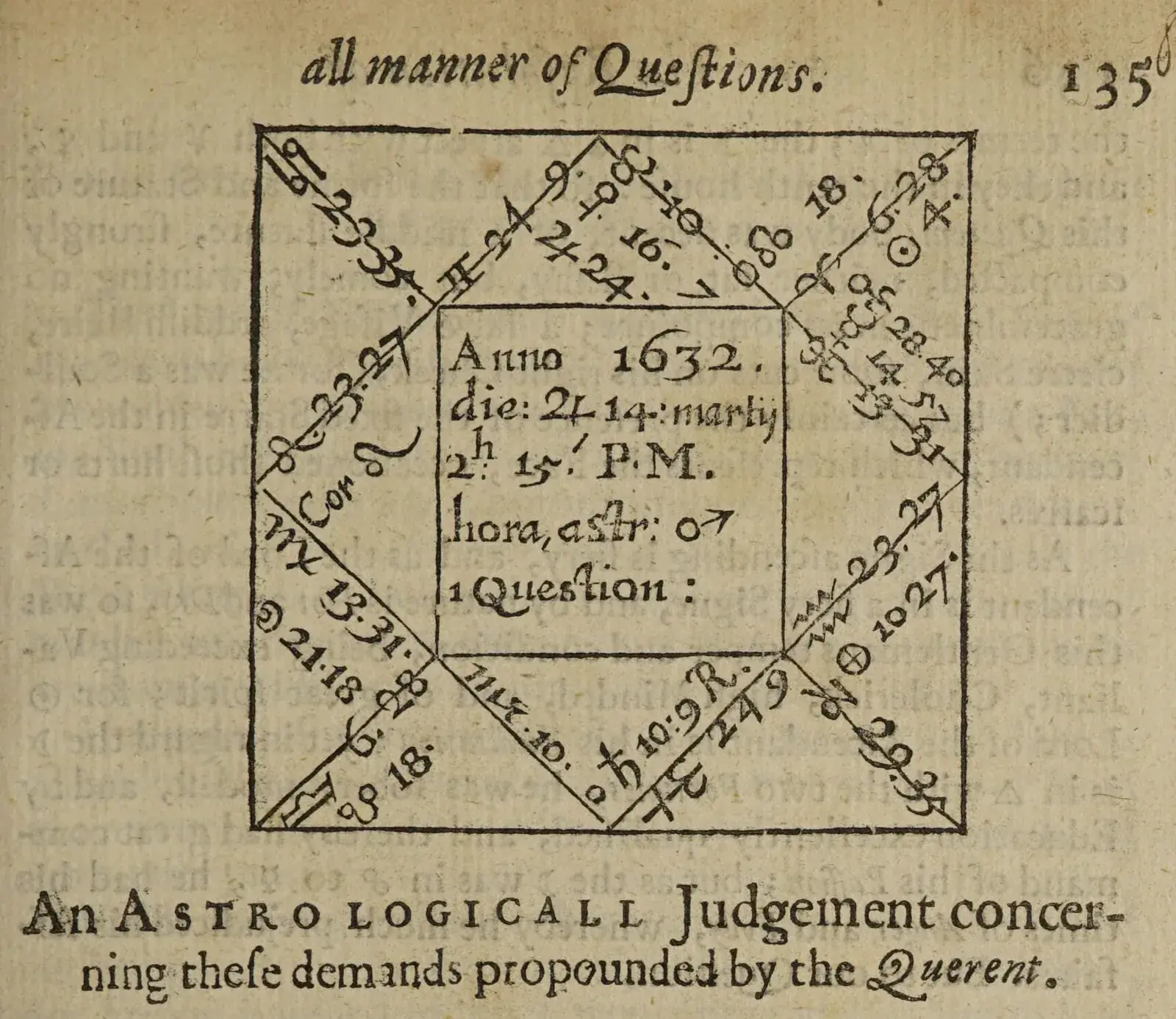
Lilly’s horary method is an argument assembled under pressure. A specific question has been asked. You identify who can act, test whether each actor has usable power, and follow the applying aspects to see whether contact is completed. Sympathy is not testimony. A beautiful trine that has already separated is memory, not promise.
William Lilly lays out this sequence in Christian Astrology (1647), Book II: considerations before judgment, significators, and the ways a matter can perfect or fail. The relevant stretch is pp. 121–129 in the original pagination; his tables of essential and accidental strength appear roughly on pp. 101–119. Later handbooks often turn his cautions into vetoes and his scores into an arithmetic verdict. The source is subtler.
Significators: who carries the question
Lilly calls the person asking the querent. The person, object, position, or event asked about is the quesited. Their significators are the planets authorized to act for them in the chart.
The ruler of the Ascendant is the querent’s primary significator. The ruler of the relevant house is the quesited’s primary significator. “Ruler” means the planet ruling the sign on that house cusp, not simply a planet placed inside the house.
Suppose the question is, “Will my brother write to me?” The third house signifies the brother. Its ruler signifies him. Mercury naturally signifies messages, but it does not replace the third-house ruler. If the question is, “Will I recover my ring?” the ruler of the second house signifies the possession. Venus may add description because rings and ornaments belong to her natural symbolism, but she remains a supporting witness unless she also rules the second.
This order protects you from choosing the planet that tells the story you prefer. Decide the house before inspecting its ruler. Write the assignment as a sentence: “The tenth house signifies the appointment because the question concerns office and professional standing.” If you silently move the matter to the eleventh because its ruler looks happier, you are no longer testing Lilly’s method.
The Moon usually co-signifies the querent and describes the movement of events. She shows what has just happened through separating aspects and what comes next through applying ones. Yet she does not receive two votes. If Cancer is on the quesited’s cusp, the Moon is already the quesited’s ruler; her testimony cannot then be counted again as an independent promise for the querent.
Sometimes one planet rules both the Ascendant and the relevant house. Do not manufacture a second ruler merely to make the chart easier. The shared planet may show entanglement, common interest, or the fact that the outcome rests heavily with one agent. Study its applications, dispositor, house position, and the Moon’s sequence.
Lilly worked with the seven visible planets. If you are using his method strictly, keep their traditional sign rulerships. The later planets can be noted as descriptive modifiers, especially when tightly angular or conjunct a significator, but replacing a traditional ruler breaks the dignity and reception structure on which the method depends.
Essential dignity: does the planet know how to do its work?
Essential dignity describes how coherently a planet can express its own nature. It is not moral worth, personal happiness, or guaranteed success. It is closer to competence and standing.
Lilly assigns numerical weights to five dignities:
- Domicile, 5 points: the planet is in its own sign. It has the keys, knows the customs, and can use the available tools.
- Exaltation, 4 points: the planet is honored and elevated. It may perform impressively, though sometimes with more status than stability.
- Triplicity, 3 points: the planet has elemental and sect-based support. It works among allies rather than alone.
- Term, 2 points: the planet has limited jurisdiction within a particular degree band. It can manage this portion of the matter.
- Face, 1 point: the planet wears an appropriate badge but possesses little deeper authority. Lilly calls this a small dignity.
Triplicity rulership changes according to whether the chart is diurnal or nocturnal. Terms are unequal subdivisions of signs. Use an actual traditional dignity table; neither system can be reconstructed by dividing a sign into convenient equal pieces.
A planet with none of the five dignities is peregrine. That means unsupported, not automatically powerless. Lilly gives detriment a score of minus five and fall minus four. A planet in detriment works with tools foreign to its usual manner. A planet in fall has reduced standing or confidence. Both may still act if their accidental condition gives them leverage.
The point totals are aids to comparison, not percentages. A planet scoring seven is not seventy percent likely to succeed. Nor should contradictory conditions be averaged into blandness. An exalted planet under severe pressure remains both elevated and pressured.
Accidental dignity: can the planet act here and now?
Accidental dignity concerns circumstance. An essentially strong planet knows the work; an accidentally strong planet has access, visibility, speed, and room to act.
Angular planets, especially those in the first or tenth houses, have a microphone and a door key. Succedent planets can sustain a matter but may take time. Cadent planets often understand more than they can immediately implement. Direct motion, ordinary or fast speed, freedom from the Sun’s rays, and supportive aspects strengthen action. Retrogradation, unusual slowness, cadency, and close solar obscuration complicate it.
Lilly defines a planet as combust when it is within 8°30′ of the Sun in the same sign. The felt experience is being overwhelmed by a brighter authority or condition: present, but hard to see and unable to act independently. A planet within about 17° of the Sun is under the beams, a milder obscuration. Within 17 arcminutes lies cazimi, “in the heart of the Sun,” which Lilly treats as an exceptional strengthening. These are historical thresholds, not measured physical effects.
Essential and accidental strength must be read together. A dignified but cadent significator may be highly qualified yet unable to influence the immediate decision. A peregrine planet on the Midheaven may have little inner steadiness but considerable public power. Authority and fitness are not the same thing.
Reception: who has room for whom?
Reception occurs when one planet occupies a dignity belonging to another. If Mercury is at 12° Aries, Mercury is in Mars’s domicile; therefore Mars receives Mercury. Keep the grammar straight. The host is Mars, not Mercury.
Reception can show welcome, obligation, dependence, protection, or control. Which meaning fits depends on the question and on the receiving planet’s own condition. A weakened host may wish to help but lack the means. A powerful host may have ample means but impose its own terms.
Mutual reception occurs when two planets occupy dignities belonging to each other. This can create cooperation or an exchange of resources. It does not erase every other problem. Reception without an aspect may show willingness without contact. An aspect without reception may show contact without welcome. Lilly often uses reception to soften squares and oppositions, but it should not be turned into a simple affection meter.
The first trial: is the chart fit for judgment?
Lilly calls a chart radical when it is rooted in the question and fit to be judged. His first test compares the planetary hour ruler with the Ascendant ruler. Agreement may occur because they are the same planet, belong to the same triplicity, or share a compatible nature (Christian Astrology, p. 121). This is a historical coherence test. No established physical mechanism explains it.
His other considerations are better treated as warnings about context and confidence than as automatic refusals:
- An Ascendant in the first three degrees may show that the matter is genuinely early, information is missing, or the querent has not yet reached the real question.
- An Ascendant in the last three degrees may show that events are already advanced or the decision has effectively been made.
- Saturn in the seventh can warn of difficulty in the astrologer’s judgment, especially when Saturn is not a proper significator of the matter.
- A combust Ascendant ruler may show that the querent is hidden, constrained, or unable to act freely.
- The Moon is void of course when she will not perfect another major planetary aspect before leaving her sign. Lilly writes that business seldom proceeds “handsomely” under this condition, while allowing some mitigation in Taurus, Cancer, Sagittarius, and Pisces (p. 122).
- The Moon between 15° Libra and 15° Scorpio occupies the Via Combusta. Lilly inherited this as a zone of instability. It is a traditional doctrine, not a measured strip of harmful sky.
An early Ascendant is not a command to discard the chart. If the querent says, “I submitted the application ten minutes ago,” the degree may describe the matter precisely. A late Ascendant may be equally apt when the committee has already voted. Saturn in the seventh may signify the person being asked about. Context decides whether a warning is descriptive or obstructive.
Record the question, time, location, and house assignment before judging. Do not cast repeated charts until one looks agreeable. A chart cannot be tested if its inconvenient evidence is continually replaced.
The second trial: can the matter perfect?
Perfection is the completion of the promised contact. The simplest form occurs when the querent’s and quesited’s significators apply to a conjunction, sextile, square, trine, or opposition and reach exactness before either changes sign, stations, or is diverted.
An aspect can be partile, exact by degree, or platick, operating within the planets’ allowed moieties of orb. The orb says the planets are close enough to engage. It does not say they will finish. You still need direction and speed.
Application means the relevant planets are moving toward exactness. Separation means exactness has passed. Check the ephemeris rather than assuming that the faster planet always applies. A station or change in speed can reverse the apparent story.
Aspect geometry describes the manner of contact, not a binary result. A square with strong reception may perfect through sustained effort. A trine that is separating does not promise a future event. Easy geometry cannot replace application.
Lilly also gives indirect and interrupted forms of perfection:
- Translation of light: a faster planet separates from one significator and applies to the other, carrying the matter between them. This often describes a messenger, intermediary, or sequence of connected actions.
- Collection of light: two planets apply to a slower planet that can receive both. The collector has enough standing to bring parties together or hold the matter in one place.
- Prohibition: a third planet perfects an aspect with one significator before the two primary significators meet. Another actor or condition gets there first.
- Frustration: one of the applying significators meets a different planet before the original contact can occur, taking the matter elsewhere.
- Refranation: a planet turns retrograde before perfection and withdraws from the promised contact.
- Change of sign before exactness: the aspect does not complete under the present conditions. A later aspect after the sign change belongs to changed circumstances and must be judged as such.
These categories describe sequences, not software switches. Prohibition may deny, delay, redirect, or force another negotiation. You need the houses ruled by the intervening planet, its condition, and what actually happens after the interruption.
Worked mini-example: the contact before the contact
Consider a constructed teaching figure for the question, “Will the arts board appoint me to the six-month commission?” The appointment belongs to the tenth house.

- Ascendant: 12°40′ Libra
- Midheaven: 8°15′ Cancer
- Venus: 17°20′ Pisces, direct, in the sixth house, moving 1°12′ per day
- Moon: 14°05′ Cancer, direct, in the tenth house, moving 13°10′ per day
- Mars: 15°10′ Cancer, direct, in the tenth house, moving 0°35′ per day
- Sun: 28°00′ Aquarius
Venus rules the Libra Ascendant and signifies the querent. The Moon rules the Cancer Midheaven and signifies the appointment. Because the Moon is already the quesited’s ruler, she is not counted again as a separate vote for the querent.
Venus is exalted in Pisces: strong essential condition. She is cadent in the sixth: less immediate leverage. The Moon is in her own domicile and angular in the tenth, so the appointment and the institution controlling it are strongly placed. Venus stands 19°20′ from the Sun, outside Lilly’s 17° under-beam threshold.
At first sight the testimony is excellent. The Moon applies to a trine with Venus. The static distance from exactness is 3°15′, comfortably within ordinary Lilly-style moieties. With the Moon moving 13°10′ per day and Venus 1°12′, their relative closing speed is about 11°58′ per day. Exactness occurs roughly six hours and thirty minutes later, near 17°39′ Cancer and 17°39′ Pisces.
But the Moon first conjoins Mars. That conjunction is only 1°05′ from exactness. Their relative speed is about 12°35′ per day, so it perfects in roughly two hours, near 15°13′ Cancer. Mars gets there before Venus.
Mars rules the seventh house of other parties and sits in the tenth. It is angular, so it can intervene effectively, but it is in fall in Cancer, suggesting poor footing or awkward conduct. The Moon receives Mars by domicile because Mars occupies the Moon’s sign. The institution has more control over this intervening party than the party has over it.
A strict reader can call the Mars conjunction prohibition and withhold a clean yes. Yet the Moon continues through Cancer and still perfects the trine with Venus before leaving the sign or changing direction. Once the Moon separates from Mars and reaches Venus, the sequence also resembles translation of light. The labels overlap because events do.
A defensible judgment would read: “The appointment is not offered cleanly or immediately. Another party or condition acts first, probably within the board’s process. After that intervention, the route to appointment remains open and leans toward completion, though the procedure or terms may change.” Both primary significators are essentially strong, and the trine survives the interruption. Mars describes interference with leverage, not necessarily final defeat.
Another Lilly-trained astrologer may give prohibition more weight and judge against completion. That disagreement should be recorded before the outcome is known. Otherwise memory quietly edits the method.
The six-hour astronomical sequence orders the contacts; it does not automatically mean the appointment arrives six hours later. Event timing depends on the question’s natural scale, house placement, sign quality, and real-world process. Degrees are not fixed units of clock time.
Horary astrology has a substantial historical record, but there is no broad body of controlled evidence establishing Lilly’s rules as reliable predictors of external events. Treat the method as a disciplined symbolic practice whose claims remain testable in your own records. Preserve misses as carefully as striking matches. Lilly gives you a grammar, not a guarantee.
Practice
Choose one past, clearly dated question whose outcome is already known.
- Write one sentence assigning the quesited’s house before looking at planetary condition.
- Name the Ascendant ruler, quesited ruler, and the Moon’s role.
- List each significator’s essential and accidental condition without combining them into one score.
- Identify reception using correct host grammar: “Planet A receives Planet B.”
- Calculate the next three applying contacts with degrees, direction, and sign boundaries. Mark any translation, collection, prohibition, frustration, or refranation.
- Check Lilly’s considerations, then write a judgment of no more than 100 words.
Compare it with the known outcome. Do not change the house assignment afterward. Note exactly which testimony worked, which did not, and where your rule choice affected the result.
Key terms
significator · querent · quesited · essential dignity · accidental dignity · reception · radicality · perfection · application · prohibition · frustration · refranation · translation of light · collection of light · void of course · Via Combusta
Check your reading
Three questions from this chapter’s worked example and its common mistakes. Two of three marks the chapter complete.
In the arts-board example, why can a strict reader withhold a clean yes?
Why is the Moon not counted as a separate vote for the querent in that chart?
Venus stands 19°20′ from the Sun. Is she under the beams by Lilly's threshold?