Zodiac myths · Cancer
Cancer is the crab that took on Heracles anyway
It had no chance. It went in sideways, pinched the hero's foot, and Hera gave it a place in the stars for trying.
Johann Bayer, Uranometria, 1603
At a glance
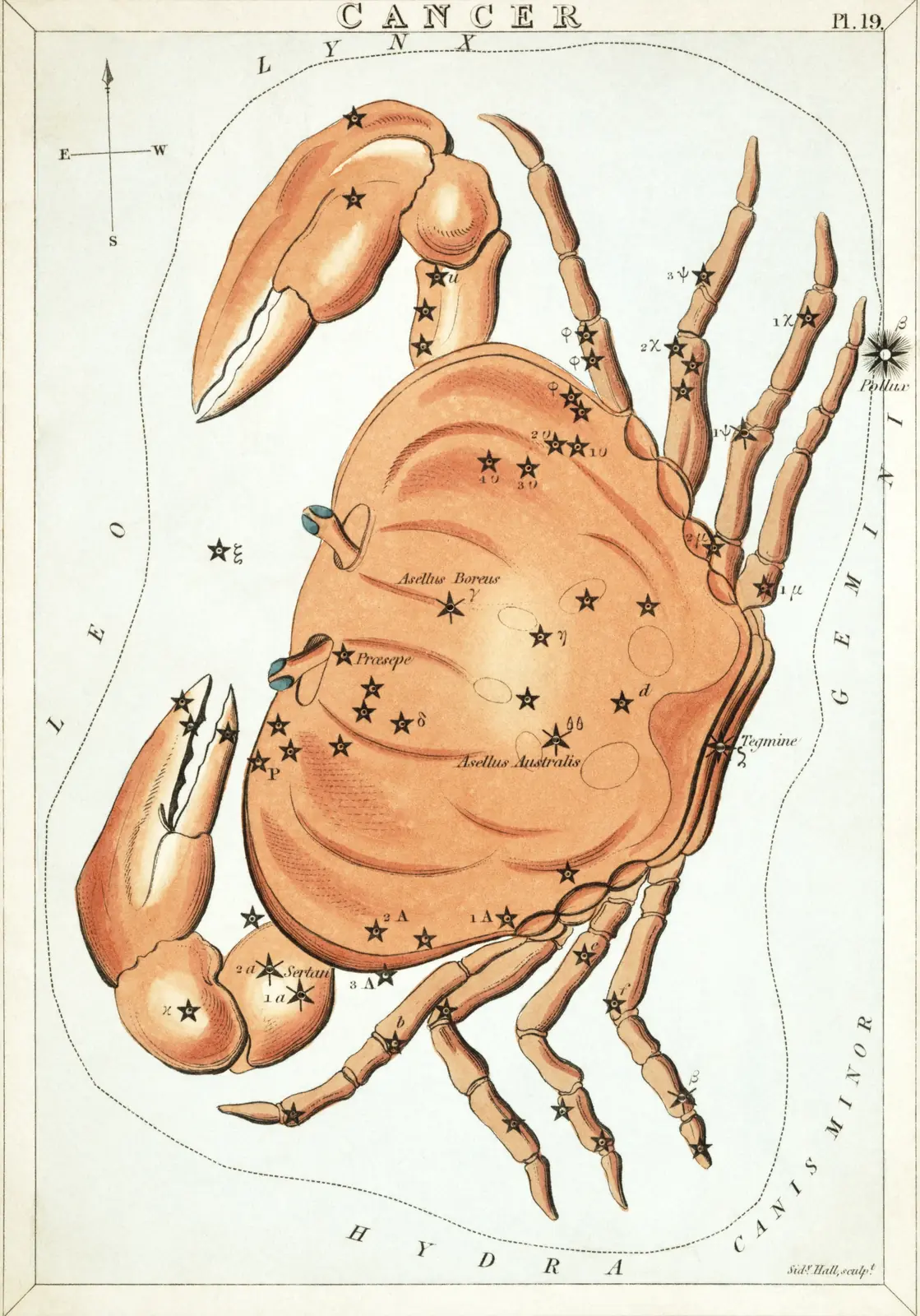
In Greek myth Cancer is Karkinos, a giant crab Hera sent to attack Heracles while he fought the Hydra at Lerna. He crushed it, and Hera set it in the sky.
- The figure
- The crabApollodorus, Library 2.5.2
- Sign dates 2026
- Jun 21 to Jul 22, 2026Sun enters Jun 21, 2026, 08:25 UTC
- Sun in the stars, 2026
- Jul 21 to Aug 10, 202621 days inside the IAU Cancer
- Best seen at midnight
- Jan 19 to Feb 6, 2027best night about Jan 28, 2027
The myth
A crab in the swamp at Lerna
Try this today
- Who would you pinch a hero's foot for? Tell them something kind this week instead.
- With binoculars on a dark winter night, find the Beehive cluster between Pollux and Regulus.
- Notice your shell. When does it help, and when does it keep the good stuff out?
The second labour of Heracles was the Hydra, the many-headed water serpent of the marshes at Lerna. Every head he cut off grew back, two for one, Apollodorus says, and the fight was going badly.
Hera hated Heracles, her husband's son by another woman, and she sent help for the other side: a huge crab, Karkinos, which came out of the mud and bit the hero on the foot. It was a small, stubborn act of loyalty to the goddess against the strongest man alive. Heracles stamped on it and crushed it, then went back to the Hydra, and with his nephew Iolaus burning each neck as he cut, he won.
The crab lost. Badly. But Hyginus and the Catasterisms attributed to Eratosthenes say Hera placed it among the constellations as a reward, and they note it sits close to the Hydra in the sky, the two monsters of Lerna still near each other.
It is a story about showing up for your people when the odds are absurd, and about a crab that, in the end, got remembered longer than most heroes' victims.
Other tellings
The donkeys and the manger
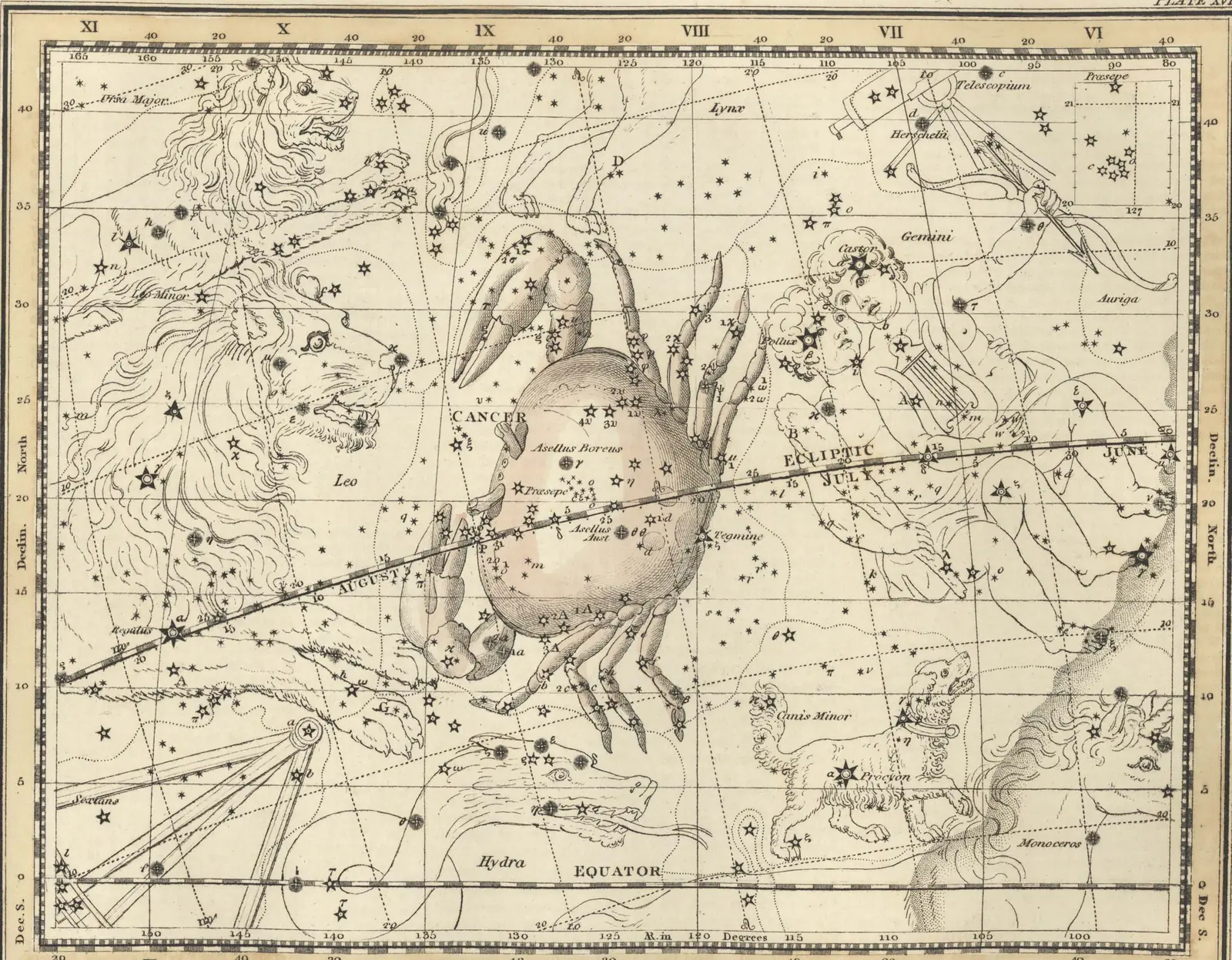
Cancer carries a second, gentler story. In the middle of the crab is a hazy cluster the Greeks called Phatne, the Manger (today the Beehive, M44), with two faint stars beside it called the Asses, Asellus Borealis and Asellus Australis.
Hyginus explains them through Dionysus: travelling to the oracle at Dodona, the god came to a marsh he could not cross, and one of two donkeys carried him over. Another version says the donkeys brayed in the war against the Giants, and the noise sent the Giants running. Either way, the gods' thanks was a manger in the sky.
Ancient weather lore watched the Manger too. Aratus says that if it disappears in a clear sky, a storm is coming.
In the sky
Finding Cancer: Jan 19 to Feb 6, 2027
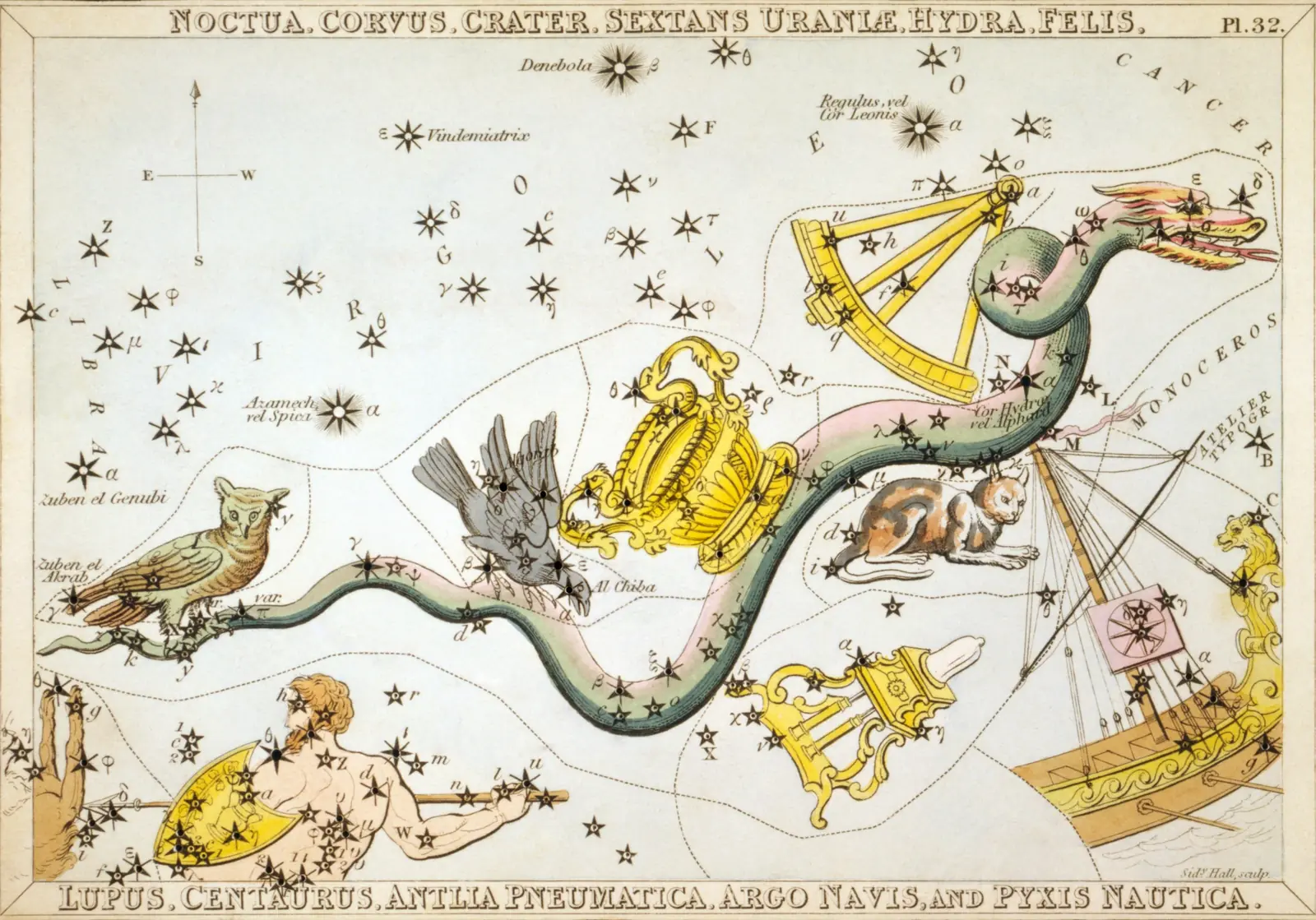
Cancer is the faintest of the zodiac constellations. You need a dark sky to see the Beehive as a misty patch between Gemini's twins and Leo's Regulus; binoculars turn it into a swarm.
2026: sign Jun 21, 2026, 08:25 UTC to Jul 22, 2026, 19:13 UTC. Sun in the stars: Jul 21 to Aug 10, 2026 (21 days). (Why the 30-day gap.) Cancer peaks at midnight near Jan 28, 2027.
Pick your telling
Inside the crab: a manger and two donkeys, thanked by a god.
3 versions of the crab.
Cancer, 3 ways
The crab of Lerna
Hera sends a giant crab to bite Heracles as he fights the Hydra. He crushes it, and Hera places it among the stars.
Source: Apollodorus, Library 2.5.2; Hyginus, Astronomica 2.23
See it yourself. Cancer: Jan 19 to Feb 6, 2027.
More to read
One shorter read. It opens in place.
In astrology
Why the crab means home
In traditional astrology Cancer is ruled by the Moon, and the summer solstice once fell among its stars, which is why the Tropic of Cancer carries its name. Astrologers read the sign as protective and home-loving, with a hard shell over a soft interior. The myth adds the loyalty: the crab goes in for its goddess. Hold that up against your Cancer placements.
Continue readingShow less
Cancer by the numbers
| Dates | Days | |
|---|---|---|
| Sign | Jun 21 to Jul 22, 2026 | 31 |
| Sun in the stars | Jul 21 to Aug 10, 2026 | 21 |
| Midnight season | Jan 19 to Feb 6, 2027 | 19 |
All times are UTC. In the Americas the local date can be a day earlier; in Asia and Australia a day later.
Quick answers
What is the Greek myth of Cancer?
Cancer is Karkinos, a giant crab sent by Hera to attack Heracles while he fought the Hydra at Lerna. Heracles crushed it, and Hera put it in the sky as a reward.
Who is the Greek god of Cancer?
The crab's patron in the myth is Hera, who sent it and honoured it. In astrology, Cancer is ruled by the Moon, which the Greeks personified as Selene.
Why is Cancer called the crab?
The Greek name Karkinos and the Latin Cancer both mean crab. Babylonian star lists also have a crab-like figure in this part of the sky.
What is the Beehive cluster in Cancer?
It is an open star cluster, M44, in the middle of the constellation. The Greeks called it the Manger, with two stars beside it as the donkeys.
Why is the Cancer constellation so hard to see?
None of its stars is brighter than about magnitude 3.5, so it fades out in city light. It is the faintest of the twelve.