Zodiac myths · Leo
Leo is the lion whose skin no weapon could cut
Arrows bounced off it. Swords bent. Heracles had to do it with his bare hands, and then he wore it for the rest of his life.
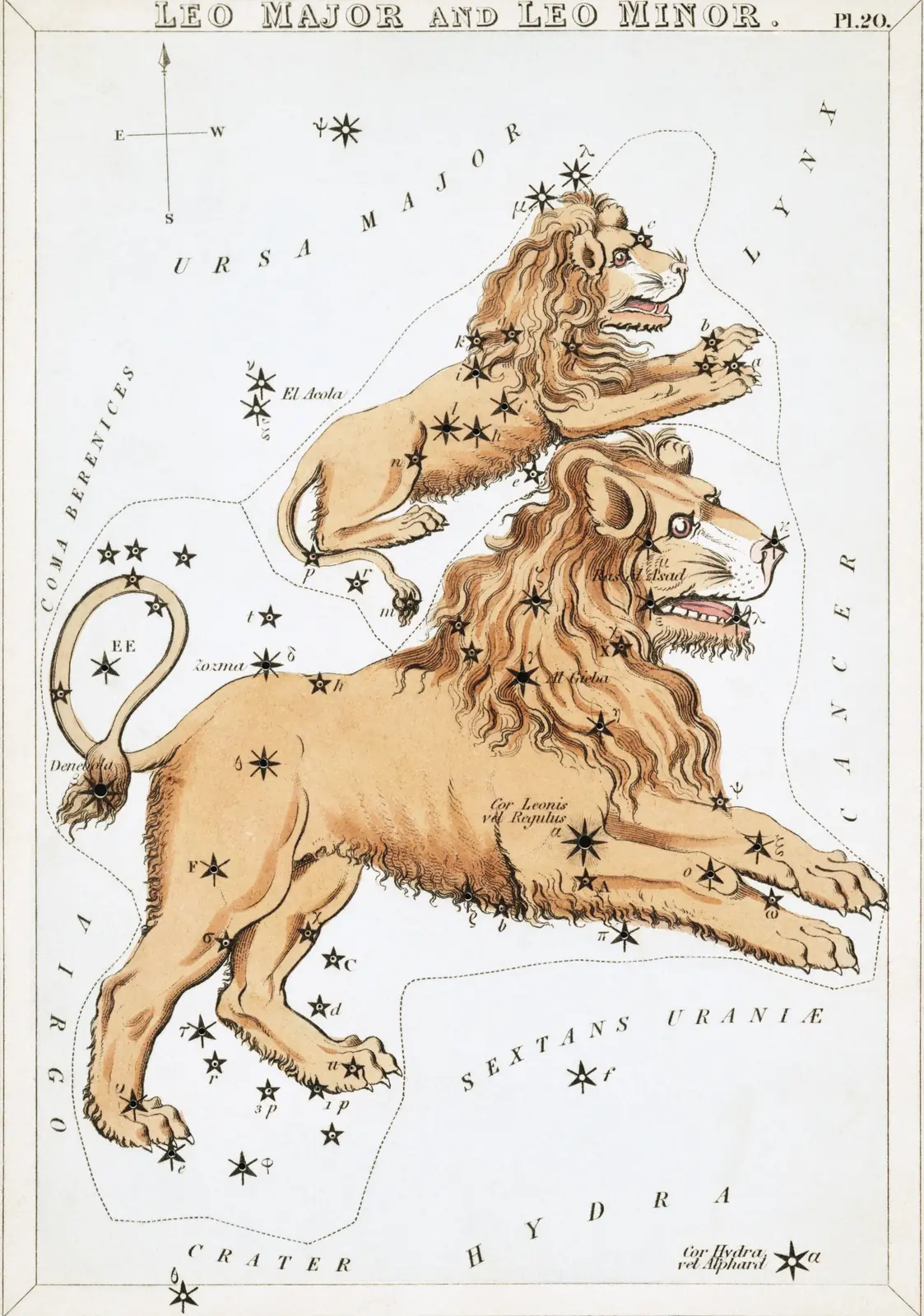
Johann Bayer, Uranometria, 1603
At a glance
In Greek myth Leo is the Nemean lion, a beast with an invulnerable hide. Heracles strangled it as his first labour and wore its skin; Zeus set the lion in the sky.
- The figure
- The Nemean lionApollodorus, Library 2.5.1
- Sign dates 2026
- Jul 22 to Aug 23, 2026Sun enters Jul 22, 2026, 19:13 UTC
- Sun in the stars, 2026
- Aug 11 to Sep 16, 202637 days inside the IAU Leo
- Best seen at midnight
- Feb 7 to Mar 14, 2027best night about Feb 24, 2027
The myth
The first labour
Try this today
- Name one thing that used to scare you that you now wear like armour.
- On a spring evening, trace the Sickle and end at Regulus.
- Find something proud in your week and let it be seen, without the club.
Near the town of Nemea, in the hills of the northern Peloponnese, a lion was killing people and herds. It was no ordinary animal. Hesiod's Theogony says Hera raised it and set it loose there, and Apollodorus adds the detail that matters: its hide could not be wounded by any weapon.
King Eurystheus made it the first of Heracles' labours. Heracles tried arrows first, Apollodorus says, and they did nothing. So he followed the lion into its cave, a den with two mouths, blocked one entrance, went in through the other, and wrestled the lion until he choked it.
Then he had a new problem: how do you skin an animal no blade can cut? Later tellings say he used the lion's own claws. He wore the hide as armour, with the lion's head as a helmet, and that is how Greek artists drew him ever after: a man in a lion skin, carrying a club.
Hyginus says Zeus placed the lion among the stars, and some writers explained the honour simply: it is the king of beasts. The constellation still looks the part, a crouching shape with a bright star at its chest.
Other tellings
The lion's lost tail, and the little king
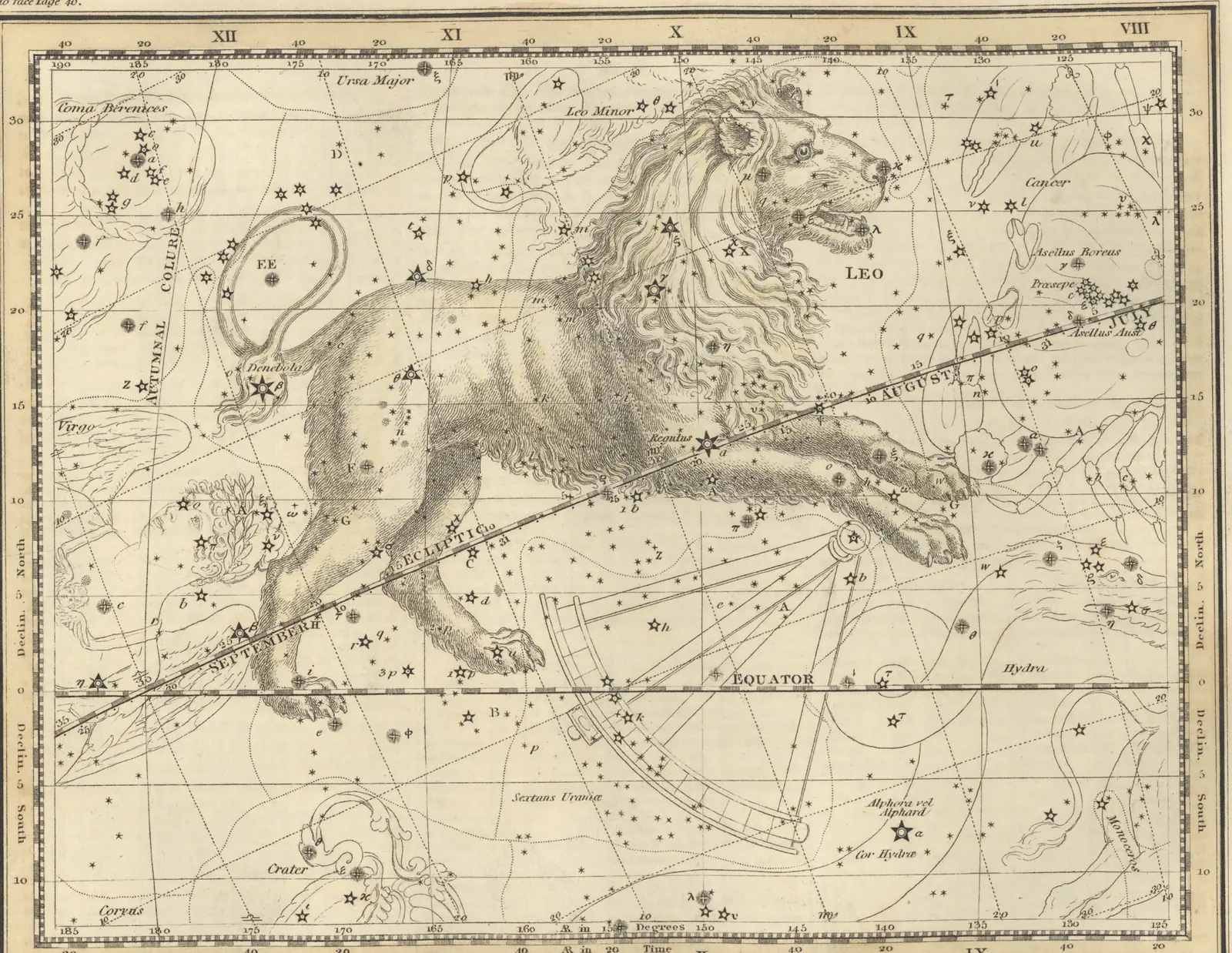
Leo's brightest star is Regulus, Latin for "little king," a name that goes back to Copernicus's era and to the older Greek Basiliskos. It sits almost exactly on the ecliptic, so the Moon and planets pass close by it.
The tuft of the lion's tail had its own story. The faint star cluster behind Leo was once counted as part of it, until the astronomer Conon of Samos, around 245 BC, named it the Lock of Berenice, after the Egyptian queen who cut off her hair as an offering for her husband's safe return from war. Callimachus wrote a poem about it, and Catullus translated it into Latin (poem 66). Today it is its own constellation, Coma Berenices.
In the sky
Finding Leo: Feb 7 to Mar 14, 2027
Look for the Sickle, a backward question mark of stars that forms the lion's head and mane, with Regulus as its full stop. Leo is one of the few zodiac figures that actually looks like its animal.
2026: sign Jul 22, 2026, 19:13 UTC to Aug 23, 2026, 02:19 UTC. Sun in the stars: Aug 11 to Sep 16, 2026 (37 days). (Why the 20-day gap.) Leo peaks at midnight near Feb 24, 2027.
Pick your telling
The lion's tail became a queen's lock of hair, renamed by an astronomer.
3 versions of the Nemean lion.
Leo, 3 ways
The Nemean lion
Heracles corners the invulnerable lion in its two-mouthed cave, strangles it, and wears its hide. Zeus sets the lion in the sky.
Source: Apollodorus, Library 2.5.1; Hyginus, Astronomica 2.24
See it yourself. Leo: Feb 7 to Mar 14, 2027.
More to read
One shorter read. It opens in place.
In astrology
Why the lion belongs to the Sun
In traditional astrology the Sun rules Leo, the only sign it governs, and in antiquity the Sun passed through the lion's stars at the height of summer. Astrologers read Leo as warmth, pride and presence. The myth adds the edge: the lion is magnificent and dangerous, and the hero who beats it takes on its look. Ask what you have earned the right to wear, and look at your Leo placements.
Continue readingShow less
Leo by the numbers
| Dates | Days | |
|---|---|---|
| Sign | Jul 22 to Aug 23, 2026 | 31 |
| Sun in the stars | Aug 11 to Sep 16, 2026 | 37 |
| Midnight season | Feb 7 to Mar 14, 2027 | 36 |
All times are UTC. In the Americas the local date can be a day earlier; in Asia and Australia a day later.
Quick answers
What is the Greek myth of Leo?
Leo is the Nemean lion, a monster whose hide no weapon could pierce. Heracles strangled it in his first labour and wore its skin, and Zeus placed the lion in the stars.
Who is the Greek god of Leo?
Leo's myth belongs to Heracles, a hero rather than a god. Astrologically, Leo is ruled by the Sun, which the Greeks associated with Helios and later Apollo.
How did Heracles kill the Nemean lion?
With his hands. Arrows and blades could not wound it, so he trapped it in its cave and choked it, according to Apollodorus.
What is the brightest star in Leo?
Regulus, the "little king," at the lion's heart. It lies very close to the ecliptic, so the Moon often passes near it.
Who sent the Nemean lion?
Hesiod says Hera reared it and set it on Nemea. Other sources make it the offspring of Typhon or of the monster Echidna.