Relationship charts · free calculator
Composite chart calculator, with the Davison alongside
Two people, one chart. Enter both births and see the relationship as its own thing: its Sun, its Moon, the face it shows the world, and what the sky is doing to it right now.
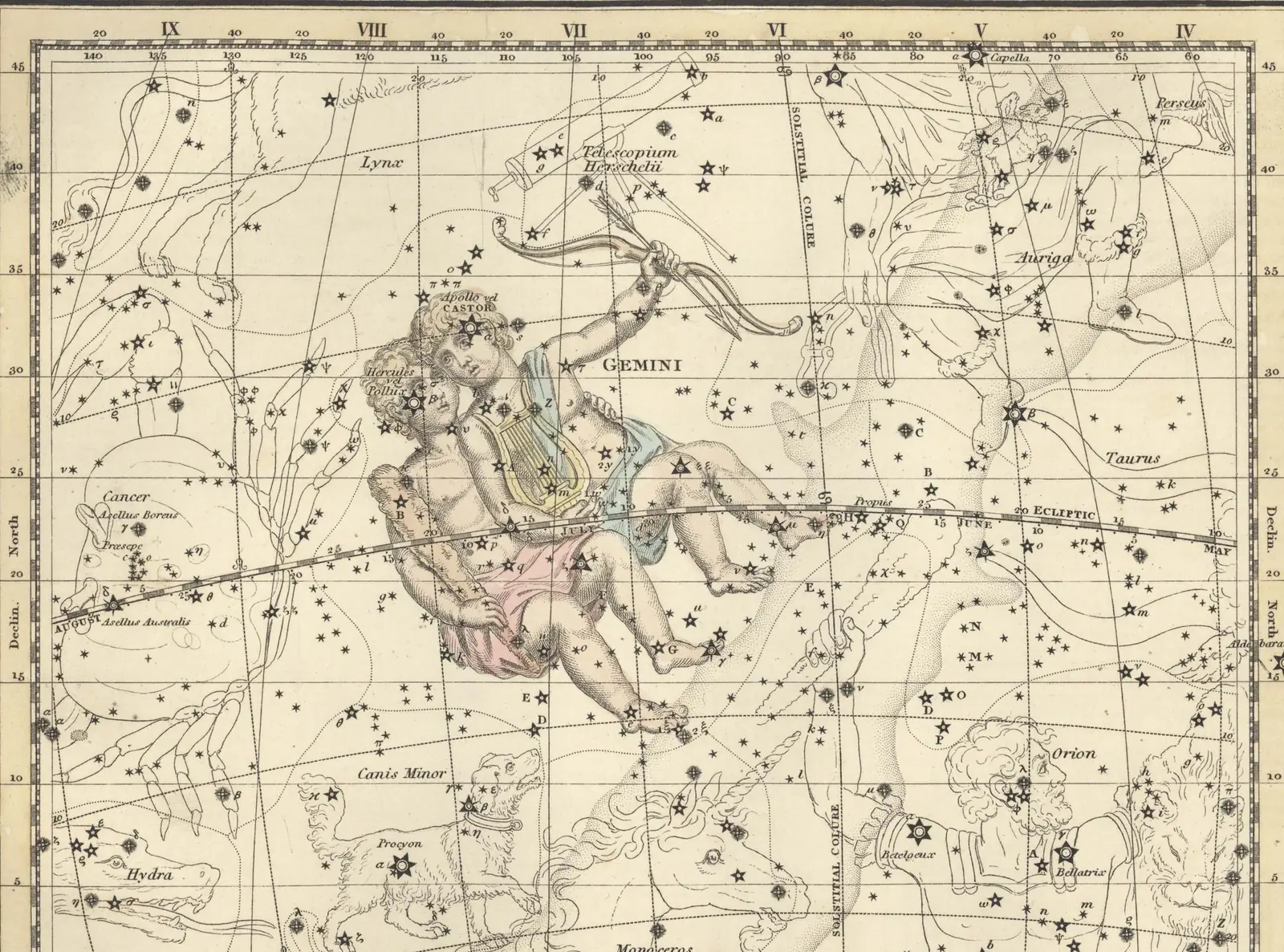
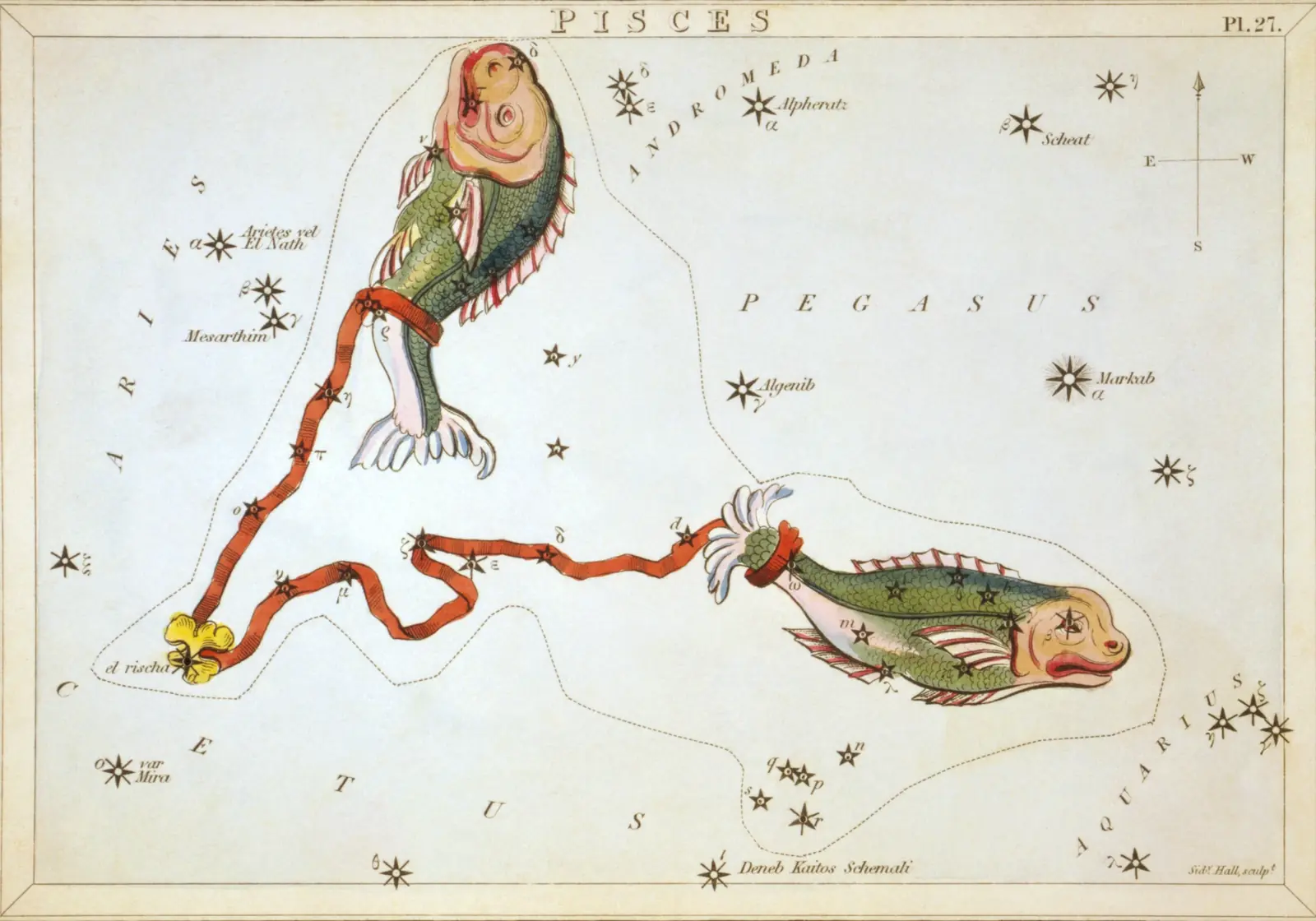
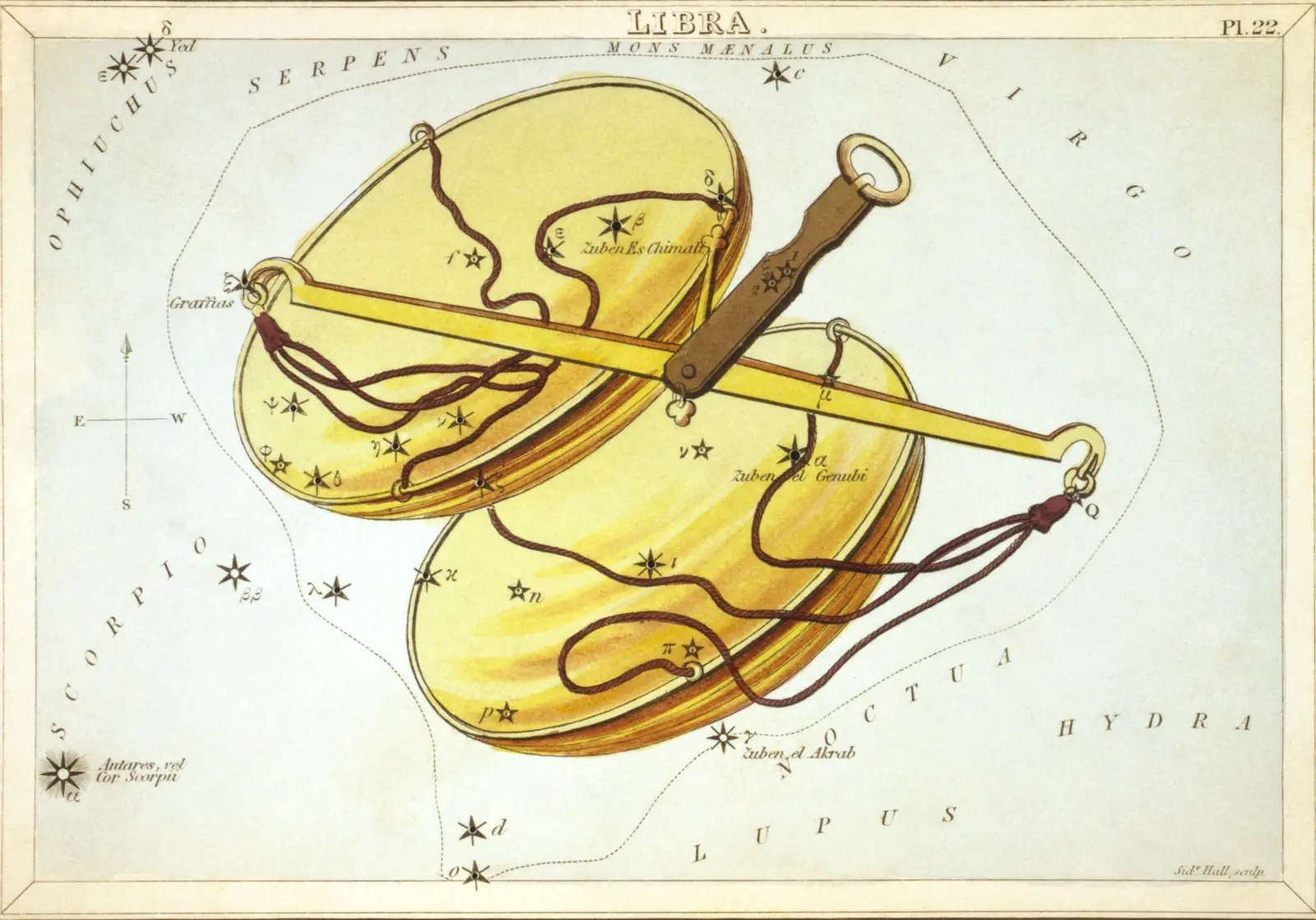
Urania's Mirror, London 1824 · Library of Congress
At a glance
A composite chart puts every planet at the halfway point between your two placements. A Davison chart is a real sky, cast for the moment and place halfway between your births. This calculator does both, with readings.
- Composite Sun (sample couple)
- 27°44′ Sagittariusin the 7th house of a Gemini rising composite
- Davison moment (sample couple)
- December 19, 1995 at 4:57 PM UTCat 46.1°N, 37.1°W, mid-Atlantic
- Same Moon sign in both charts
- 42.9% of pairs20,000 random pairs tested
- Same Sun sign in both charts
- 98.1%when your age gap rounds to an even number of years
- Needs
- Two birth dates and placestimes optional; angles need both
Make your composite chartFree, no account. Computed in your browser.
The relationship as a third thing
What a composite chart actually is
Try this today
- Before you run the calculator, guess the composite Sun sign. Your two Sun signs are the clue: it usually lands between them.
- Read the composite Moon line out loud to the other person. If you both laugh, it's working.
You know how some couples feel like a different person when they're together? Louder, softer, funnier, more serious. Relationship astrology has a chart for exactly that.
A composite chart takes your birth chart and theirs and finds the halfway point of every pair. Your Sun and their Sun make one composite Sun. Your Moon and their Moon make one composite Moon. And so on, through Pluto and the two angles. The result is one chart that belongs to neither of you. It belongs to the relationship.
The idea goes back to the 1970s. John Townley published the first book on composite charts, The Composite Chart, in 1973 (The Astrology Podcast). Robert Hand's Planets in Composite followed in 1975 (Wikipedia).
Here's the sample couple we use on this page, two invented people so nobody's real data is on show:
- Sample A: born March 11, 1994, 8:40 am, London, UK. Sun 20°32′ Pisces, Moon 10°03′ Pisces, rising 27°33′ Taurus.
- Sample B: born September 27, 1997, 9:15 pm, New York, US. Sun 4°57′ Libra, Moon 25°27′ Leo, rising 2°37′ Gemini.
Their composite Sun lands at 27°44′ Sagittarius, the composite Moon at 2°45′ Gemini, and the composite Ascendant at 0°05′ Gemini, right on the edge of a sign. A Sagittarius-Sun relationship between a Pisces and a Libra: neither of them is a Sagittarius, but together they make one.
The sky behind it
Rule: each composite planet is the nearer midpoint, halfway along the shorter arc between the two natal positions. The composite Ascendant and Midheaven are the nearer midpoints of the two Ascendants and the two Midheavens; houses on this page are Whole Sign houses counted from the composite Ascendant. Sample positions computed from JPL DE442 (planets) and the Swiss Ephemeris (angles).
A real moment in the sky
The Davison chart: halfway in time, halfway on the map

Try this today
- Switch the calculator to Davison and look up the halfway place on a map. Couples who were born far apart often get somewhere funny.
- Check whether your Davison date falls on a day either of you remembers. It usually doesn't, which is part of the charm.
The Davison chart gets to "the two of you" a different way. Instead of averaging planets, it averages time and place: find the moment exactly halfway between your two births, find the spot halfway between your two birthplaces, and cast an ordinary birth chart for that moment and place. Ronald Davison set out the method, which he called the relationship horoscope, in his book Synastry: Understanding Human Relations Through Astrology.
For the sample couple, the halfway moment is December 19, 1995 at 4:57 PM UTC and the halfway place is 46.1°N, 37.1°W, which is open ocean between London and New York. That's normal. The Davison doesn't care whether anyone was standing there.
Because it's a real sky, everything in it is physically possible. Mercury stays close to the Sun, Venus stays within its real distance, and the Moon is the actual Moon of that hour. The sample couple's Davison Sun is 27°18′ Sagittarius, close to their composite Sun. Their Davison Moon is 23°41′ Scorpio, about 171° away from the composite Moon. Same relationship, different emotional read.
The Davison Ascendant is 29°39′ Taurus, a whisker from the composite's 0°05′ Gemini, so here the two methods land less than half a degree apart yet in different rising signs. That happens more than you'd think.
The sky behind it
Rule: the Davison moment is the UTC midpoint of the two births. The place is the mean of the two latitudes and the midpoint of the two longitudes on the shorter arc (a simple map midpoint, as most software uses). Sample Davison cast for 1995-12-19 16:57 UTC, 46.1101°, -37.0669°.
With interpretation
How to read your relationship chart, in five steps

Try this today
- Write the composite Sun sign and house on a sticky note. Ask: are we living that, or something else?
- If the composite Moon line feels off, flip to the Davison Moon. One of them usually lands harder.
The calculator gives you a reading straight away. If you want to go further, read it in this order:
- The Sun: what the relationship is for. Sign first, then house. The sample couple's composite Sun is in Sagittarius in the 7th house: a bond built for adventure and, in the 7th, for partnership itself.
- The Moon: how it feels to be in it. The emotional weather of the bond, how you comfort each other, what makes it feel safe.
- The Ascendant: how you come across as a pair. What friends notice first. Needs both birth times.
- Venus and Mars: affection and drive. How the relationship shows love, and how it argues and gets things done.
- The tightest aspects. Two planets within a degree or two of an exact angle are the loudest themes. In the sample composite, the closest are Venus sextile Saturn (0.5°), Sun conjunct Jupiter (0.6°), Uranus sextile Pluto (0.6°).
A word on houses. Composite houses are the most debated part of the method, since averaging two Ascendants doesn't always give a tidy chart. We use Whole Sign houses from the composite Ascendant: simple, traceable and easy to check by hand.
Timing for two
Run real transits to your relationship chart
Try this today
- Note any transit within 1° in the calculator. Check back in three months and see if it still feels relevant.
- If Saturn is touching your composite Sun or Moon, it's a good season for the boring, solid conversations: money, moving, the five-year plan.
This is where the two methods earn their keep. Because both charts have fixed positions, you can track slow planets crossing them, the same way you'd track Saturn crossing your own Sun.
The calculator checks Jupiter, Saturn, Uranus, Neptune and Pluto against every point in your composite and your Davison, live, on the day you open it. On October 18, 2026, the sample couple had:
- Composite: Transiting Pluto conjunct Midheaven (orb 0.2°); Transiting Pluto trine Moon (orb 0.3°); Transiting Neptune sextile Moon (orb 0.4°).
- Davison: Transiting Pluto conjunct Midheaven (orb 0.2°); Transiting Neptune sextile Midheaven (orb 0.4°); Transiting Neptune trine Pluto (orb 0.9°).
Notice both charts share Pluto on the Midheaven. When the two methods agree on a transit, it's an easy one to take seriously. When they disagree, read both and see which story fits the relationship.
In the tradition, Saturn transits to a composite are read as tests and commitments, Jupiter as growth and good luck, and Pluto as slow, deep change. Not a forecast of what will happen to the two of you. A frame for noticing what's already happening.
The sky behind it
Transits listed use the five slow planets and the five major aspects within 2°. Positions on October 18, 2026 (00:00 UTC): Jupiter 22°24′ Leo, Saturn 10°15′ Aries, Uranus 5°08′ Gemini, Neptune 2°24′ Aries, Pluto 3°04′ Aquarius.
Which to trust
Synastry, composite or Davison: which one to trust
Try this today
- Run the side-by-side view. Every highlighted row is a place where the two methods tell different stories.
- Then open the house overlays calculator to see the synastry side of the same couple.
House overlays calculatorSynastry compatibilityComposite vs Davison, the data
Short version: you don't have to pick one. They answer different questions.
- Synastry lays one birth chart over the other. It shows how you affect them: your Venus on their Mars, their Saturn on your Moon. It is the oldest of the three and the usual starting point.
- Composite shows the relationship as a third thing with its own purpose. It's great for "what are we for?" and for watching transits.
- Davison answers the same question with a real sky. Fans like that its Moon, Mercury and Venus are physically possible. The catch is a birthplace neither of you has a link to, and far less published interpretation to lean on.
Where they disagree, it's usually the fast stuff. In our test of 20,000 random pairs, the composite and Davison put the Moon in the same sign only 42.9% of the time, and Venus only 22.6%. Neptune and Pluto agreed 96.1% and 95.6% of the time.
So read synastry for chemistry, the composite for purpose, and the Davison when you want a second opinion grounded in a real moment. If you only have time for one, start with synastry.
Your relationship chart
The composite and Davison calculator
Add two births. You get the composite and the Davison, each with a reading of its Sun, Moon and Ascendant, its Venus and Mars, the tightest aspects, and today's slow-planet transits. Then flip to side by side to see where the two methods agree. Everything is computed in your browser.
Person 1
Not added yet
Person 2
Not added yet
Person 1: you, or whoever goes first
No birth details to hand?
More to read
Shorter reads. Each opens in place.
No birth time?
What works without birth times
Tick "I don't know the birth time" and we use noon. The Sun through Pluto barely move in half a day, so the composite and Davison planets still hold. The Moon can drift about 6°, so treat it as approximate. The Ascendant, Midheaven and houses need both times, so we leave them out instead of guessing. If you're unsure of yours, the rising sign without birth time tool shows what your birthday allows.
Continue readingShow less
Strange but true
When the composite breaks physics
Midpoints can land on the far side of the zodiac. In 5.4% of our test pairs, the composite Mercury ended up farther from the composite Sun than Mercury ever gets in a real sky; for Venus it was 10.4%. It happens when your two Suns are far apart. The Davison never does this. Full numbers on composite vs Davison.
Continue readingShow less
Going deeper
The karmic layer
Composite and Davison charts describe the bond. If you want the "have we met before?" angle, the karmic synastry calculator looks at nodes, Saturn and the Vertex between two birth charts. For a quick emotional read, try Moon sign compatibility.
Continue readingShow less
The sample couple, in full
Both birth charts, the composite and the Davison for our invented sample couple, computed from JPL DE442. Sample A and Sample B were born about 3.6 years apart, which rounds to 4, an even number: that's why their composite and Davison Suns nearly match.
| Planet | Sample A | Sample B | Composite | Davison |
|---|---|---|---|---|
| Sun | 20°32′ Pisces | 4°57′ Libra | 27°44′ Sagittarius | 27°18′ Sagittarius |
| Moon | 10°03′ Pisces | 25°27′ Leo | 2°45′ Gemini | 23°41′ Scorpio |
| Mercury | 24°25′ Aquarius | 22°32′ Virgo | 8°28′ Sagittarius | 11°45′ Capricorn |
| Venus | 3°25′ Aries | 18°22′ Scorpio | 25°54′ Capricorn | 27°27′ Capricorn |
| Mars | 3°04′ Pisces | 29°23′ Scorpio | 16°13′ Capricorn | 14°37′ Capricorn |
| Jupiter | 14°28′ Scorpio | 12°15′ Aquarius | 28°22′ Sagittarius | 26°40′ Sagittarius |
| Saturn | 4°58′ Pisces | 17°51′ Aries | 26°24′ Pisces | 18°40′ Pisces |
| Uranus | 25°18′ Capricorn | 4°50′ Aquarius | 0°04′ Aquarius | 28°40′ Capricorn |
| Neptune | 22°48′ Capricorn | 27°12′ Capricorn | 25°00′ Capricorn | 24°14′ Capricorn |
| Pluto | 28°02′ Scorpio | 3°23′ Sagittarius | 0°43′ Sagittarius | 1°31′ Sagittarius |
| Ascendant | 27°33′ Taurus | 2°37′ Gemini | 0°05′ Gemini | 29°39′ Taurus |
| Midheaven | 26°37′ Capricorn | 9°10′ Aquarius | 2°53′ Aquarius | 2°50′ Aquarius |
| Aspect | Orb |
|---|---|
| Venus sextile Saturn | 0.5° |
| Sun conjunct Jupiter | 0.6° |
| Uranus sextile Pluto | 0.6° |
| Venus conjunct Neptune | 0.9° |
| Sun square Saturn | 1.3° |
| Saturn sextile Neptune | 1.4° |
| Moon opposite Pluto | 2.0° |
| Jupiter square Saturn | 2.0° |
| Moon trine Uranus | 2.7° |
| Saturn sextile Uranus | 3.7° |
| Chart | Transit | Orb |
|---|---|---|
| Composite | Pluto conjunct Midheaven | 0.2° |
| Composite | Pluto trine Moon | 0.3° |
| Composite | Neptune sextile Moon | 0.4° |
| Composite | Neptune sextile Midheaven | 0.5° |
| Composite | Neptune trine Pluto | 1.7° |
| Composite | Saturn trine Mercury | 1.8° |
| Davison | Pluto conjunct Midheaven | 0.2° |
| Davison | Neptune sextile Midheaven | 0.4° |
| Davison | Neptune trine Pluto | 0.9° |
| Davison | Jupiter square Moon | 1.3° |
| Davison | Saturn square Mercury | 1.5° |
| Davison | Pluto sextile Pluto | 1.6° |
| Chart | Ascendant | Sun | Sun's house |
|---|---|---|---|
| Composite | 0°05′ Gemini | 27°44′ Sagittarius | 7th |
| Davison | 29°39′ Taurus | 27°18′ Sagittarius | 8th |
All times are UTC. In the Americas the local date can be a day earlier; in Asia and Australia a day later.
Quick answers
How do I calculate a composite chart?
Take each planet in both birth charts and find the halfway point between them on the shorter arc of the zodiac. If one Sun is at 10° Aries and the other at 20° Gemini, the composite Sun is at 15° Taurus. Do that for every planet and both angles, and you have the composite. The calculator above does all twelve points at once.
Is there a free composite chart calculator with interpretation?
Yes, this one. It computes the composite and the Davison in your browser, then gives a short reading of the relationship's Sun, Moon and Ascendant, its Venus and Mars style, the tightest aspects, and which slow planets are touching the chart today. No account, and your birth details are not stored.
What is the difference between a composite and a Davison chart?
A composite is pure arithmetic: the midpoint of each pair of planets. A Davison is a real chart for the moment and place halfway between the two births. For our sample couple the Davison moment is December 19, 1995 at 4:57 PM UTC. The two often agree on the slow planets and disagree on the Moon.
Synastry vs composite vs Davison: which should I use?
Synastry compares the two birth charts directly and shows how each of you affects the other. The composite and Davison describe the relationship as a third thing with its own character. A common approach is to start with synastry, then read a composite or Davison for the bond's purpose and timing.
Can I make a composite chart without a birth time?
Mostly. The Sun through Pluto barely move in a day, so their composite positions hold. The Moon moves about 13° a day, so with an unknown time its composite position can be off by several degrees. The Ascendant, Midheaven and houses need both times, so the calculator leaves them out instead of guessing.
Why is my composite Venus opposite my composite Sun?
Because midpoints can land on the far side of the zodiac. In a real sky Venus never gets more than about 47° from the Sun, but in a composite it can. In our 20,000-pair test, the composite Venus landed farther from the composite Sun than any real Venus can in 10.4% of pairs. Astrologers read it, but it is a feature of the maths, not the sky.
Do transits to a composite chart work?
Many relationship astrologers watch transits to the composite and the Davison the same way they watch transits to a birth chart, especially slow planets crossing the relationship's Sun, Moon or angles. Treat them as a timeline for reflection. The calculator lists today's Jupiter-to-Pluto contacts within 2°.