Systems · A history
Where did astrology come from? Babylon, then everywhere
Clay omen tablets, a 12-sign zodiac, a Greek rising sign, Arabic translators, a London horary manual and a 1930 newspaper column. Here is the route your horoscope took to your phone.
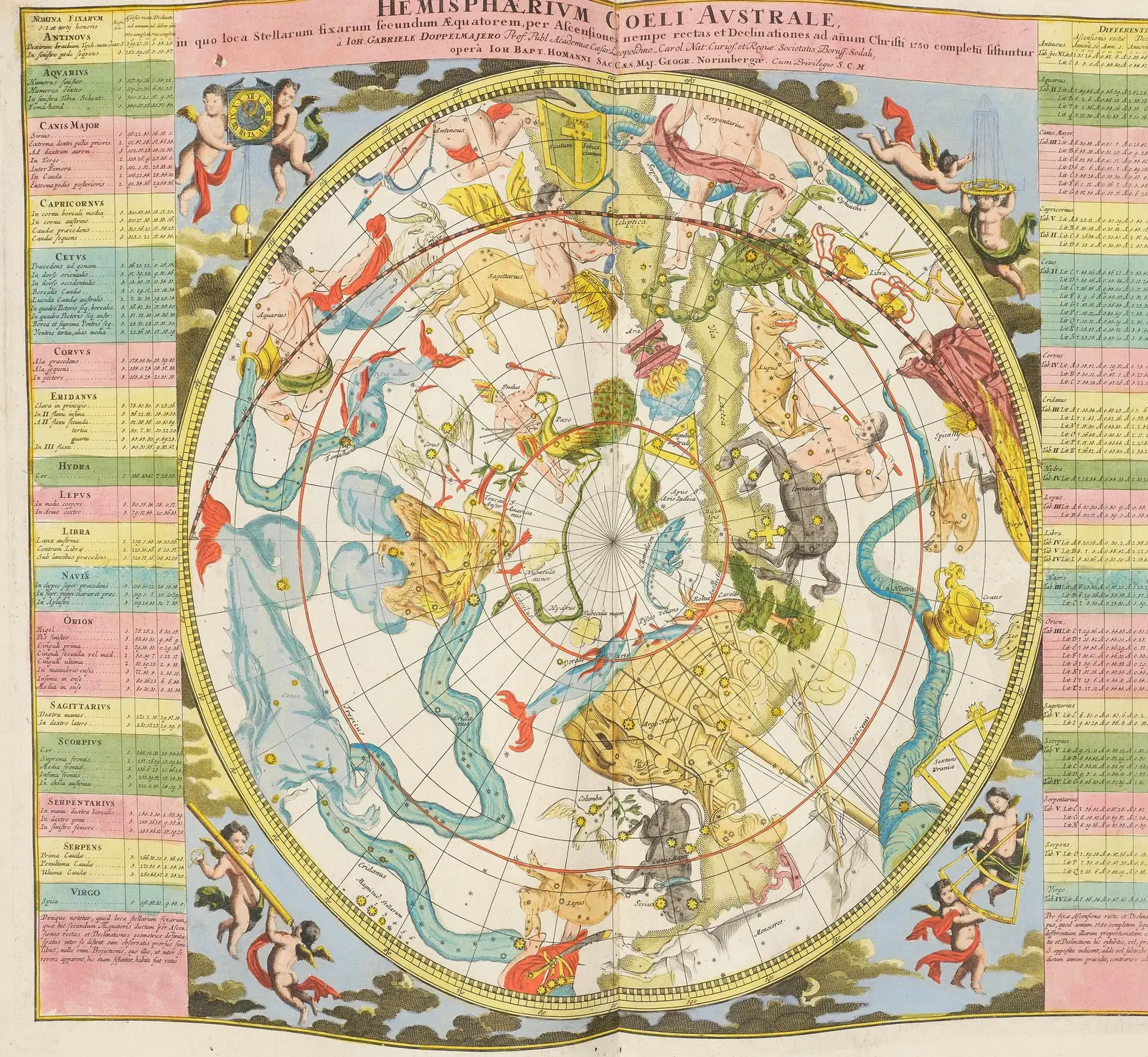
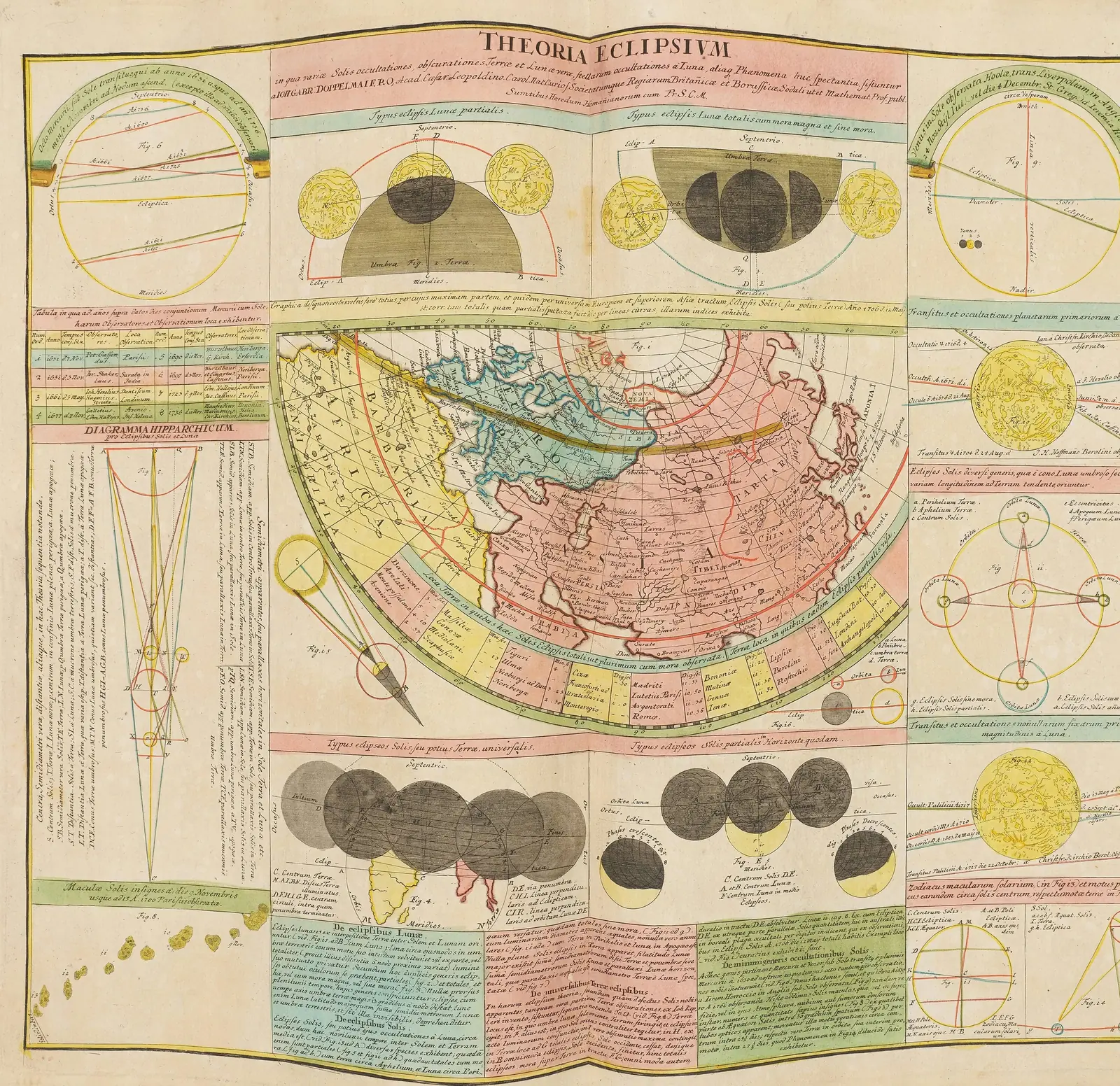
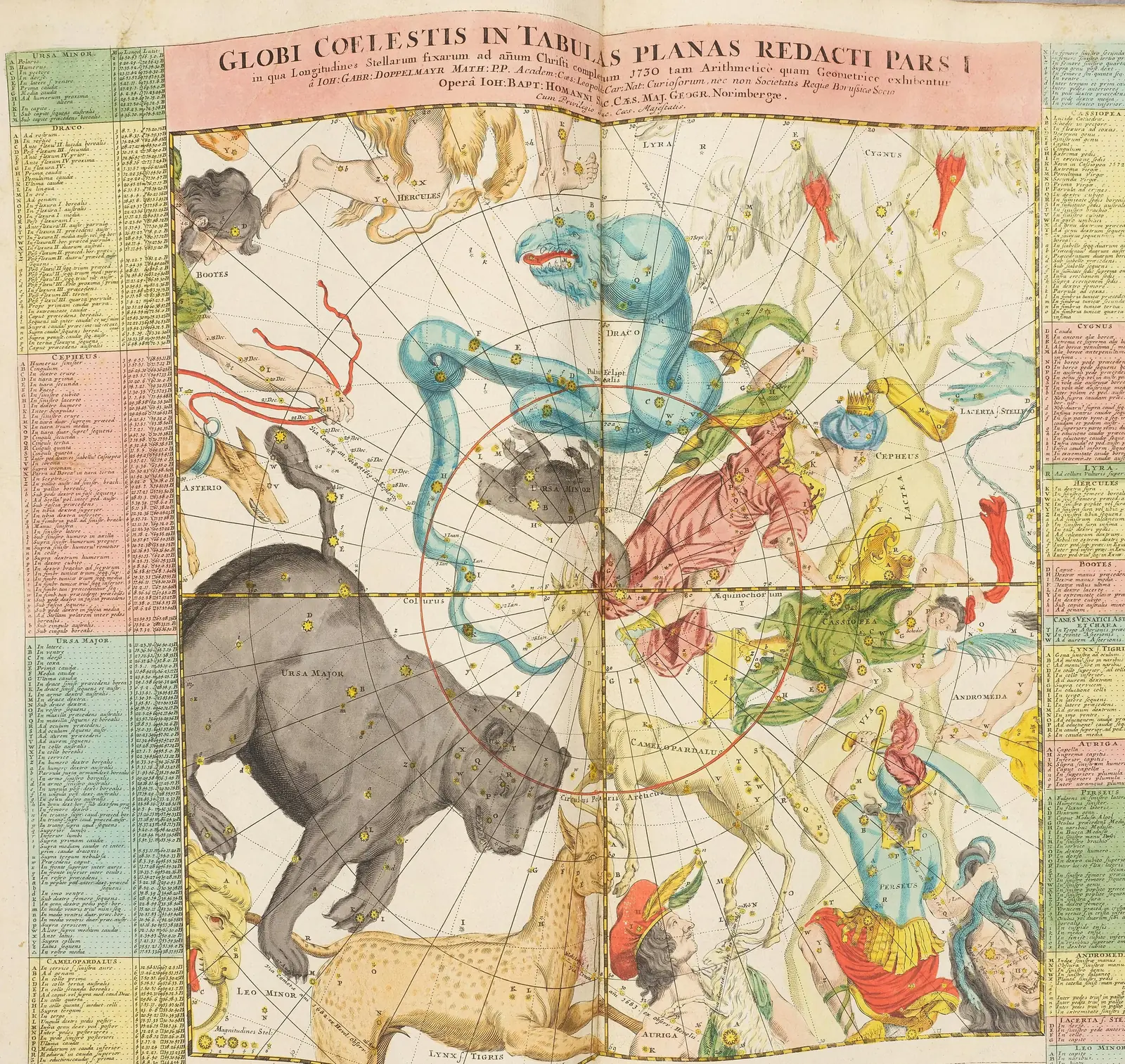
Johann Gabriel Doppelmayr, Atlas Novus Coelestis, 1742
At a glance
Astrology came from ancient Mesopotamia. Babylonian scribes read sky omens, created the 12-sign zodiac and cast the first birth horoscope in 410 BCE.
- Birthplace
- Mesopotamia (Iraq)omens from the 2nd millennium BCE
- 12 equal signs
- c. 5th century BCEBabylonian astronomers
- Oldest dated horoscope
- 410 BCEcuneiform, Babylon
- Rising sign and houses
- Hellenistic Egyptc. 2nd to 1st century BCE
- Sky drift since Ptolemy
- 26.1°computed, IAU 2006 precession
See your chart, the Hellenistic wayFree birth chart with rising sign and houses.
The first chapter
It started with a king, a tablet and the Moon
Try this today
- Look for Venus low in the west after sunset or east before dawn. You are doing exactly what the Venus Tablet records.
- Note tonight's Moon phase and how you feel. Three months of notes is the beginner's version of an omen list.
Picture a rooftop in Babylon. A scribe watches the new crescent appear, notes the date and checks it against a list that has been growing for centuries. If the Moon looks a certain way, the list says, the harvest will be good. Or the king should be careful.
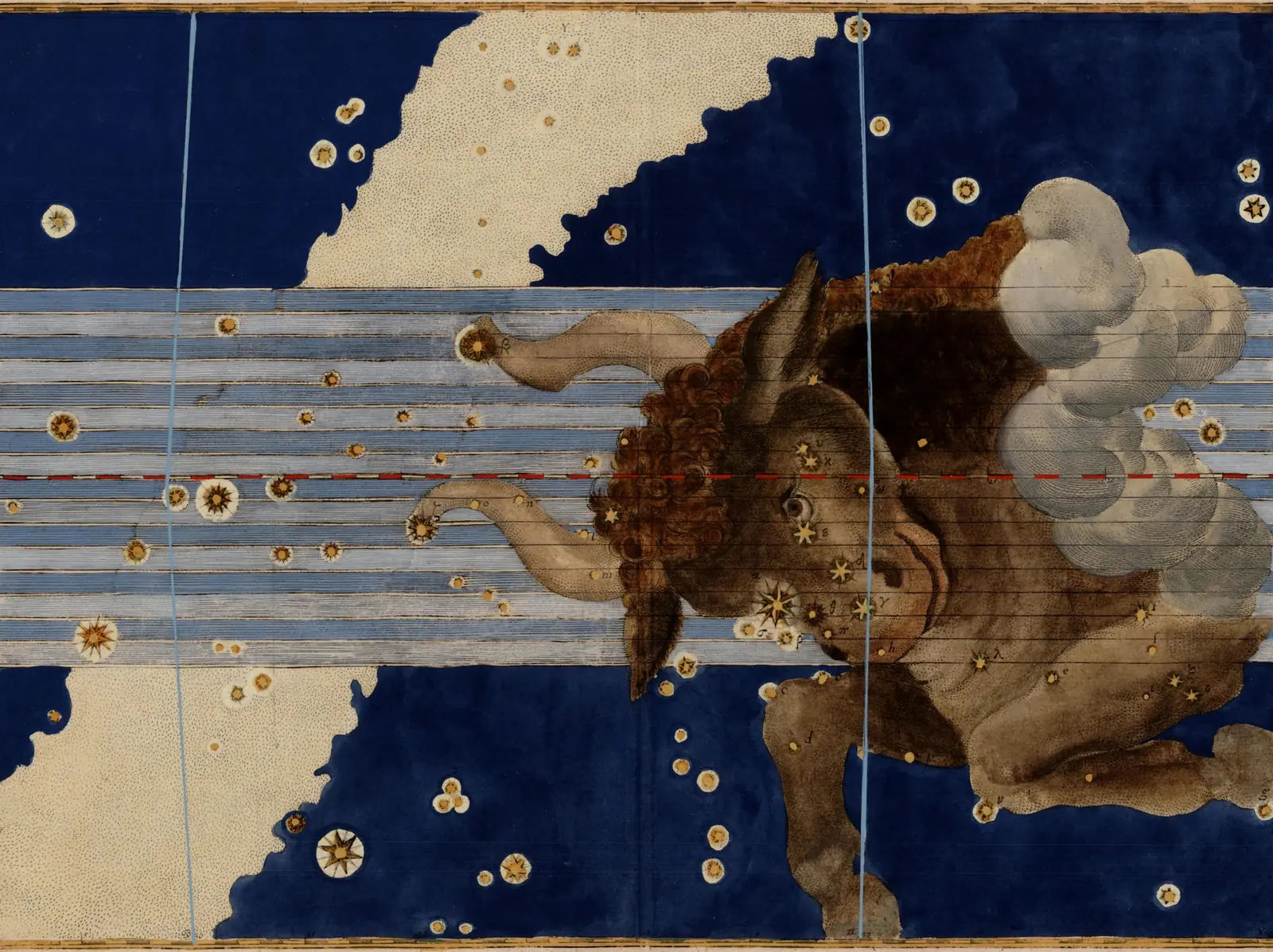
That list was real. Its largest form, Enuma Anu Enlil, ran to about 70 tablets of sky omens. Tablet 63, the Venus Tablet of Ammisaduqa, records the rising and setting of Venus over 21 years. The copy we have was made in the 7th century BCE and sits in the British Museum.
This was astrology for the state. Eclipses, planets and the Moon spoke about the king, wars and crops. Nobody was checking their own chart, because nobody had one yet.
What these scribes built was a habit: watch the sky every night, write it down, look for patterns. That habit is the root of both astrology and astronomy.
The signs
How the sky's path became twelve signs
Try this today
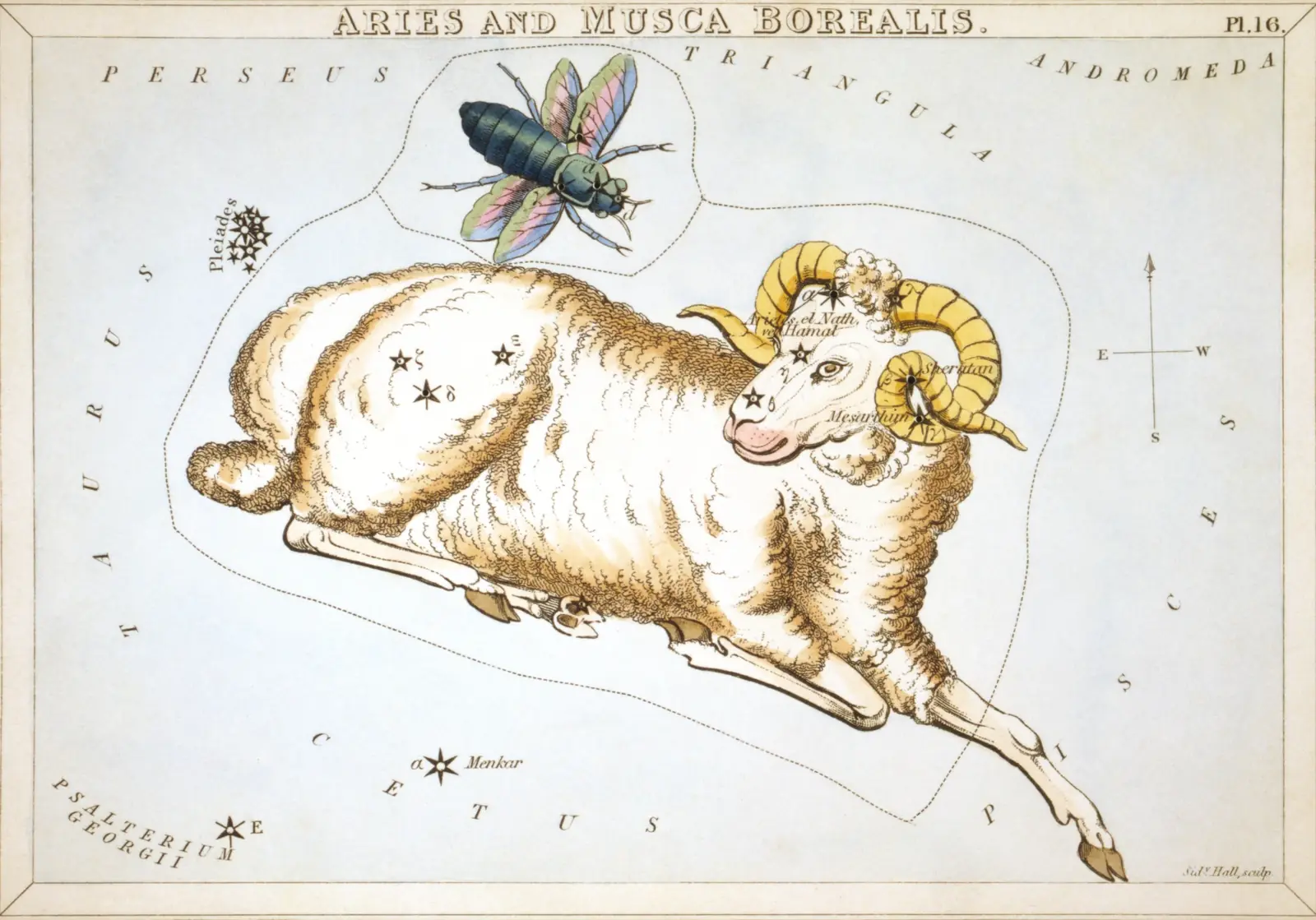
- Find your Sun sign's constellation in the evening sky about six months after your birthday, when it is opposite the Sun and up all night.
The Sun, Moon and planets all travel the same narrow band of sky. Babylonian astronomers listed the star groups along it. MUL.APIN, a star manual whose oldest dated copy was written in 686 BCE, names the constellations in the path of the Moon.
Then came a tidy idea. Around the 5th century BCE, astronomers cut that path into 12 equal parts of 30°, each named after a constellation it overlapped. Equal signs made the maths easy: you could say a planet was at 10° of the Lion and everyone could compute with it.
With signs came the first personal charts. The oldest dated birth horoscope is a cuneiform tablet from 410 BCE. It lists where the Moon and planets stood when a child was born. No rising sign, no houses yet, but the idea of you, written in the sky, had arrived.
Several sign names are Babylonian. The Bull, the Twins, the Lion and the Scales are there in cuneiform. Greek writers later wrapped them in their own myths.
The chart as we know it
Alexandria gave astrology its rising sign
Try this today
- Find your rising sign. It is the Hellenistic layer of your chart and needs your birth time.
- Look at your 10th house. Hellenistic writers tied it to action and reputation, an idea that is now 2,000 years old.
Rising sign calculatorEgyptian zodiac signs: myth and evidence
After Alexander the Great, Egypt was ruled by Greek-speaking kings, and Alexandria became the place where everything met. Babylonian planet tables, Egyptian decans (36 star groups used to tell time at night) and Greek geometry ended up on the same desks.
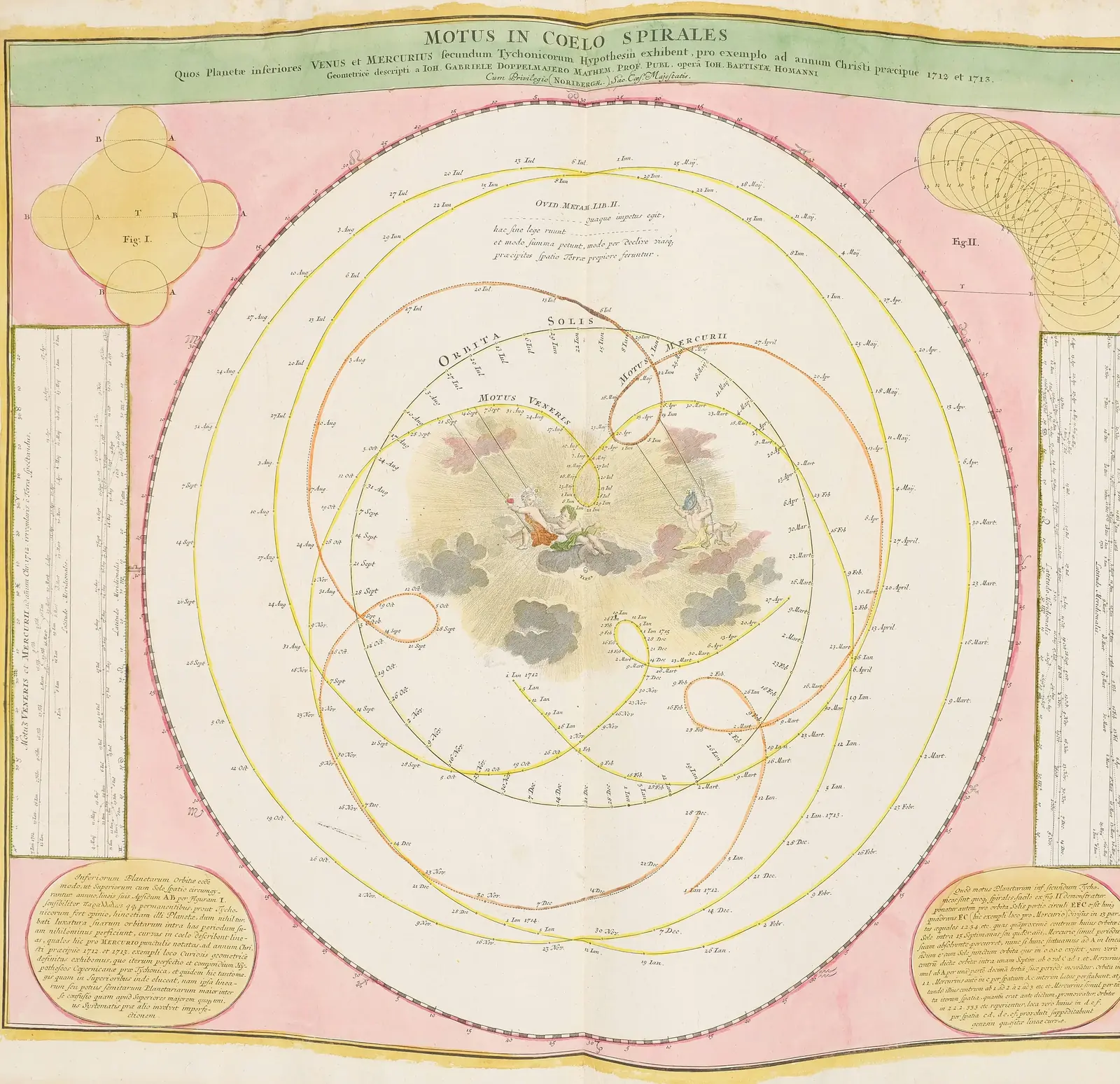
Between roughly the 2nd and 1st centuries BCE that mix produced what we now call Hellenistic astrology. It added the ascendant, the sign rising on the eastern horizon at birth, and the twelve houses counted from it. The chart became personal down to the hour and the place.
You can see the period in stone. The Dendera zodiac, a carved ceiling from a temple of Hathor made around 50 BCE, shows the twelve signs among Egyptian sky figures. It is in the Louvre.
Around 150 CE, Claudius Ptolemy wrote the Tetrabiblos, four books that became astrology's standard reference for 1,500 years. He tied the signs to the seasons: Aries begins at the March equinox. That is the tropical zodiac, and Western astrology still uses it.
The sky behind it
Ptolemy's tropical zodiac starts at the March equinox. When he wrote, that point sat in front of the stars of Pisces; by our computation it had left Aries around 67 BCE.
The long relay
Baghdad, Toledo, and the road back to Europe
Try this today
- Ask one clear question and look at the chart for that minute. That is Lilly's method, and we keep a guide to it.
Astrology travelled east as well as west. Greek texts reached India, where the Yavanajataka ("sayings of the Greeks") adapted them in the 2nd and 3rd centuries CE. Indian astrology kept a star-anchored zodiac, which is why Vedic and Western signs now differ.
From the 8th century, the Abbasid court in Baghdad sponsored translations of Greek, Persian and Indian works into Arabic. Abu Ma'shar (787-886) wrote about Jupiter-Saturn conjunctions as markers of history. In the 12th century his books, and many others, were translated into Latin in places like Toledo.
Medieval European universities taught astrology alongside medicine and astronomy. Doctors used it to time treatments. It was learned, mainstream and argued over.
Then in 1647, William Lilly published Christian Astrology, the first major astrology manual in English. Its centrepiece was horary: cast a chart for the moment a question is asked and read the answer from it.
The modern horoscope
New planets, a newspaper, and your phone

By the 18th century astronomy and astrology had split, and astrology lost its place in universities. It lived on in almanacs and among enthusiasts.
Then the sky grew. Uranus was spotted by William Herschel in 1781, at 24°27′ Gemini by our computation for his first sighting. Neptune followed in 1846, found at 25°53′ Aquarius. Pluto turned up on photographic plates in 1930, at 17°47′ Cancer. Astrologers added each one to the chart.
In the late 1800s and early 1900s, writers like Alan Leo recast astrology around character and psychology, with the Sun sign at the centre. And in August 1930, R. H. Naylor wrote about Princess Margaret's birth chart in the Sunday Express. Readers wanted more, so he began a column by birth date. That is the format of almost every horoscope you have ever read.
The rest you know: magazine columns, 1970s paperbacks, and now apps that compute a whole chart in a second.
The sky behind it
Positions are apparent geocentric ecliptic longitudes from JPL DE442: Uranus 1781-03-13, Neptune 1846-09-23, Pluto 1930-02-18, the day Clyde Tombaugh spotted it on plates taken that January. Neptune was found within about a degree of where Le Verrier predicted it.
Play with it
The astrology time machine
Jump to an era and see what an astrologer did there, what survives, and how far the sky has slid since. Then put in your birthday to see your Sun sign two ways: by the seasons, as Ptolemy measured it, and by the stars.
Choose an era
Mesopotamia
Sky omens for the king
Scribes watched the Moon, Venus and eclipses and matched them against a huge omen series, Enuma Anu Enlil. The readings were about the king and the land, not about you.
What you can still see
The Venus Tablet of Ammisaduqa (tablet 63 of the series), a 7th-century BCE copy in the British Museum.
The sky since then
The March equinox point sat in front of the stars of Aries. It has slid 42.0° westward along the zodiac since, close to 140% of one sign.
Pick a date to see your Sun sign by the season and by the stars. Birth time is not needed for the Sun; it moves about a degree a day.
More to read
Shorter reads. Each opens in place.
Why the signs slipped
26.1° of drift since Ptolemy
The signs did not change. The sky under them moved.
Earth wobbles like a slow top, one full turn in about 26,000 years. That wobble, precession, slides the equinox backward against the stars by about 1.4° per century, one degree every 71.6 years.
Continue readingShow less
Ptolemy's zodiac follows the equinox, so it slides too. Since about 150 CE the gap has grown to 26.1°. The equinox point left the stars of Aries around 67 BCE and will cross into Aquarius around 2598, using the modern IAU constellation borders.
This is why "your sign changed" stories go viral every few years. Nothing changed. Western astrology chose the seasons; Vedic astrology chose the stars.
A fair note
History is real. Prediction is a different question
Astrology's past is documented in museums and libraries. Whether it predicts anything is a separate question, and controlled studies have not found that it does. We treat it as a tradition worth knowing and a mirror for reflection, never as a guarantee.
Continue readingShow less
The timeline, with the sky computed
Each step of the story with the equinox's position among the constellations at the time, and how far it has moved since.
| When | Where | What happened | Equinox among the stars of | Drift to 2026 |
|---|---|---|---|---|
| c. 1000 BCE | Mesopotamia | Sky omens for the king | Aries | 42.0° |
| 686 BCE | Assyria and Babylonia | MUL.APIN, a star manual | Aries | 37.7° |
| 410 BCE | Babylon | The first birth horoscopes | Aries | 33.9° |
| c. 150 BCE | Alexandria, Egypt | The rising sign is born | Aries | 30.3° |
| c. 150 CE | Alexandria | Ptolemy's Tetrabiblos | Pisces | 26.1° |
| c. 800 CE | Baghdad | The Abbasid translators | Pisces | 17.1° |
| 1647 | London | Christian Astrology | Pisces | 5.3° |
| 1930 | London | The first horoscope column | Pisces | 1.3° |
| Event | Date (UTC) | Position |
|---|---|---|
| Herschel first sees Uranus, 13 March 1781 | 1781-03-13 | 24°27′ Gemini |
| Galle and d'Arrest find Neptune, 23 September 1846 | 1846-09-23 | 25°53′ Aquarius |
| Tombaugh spots Pluto on plates, 18 February 1930 | 1930-02-18 | 17°47′ Cancer |
| The Sun on 21 August 1930, the birth that prompted the first newspaper horoscope | 1930-08-21 | 27°42′ Leo |
All times are UTC. In the Americas the local date can be a day earlier; in Asia and Australia a day later.
Quick answers
Where did astrology come from?
Mesopotamia, modern Iraq. Babylonian and Assyrian scribes kept omen lists of the sky from the second millennium BCE, invented the 12-sign zodiac by about the 5th century BCE and cast the first birth horoscopes, the earliest dated 410 BCE. Greek-speaking Egypt then added the rising sign and houses.
Who invented astrology?
No single person. It grew over centuries among Mesopotamian scribes whose names are mostly lost. The people you can name are later: Ptolemy, who wrote the Tetrabiblos around 150 CE, Vettius Valens, Abu Ma'shar in Baghdad, and William Lilly in 17th-century London.
What is the origin of the zodiac signs?
The signs come from Babylonian constellations along the Sun's path, listed in texts like MUL.APIN. Around the 5th century BCE astronomers split that path into 12 equal 30° parts named after the main constellations. Several names are Babylonian originals, such as the Bull, the Twins, the Lion and the Scales; the Greeks added their own myths later.
How old is astrology?
Sky omens go back at least to the second millennium BCE. Personal birth horoscopes are younger: the oldest dated one is from 410 BCE, so about 2,400 years old. The Western chart with a rising sign and houses dates to Hellenistic Egypt, roughly the 2nd to 1st century BCE.
Is astrology older than astronomy?
They started as the same job. The Babylonian scribes who predicted eclipses and planetary positions also read them as omens. The two only separated in Europe during the 17th and 18th centuries.
When did the first horoscope column appear?
In August 1930, when R. H. Naylor wrote about the birth chart of Princess Margaret in London's Sunday Express. Readers responded so well that he was given a regular column, and horoscopes by birth date followed. Her Sun was at 27°42′ Leo, computed for noon on 21 August 1930.
Why do astrology signs not match the constellations anymore?
Because of precession. The tropical zodiac is tied to the equinox, which drifts against the stars about 1.4° per century. Since Ptolemy's time it has moved 26.1°, nearly a whole sign. The equinox left the stars of Aries around 67 BCE and reaches Aquarius around 2598.
Is astrology a science?
Not in the modern sense. Controlled tests have not shown that astrology predicts personality or events. Its history is real and scientific in a different way: astrology paid for centuries of careful sky-watching. Shymea treats it as a tradition and a tool for reflection.