Astrology systems · The 13th sign question
Is Ophiuchus a real zodiac sign? A real constellation, yes. A sign, no.
The Sun stands in front of Ophiuchus for 18.3 days every year, Nov 30 to Dec 18 in 2026. That makes it a real part of the sky, not a lost 13th sign. Here is the difference, with the dates computed.
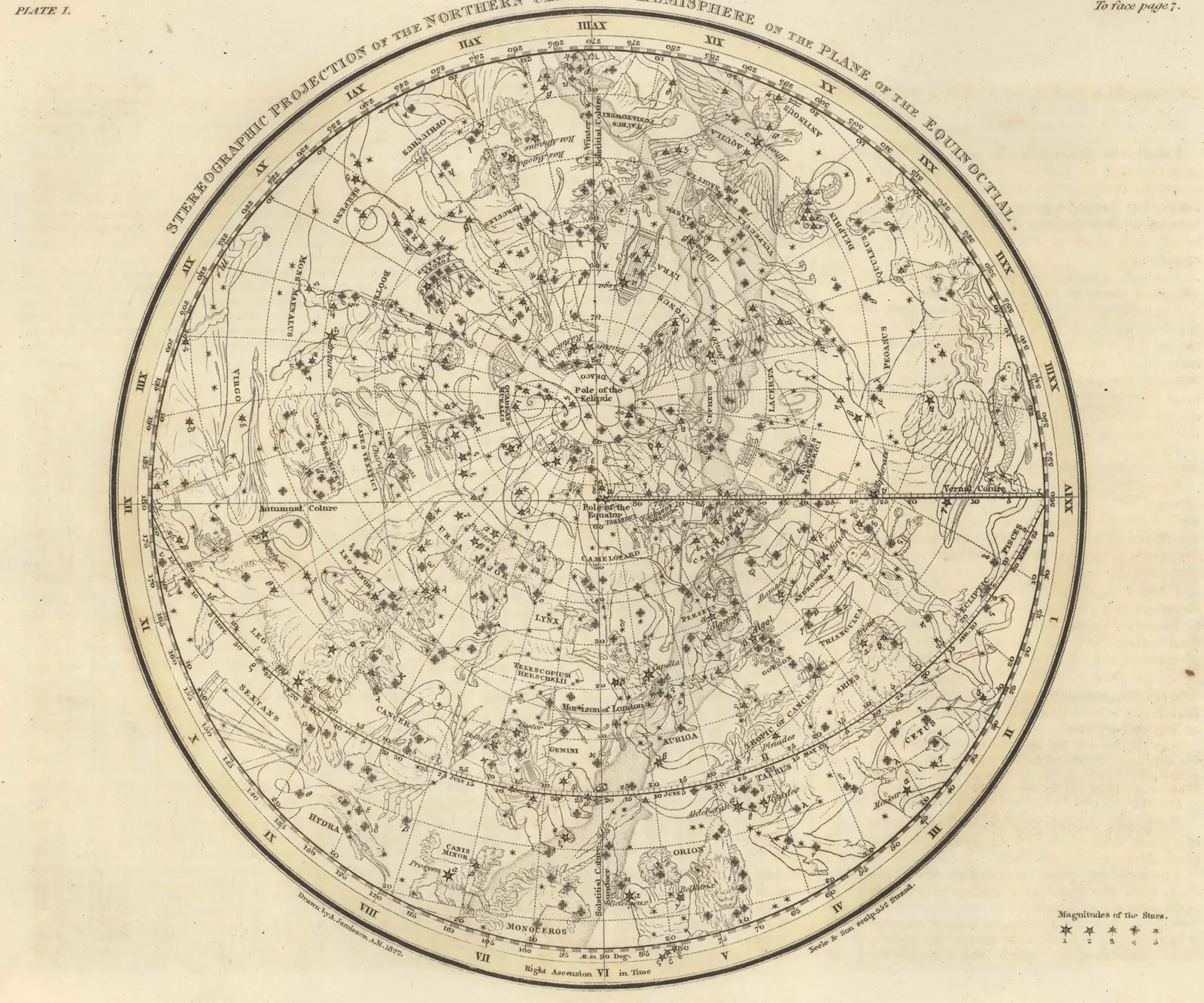
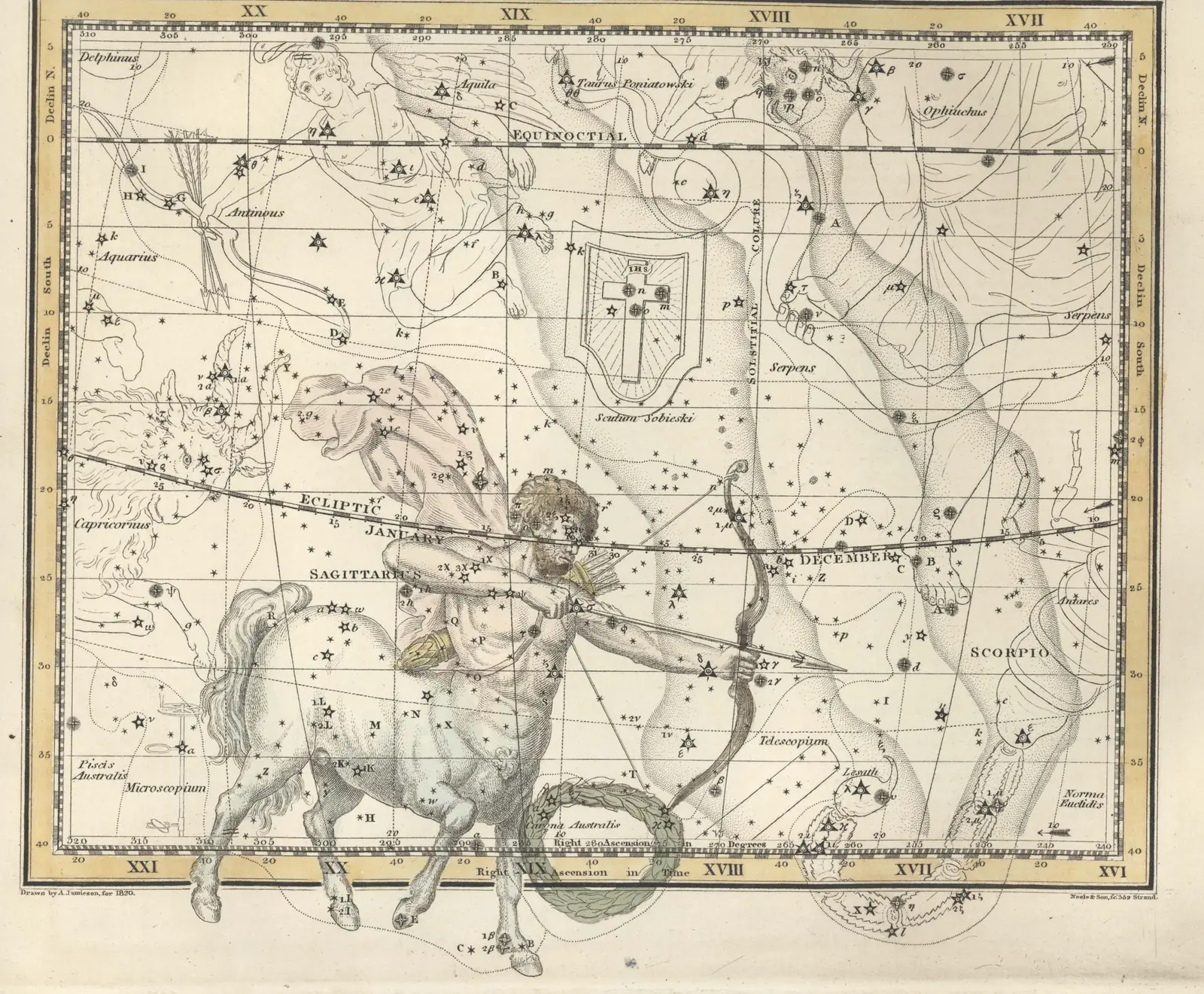
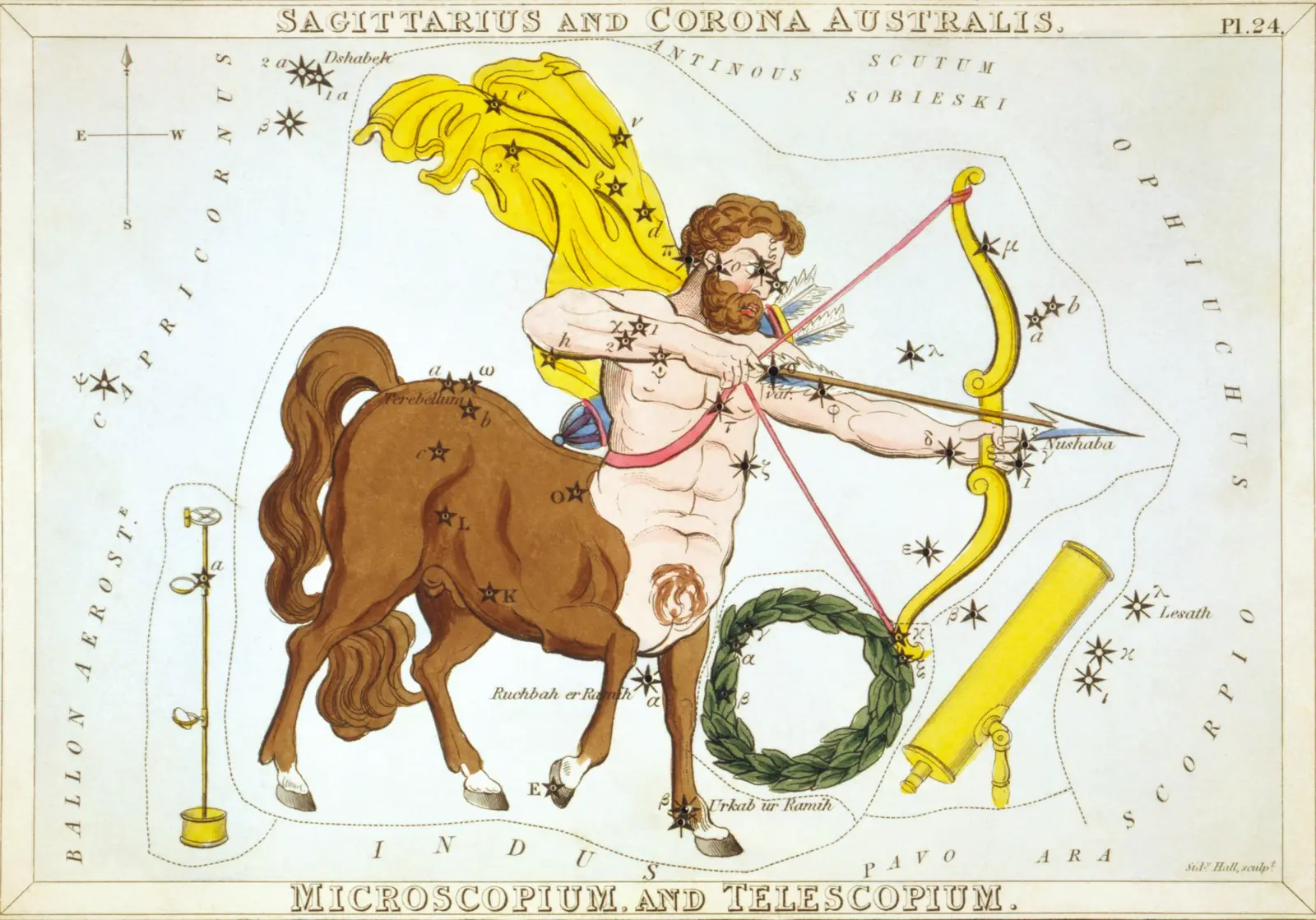
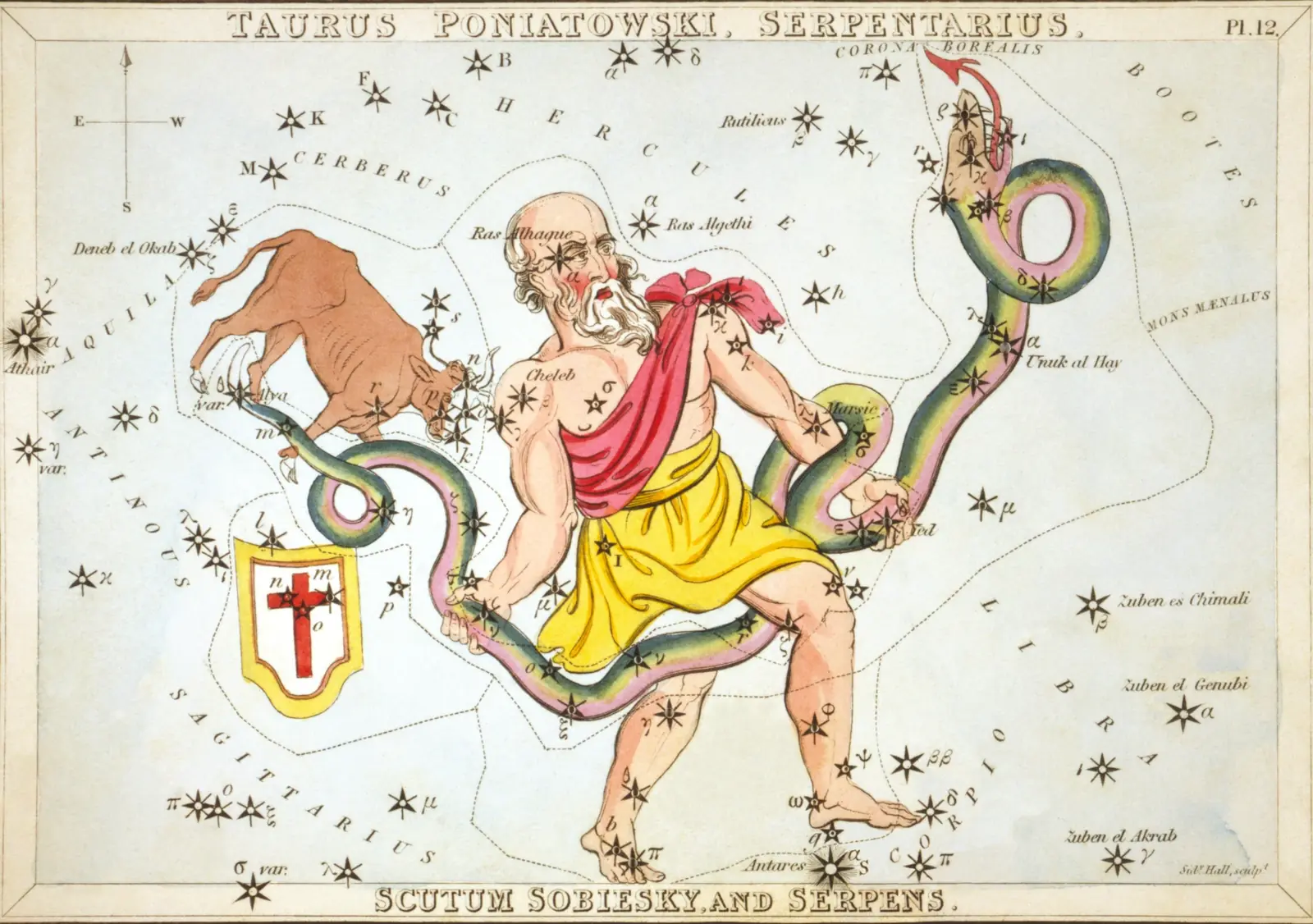
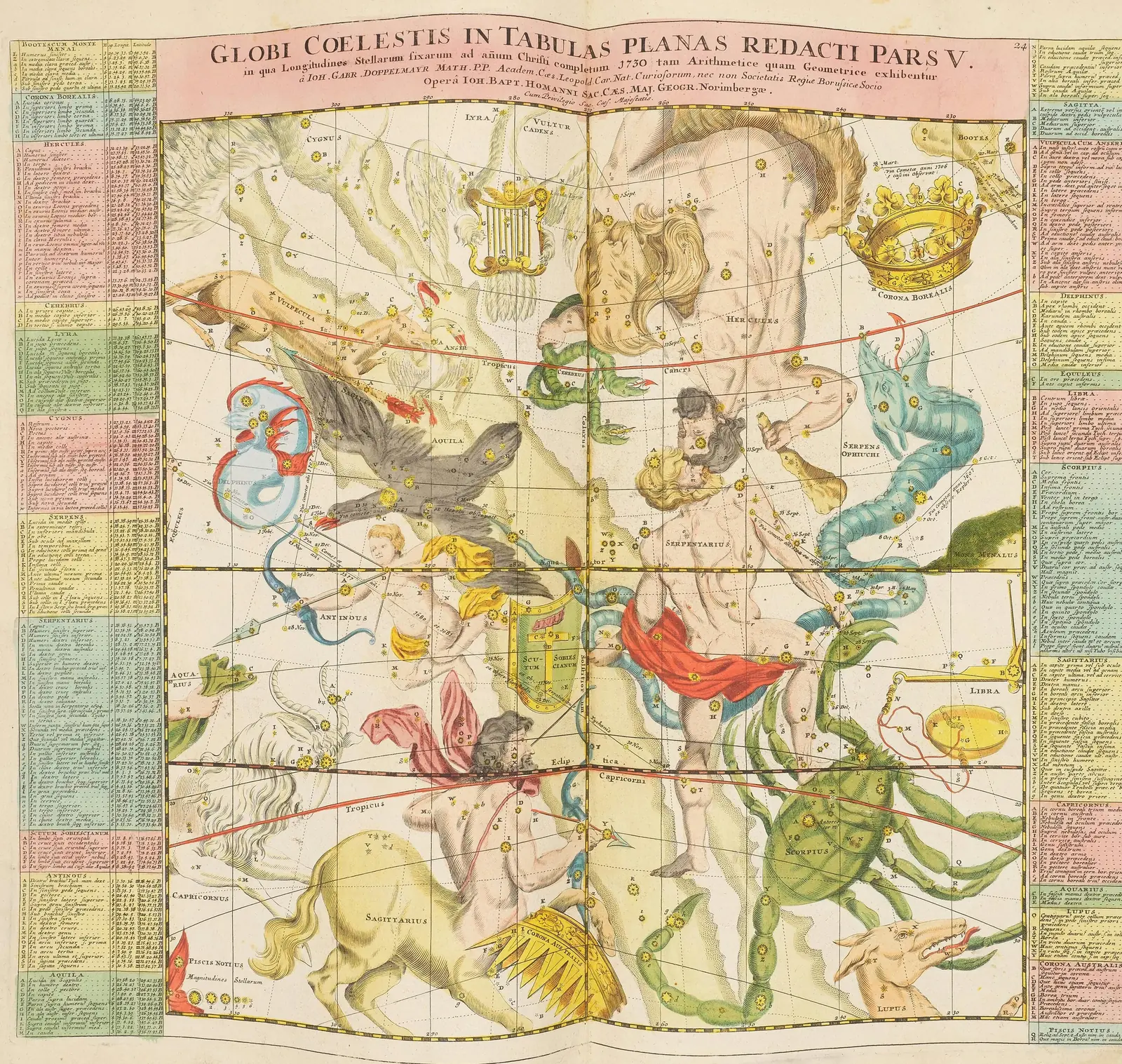
Urania's Mirror, London 1824 · Library of Congress
At a glance
No. Ophiuchus is a real constellation, not a zodiac sign. The Sun passes in front of it from Nov 30 to Dec 18, 2026, and anyone born then is a Sagittarius in Western astrology.
- Sun in Ophiuchus 2026
- Nov 30 to Dec 1805:39 to 13:06 UTC, 18.3 days
- Sun in Ophiuchus 2027
- Nov 30 to Dec 1811:46 to 19:20 UTC, 18.3 days
- Your Western sign then
- SagittariusSun at 8°01′ Sagittarius to 26°37′ Sagittarius
- Vedic sign then (Lahiri)
- Scorpio or Sagittarius13°47′ Scorpio to 2°23′ Sagittarius
- Scorpius, for scale
- 6.5 daysNov 23 to Nov 30, 2026
See your real Sun sign and the rest of your chartFree birth chart: Sun, Moon, rising and every planet, to the minute.
The short answer
Ophiuchus is real. It is just not a sign.
Try this today
- Next time the screenshot drops, ask one question: does it mean the constellation or the sign? Most of the confusion dies right there.
- Check your own birthday in the tool below. Unless you were born between about Nov 29 and Dec 18, Ophiuchus does not touch your Sun at all.
Has my zodiac sign changed? Check all threeReal zodiac dates 2026: all 13 constellations
Someone in the group chat just posted the screenshot again: "NASA says there's a 13th sign and you're probably not what you think." You check your birthday against the list. Panic, briefly. Then the question: is any of this real?
Half of it is. Ophiuchus (oh-fee-YOO-kus), the serpent-bearer, is a genuine constellation. It is one of the 88 the International Astronomical Union recognises, and it was already one of the 48 that Ptolemy catalogued in the 2nd century. The Sun really does pass in front of it every year. In 2026 that happens from Nov 30, 2026 · 05:39 UTC to Dec 18, 2026 · 13:06 UTC.
The other half is a mix-up between two different things that share names. Constellations are star patterns of every size, with borders astronomers drew in 1930. Zodiac signs are 12 equal slices of the Sun's yearly path, each exactly 30 degrees, counted from the March equinox. They were named after constellations about two and a half thousand years ago, but they were never the same thing, and they were never meant to be.
So the honest answer to "is Ophiuchus a real zodiac sign" is: it is a real thing in the sky, and it is not a zodiac sign in Western astrology, Vedic astrology, or any mainstream tradition.
The sky behind it
Constellation membership uses the IAU boundaries (Delporte 1930, in B1875.0 coordinates), applied to the Sun's apparent geocentric position from NASA JPL's DE442 ephemeris. Method: skyfield 1.53 + JPL DE442 (loaded via scripts/calendars/generate.py, which looks for ~/Desktop/de442.bsp). Positions of date are precessed to B1875.0 and looked up with skyfield's load_constellation_map(), the IAU boundary table (Delporte 1930; Roman 1987, CDS VI/42). Changes are bracketed on a 1-hour grid and bisected to 1 second. Lahiri ayanamsa = 23.85305 deg at J2000 plus general precession in longitude (IAU 2006).
The dates
Ophiuchus dates 2026 and 2027: 18.3 days, and Scorpius gets 6.5
Try this today
- Put Nov 30 in your calendar as "the Sun walks past the serpent-bearer." The countdown in the tool below shows it in your time zone.
- Seen Ophiuchus dates a day off from these? Time zones and rounding shift the edges. The table below gives exact UTC times for every year from 2020 to 2040.
Here are the numbers, computed to the second. In 2026 the Sun leaves Scorpius and enters Ophiuchus on Nov 30 at 05:39 UTC, then crosses into Sagittarius on Dec 18 at 13:06 UTC. That is 18.3 days. If you live in the Americas, the start lands on your evening of Nov 29 (21:39 Pacific).
In 2027 the window runs Nov 30, 2027 · 11:46 UTC to Dec 18, 2027 · 19:20 UTC, 18.3 days again.
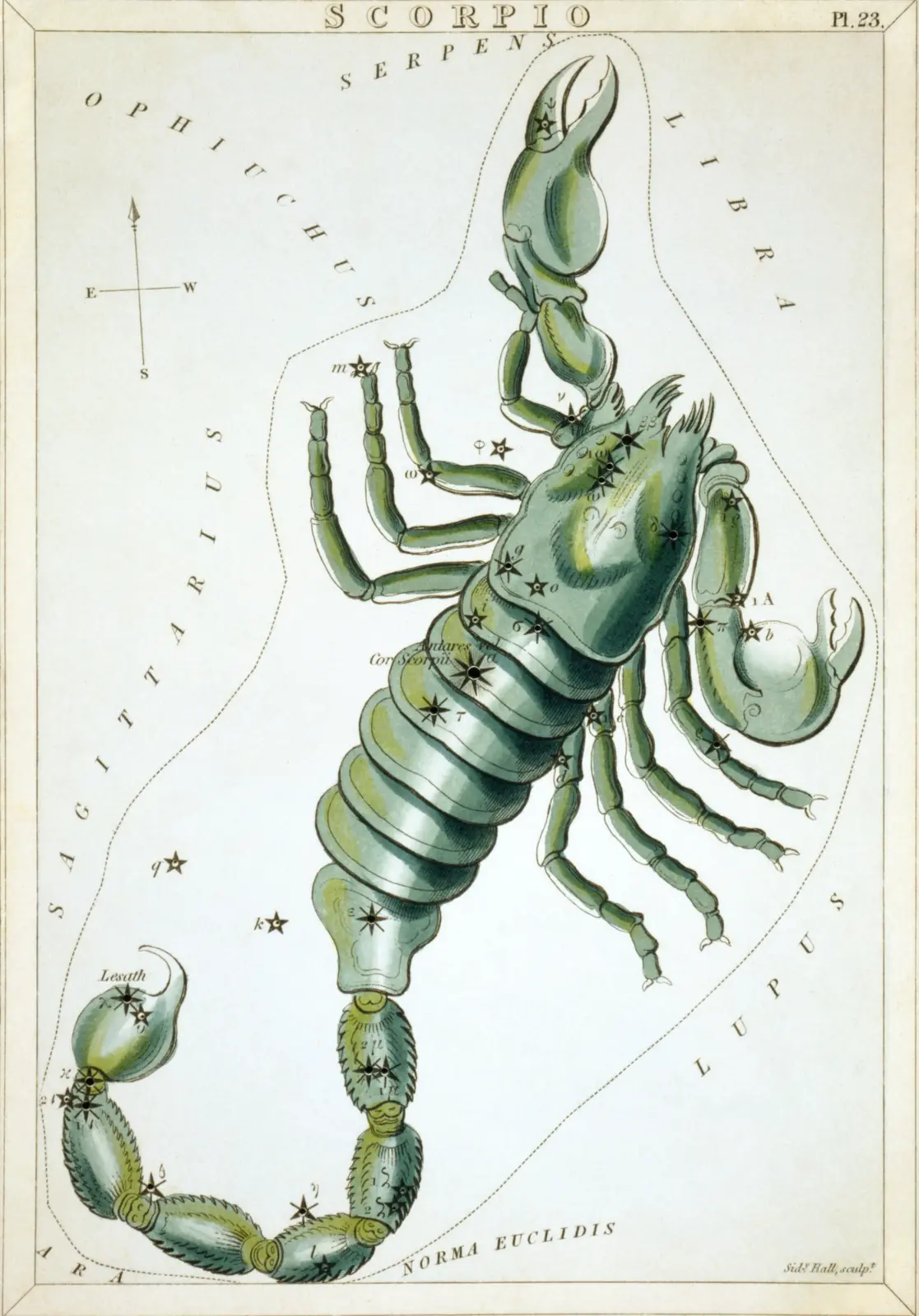
The surprise is how little Scorpius gets. The Sun is in front of the scorpion's stars for only 6.5 days in 2026, Nov 23 to Nov 30. Measured along the Sun's path, Scorpius covers just 6.59° of the ecliptic and Ophiuchus covers 18.6°. Virgo, the biggest, covers 43.96° and holds the Sun for 44.5 days.
That is why "constellation dates" look so lopsided next to sign dates. The constellations are irregular patches with borders drawn on a grid of right ascension and declination. The signs are equal on purpose. Neither is wrong; they measure different things.
The sky behind it
Window length 1940 to 2040: 18.3 to 18.3 days. Ecliptic coverage is measured along the true ecliptic of date at 2026-07-02 in 0.01° steps; Ophiuchus spans 8°01′ Sagittarius to 26°37′ Sagittarius of tropical longitude, and the Sun's path crosses 13 constellations in all.
Where the 12 come from
Why the zodiac has 12 signs, not 13
Try this today
- Ask whether a source talks about signs or constellations before you trust its dates. Sign dates are equal; constellation dates swing from about a week to six weeks.
- If the stars-not-seasons idea appeals to you, look at sidereal astrology instead. It still uses 12 signs.
Picture the sky as Babylonian astronomers did: a belt of stars the Sun, Moon and planets all move through. Early star lists from Mesopotamia name more than twelve figures along that belt. By around the 5th century BC, though, astronomers had settled on something tidier: 12 equal divisions of 30 degrees, close to the number of lunar months in a year, which made the arithmetic of the calendar much easier.
Greek astrology inherited that grid, and by Ptolemy's time in the 2nd century AD the signs were counted from the spring equinox, the tropical zodiac Western astrology still uses. Aries begins where the Sun crosses the equator in March, whatever stars happen to sit behind it. Because Earth's axis slowly wobbles (precession), those stars have drifted by almost a whole sign since then. The signs stayed with the seasons, by design.
Ophiuchus was well known to the same astronomers. Aratus describes the serpent-bearer in his poem Phaenomena in the 3rd century BC, and Ptolemy lists its stars. They knew its feet came down near the Sun's path. They simply did not count it, because the zodiac was a measuring tape, not a census.
The neat modern line that hands Ophiuchus 18.3 days of the year came much later. In 1930 the IAU published official constellation borders, drawn by the Belgian astronomer Eugène Delporte along lines of right ascension and declination. Those borders put a slice of the ecliptic inside Ophiuchus, and that slice is where every "13th sign" story begins.
The sky behind it
Between 1940 and 2040 the Sun's entry into Ophiuchus moves 1.4° later in the tropical zodiac (6°49′ Sagittarius to 8°12′ Sagittarius). That is precession at work: about 1° every 72 years.
The viral part
Where the 13th zodiac sign story actually came from

Try this today
- Next time it trends, reply with the year of the original book. It is a better comeback than any meme.
- Run the myth-or-fact round in the tool below with a friend. Loser explains precession at the next dinner.
Which astrology is most accurate?The history of astrology, in one timeline
The idea has a paper trail, and it is younger than your parents' record collection.
1970. Steven Schmidt's book Astrology 14 proposed a 14-sign zodiac of equal signs that added both Ophiuchus and Cetus, the sea monster. That appears to be where the idea starts.
1995. Walter Berg's The 13 Signs of the Zodiac promoted a 13-sign version with Ophiuchus, and it found a big audience, especially in Japan. Schmidt (in a 1974 follow-up) and Berg both made Pluto the ruler of Ophiuchus. Once Ophiuchus was treated as a sign, people started writing personality profiles for it.
January 2011. Parke Kunkle, an astronomer with the Minnesota Planetarium Society, pointed out in a newspaper interview that the stars behind the signs have shifted and that the Sun passes through Ophiuchus. The quote went around the world as "your sign has changed."
2016. A NASA education page for kids explained the same astronomy and mentioned that the Babylonians left Ophiuchus out. It was read as NASA rewriting the zodiac. NASA's spokesperson set it straight: they had not changed any zodiac signs, they had just done the math. The page was about astronomy, not astrology.
2020. The NASA version went viral again, and was corrected again. It will probably come back. Now you know the receipts.
The story in the stars
Who the serpent-bearer is, and what to look for
Try this today
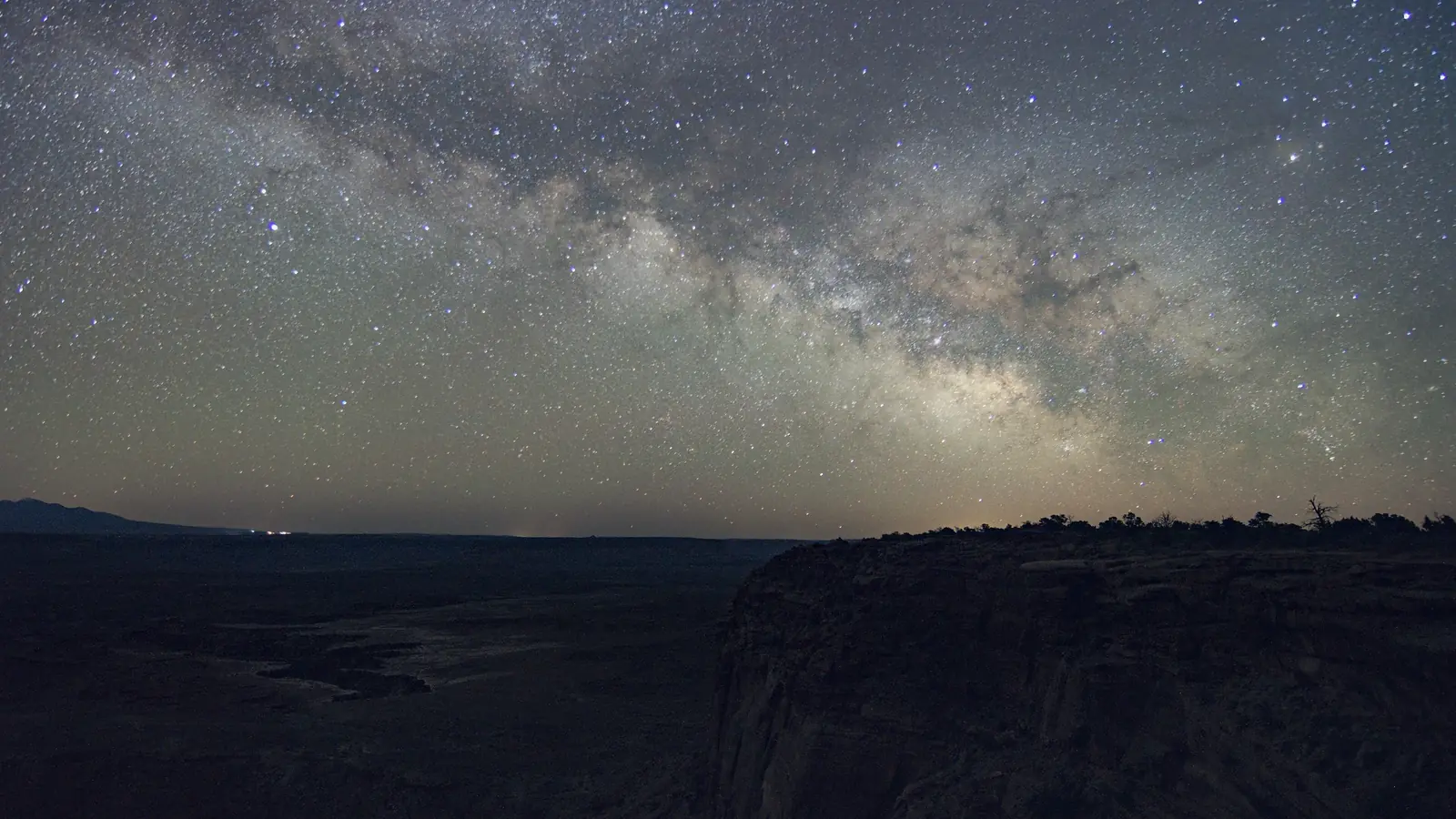
- On a clear night next June or July, find red Antares in Scorpius, then look up. The big faint pentagon-ish shape above it is Ophiuchus.
- Notice that Asclepius' staff has one snake. The two-snake staff (the caduceus) belongs to Hermes. Ophiuchus is the one-snake guy.
The myths behind all 12 zodiac signsSagittarius: the sign you really are
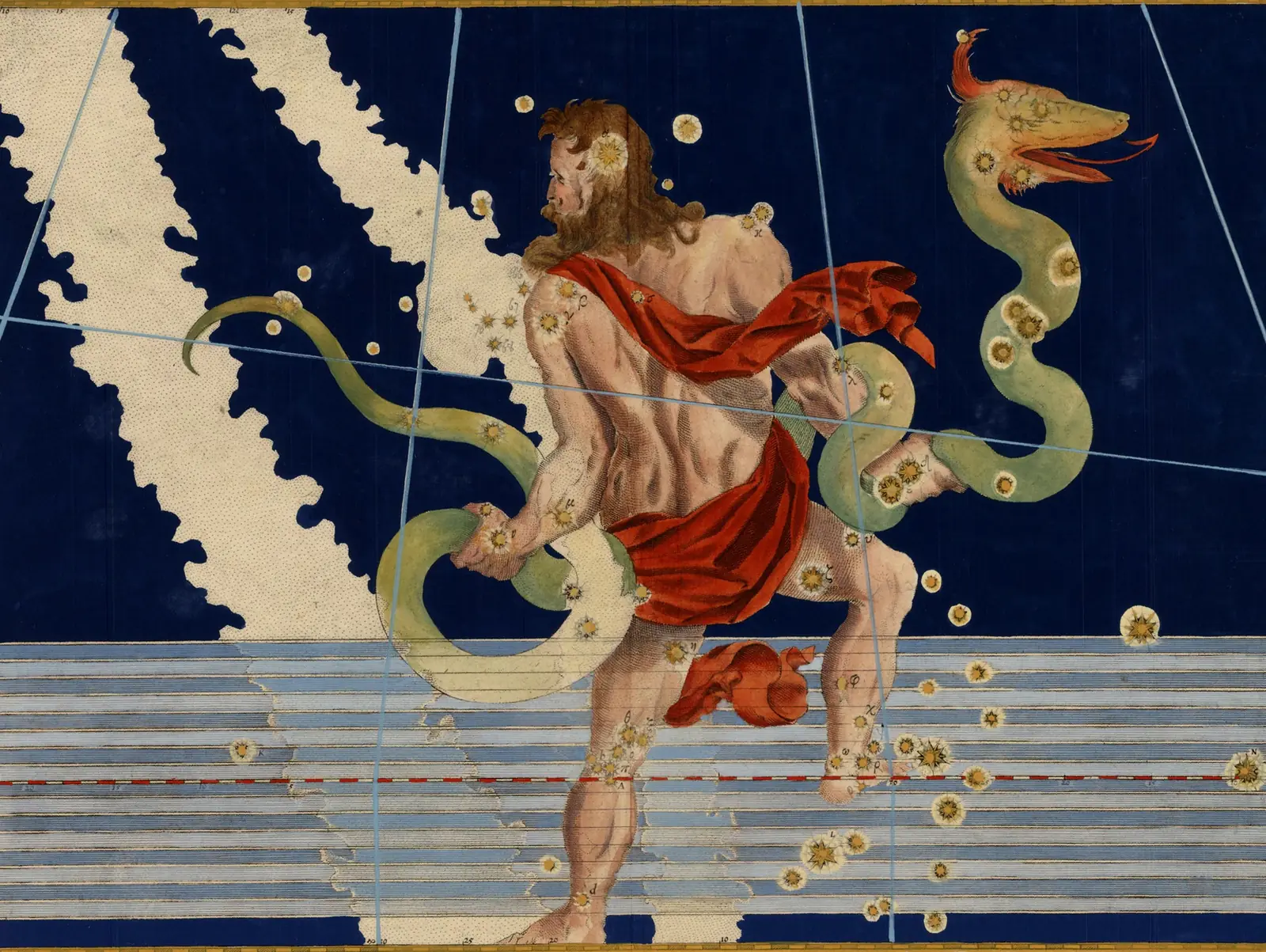
The name is just Greek for what you see: ophioukhos, "the one holding a serpent." The constellation is drawn as a huge figure standing over Scorpius, gripping a snake that is its own constellation, Serpens, split into a head on one side and a tail on the other.
Classical writers were not unanimous about who he was. The most common identification, found in Hyginus's Astronomica and repeated by later star-lore collectors, is Asclepius (Aesculapius to the Romans), the healer whose staff with a single snake is still a symbol of medicine. In the story, his skill at raising the dead angered the gods, Zeus struck him down, and he was placed among the stars. Hyginus also records other candidates, including a Thracian king named Carnabon. That is a myth told in several versions, not a single canon.
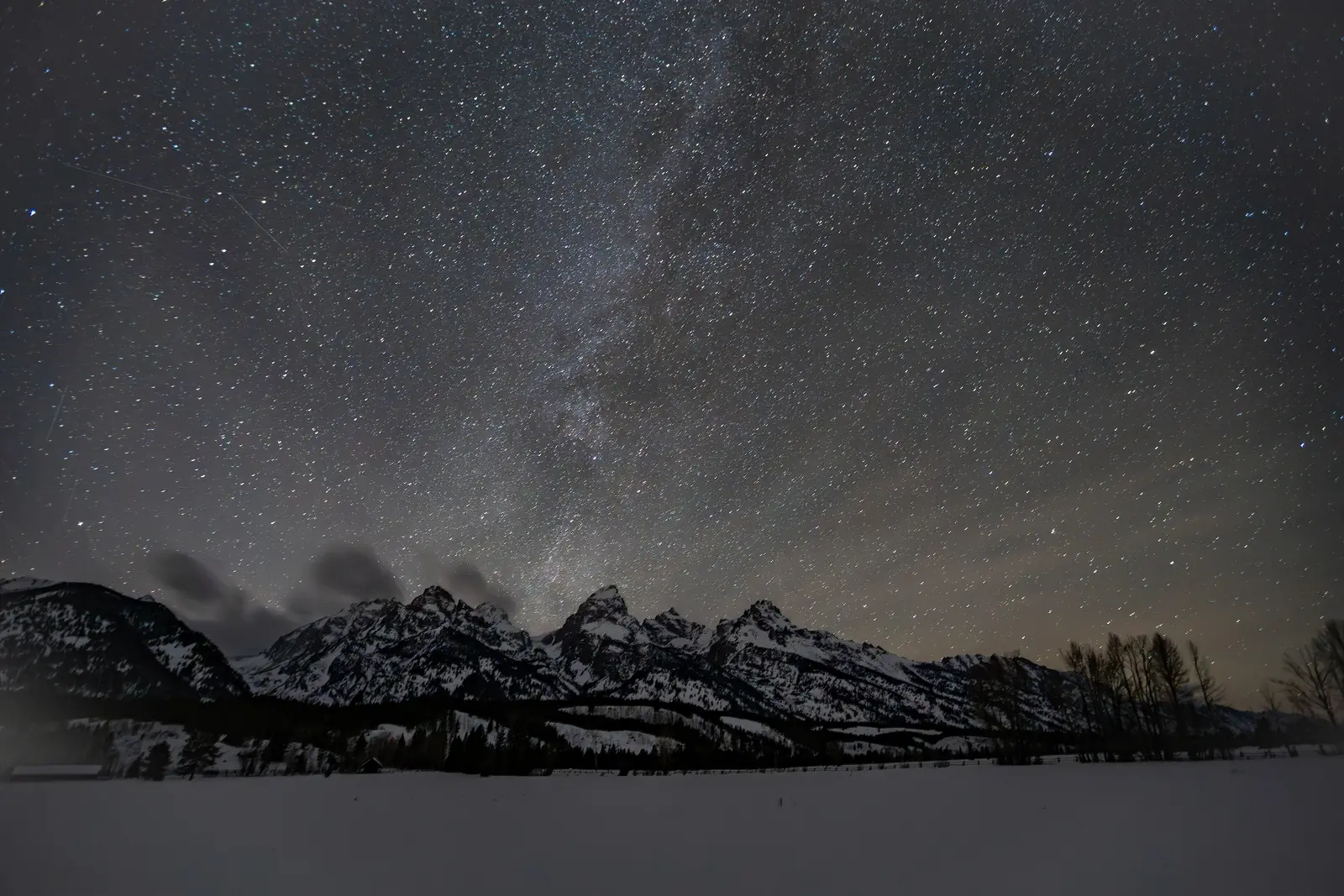
If you want to see the real thing, look on a summer evening in the northern hemisphere, high above the reddish heart of Scorpius. Its brightest star, Rasalhague, sits at the figure's head. In 1604 a "new star" blazed up in Ophiuchus, the supernova now called Kepler's Supernova, the last one seen with the naked eye in our galaxy. And Barnard's Star, one of the Sun's nearest neighbours, sits inside its borders too.
By December, when the Sun is in front of Ophiuchus, the constellation is lost in the glare. You are standing on the wrong side of the Sun to see it, which is a nice way to think about your birthday month.
Check yourself
Am I an Ophiuchus? (And a quick myth-or-fact round)
Enter your birthday from 1940 to 2040. The checker uses the Sun's computed Ophiuchus window for your birth year and tells you whether the Sun was in front of the serpent-bearer, plus your actual Western sign. Then try eight claims from the internet and see how many you can call.
The constellation behind the Sun
Yes, the Sun was in Ophiuchus
It had been there 6 days and would leave 12 days later. In 2000 the Sun's stay ran from Nov 29, 2000, 1:39 PM UTC to Dec 17, 2000, 9:11 PM UTC.
Your Western zodiac sign: Sagittarius (Sun at 13°39′ Sagittarius). That is the sign horoscopes use, and it does not change. Everyone born in the Ophiuchus window is a Western Sagittarius.
More to read
Shorter reads. Each opens in place.
Not just the Sun
Other planets pass through Ophiuchus too
The Moon crosses Ophiuchus 27 times in 2026 and 2027, staying 0.9 to 1.0 days each time. Mercury passes through from Dec 11 to Dec 23, 2026 and Dec 4 to Dec 16, 2027. Venus is there Jan 15 to Jan 31 and again Nov 7 to Nov 22, 2027, and Mars Oct 27 to Nov 21, 2027. Jupiter and Saturn stay away in both years. Astrologers still read all of these in the 12 signs.
Continue readingShow less
December birthdays
Born in the Ophiuchus window? You are a Sagittarius
In 2026 the Sun enters tropical Sagittarius on Nov 22, 2026 · 07:23 UTC, 8 days before it reaches Ophiuchus, and stays until Dec 21, 2026 · 20:50 UTC, 3 days after it leaves. Every window from 1940 to 2040 sits entirely inside Sagittarius, so the answer is the same for every birth year. Your horoscope sign never moved.
Continue readingShow less
About those trait lists
Ophiuchus personality traits are a modern invention
No classical text describes an Ophiuchus temperament, ruler or element, because no classical astrologer used it as a sign. The trait lists you see online are modern writing, built on the 13-sign idea that took off after 1970. They can be fun. They are not tradition.
Continue readingShow less
Ophiuchus dates, computed
When the Sun stands in front of Ophiuchus each year, how 2026 compares with every other constellation on the Sun's path, and who else drops by.
| Year | Enters Ophiuchus | Leaves for Sagittarius | Days | Western position |
|---|---|---|---|---|
| 2020 | Nov 29, 2020 · 16:44 UTC | Dec 18, 2020 · 00:11 UTC | 18.3 | 7°56′ Sagittarius to 26°32′ Sagittarius |
| 2021 | Nov 29, 2021 · 22:57 UTC | Dec 18, 2021 · 06:26 UTC | 18.3 | 7°56′ Sagittarius to 26°33′ Sagittarius |
| 2022 | Nov 30, 2022 · 05:02 UTC | Dec 18, 2022 · 12:39 UTC | 18.3 | 7°57′ Sagittarius to 26°33′ Sagittarius |
| 2023 | Nov 30, 2023 · 11:12 UTC | Dec 18, 2023 · 18:38 UTC | 18.3 | 7°58′ Sagittarius to 26°34′ Sagittarius |
| 2024 | Nov 29, 2024 · 17:22 UTC | Dec 18, 2024 · 00:53 UTC | 18.3 | 7°59′ Sagittarius to 26°35′ Sagittarius |
| 2025 | Nov 29, 2025 · 23:24 UTC | Dec 18, 2025 · 07:00 UTC | 18.3 | 8°00′ Sagittarius to 26°36′ Sagittarius |
| 2026 | Nov 30, 2026 · 05:39 UTC | Dec 18, 2026 · 13:06 UTC | 18.3 | 8°01′ Sagittarius to 26°37′ Sagittarius |
| 2027 | Nov 30, 2027 · 11:46 UTC | Dec 18, 2027 · 19:20 UTC | 18.3 | 8°02′ Sagittarius to 26°38′ Sagittarius |
| 2028 | Nov 29, 2028 · 17:49 UTC | Dec 18, 2028 · 01:20 UTC | 18.3 | 8°03′ Sagittarius to 26°39′ Sagittarius |
| 2029 | Nov 30, 2029 · 00:05 UTC | Dec 18, 2029 · 07:31 UTC | 18.3 | 8°04′ Sagittarius to 26°40′ Sagittarius |
| 2030 | Nov 30, 2030 · 06:14 UTC | Dec 18, 2030 · 13:49 UTC | 18.3 | 8°05′ Sagittarius to 26°41′ Sagittarius |
| 2031 | Nov 30, 2031 · 12:28 UTC | Dec 18, 2031 · 19:53 UTC | 18.3 | 8°05′ Sagittarius to 26°41′ Sagittarius |
| 2032 | Nov 29, 2032 · 18:41 UTC | Dec 18, 2032 · 02:09 UTC | 18.3 | 8°06′ Sagittarius to 26°42′ Sagittarius |
| 2033 | Nov 30, 2033 · 00:43 UTC | Dec 18, 2033 · 08:19 UTC | 18.3 | 8°07′ Sagittarius to 26°43′ Sagittarius |
| 2034 | Nov 30, 2034 · 06:55 UTC | Dec 18, 2034 · 14:23 UTC | 18.3 | 8°08′ Sagittarius to 26°44′ Sagittarius |
| 2035 | Nov 30, 2035 · 13:04 UTC | Dec 18, 2035 · 20:37 UTC | 18.3 | 8°08′ Sagittarius to 26°44′ Sagittarius |
| 2036 | Nov 29, 2036 · 19:07 UTC | Dec 18, 2036 · 02:40 UTC | 18.3 | 8°09′ Sagittarius to 26°45′ Sagittarius |
| 2037 | Nov 30, 2037 · 01:22 UTC | Dec 18, 2037 · 08:50 UTC | 18.3 | 8°10′ Sagittarius to 26°46′ Sagittarius |
| 2038 | Nov 30, 2038 · 07:28 UTC | Dec 18, 2038 · 15:06 UTC | 18.3 | 8°11′ Sagittarius to 26°47′ Sagittarius |
| 2039 | Nov 30, 2039 · 13:35 UTC | Dec 18, 2039 · 21:05 UTC | 18.3 | 8°11′ Sagittarius to 26°48′ Sagittarius |
| 2040 | Nov 29, 2040 · 19:47 UTC | Dec 18, 2040 · 03:15 UTC | 18.3 | 8°12′ Sagittarius to 26°48′ Sagittarius |
| Constellation | Sun enters (UTC) | Days | Degrees of ecliptic |
|---|---|---|---|
| Capricornus | Jan 20, 2026 · 02:18 UTC | 27.4 | 27.83° |
| Aquarius | Feb 16, 2026 · 12:54 UTC | 24.1 | 24.16° |
| Pisces | Mar 12, 2026 · 14:30 UTC | 37.5 | 37.04° |
| Aries | Apr 19, 2026 · 02:29 UTC | 25.5 | 24.73° |
| Taurus | May 14, 2026 · 13:57 UTC | 38.3 | 36.72° |
| Gemini | Jun 21, 2026 · 21:19 UTC | 29.2 | 27.85° |
| Cancer | Jul 21, 2026 · 02:04 UTC | 21.0 | 20.05° |
| Leo | Aug 11, 2026 · 01:09 UTC | 37.1 | 35.81° |
| Virgo | Sep 17, 2026 · 02:15 UTC | 44.5 | 43.96° |
| Libra | Oct 31, 2026 · 14:40 UTC | 23.1 | 23.24° |
| Scorpius | Nov 23, 2026 · 17:27 UTC | 6.5 | 6.59° |
| Ophiuchus | Nov 30, 2026 · 05:39 UTC | 18.3 | 18.6° |
| Sagittarius | Dec 18, 2026 · 13:06 UTC | 32.8 | 33.42° |
| Body | Enters | Leaves | Days |
|---|---|---|---|
| Mercury | Dec 11, 2026 · 13:59 UTC | Dec 23, 2026 · 15:22 UTC | 12.1 |
| Mercury | Dec 4, 2027 · 14:01 UTC | Dec 16, 2027 · 09:50 UTC | 11.8 |
| Venus | Jan 14, 2027 · 09:23 UTC | Jan 15, 2027 · 12:44 UTC | 1.1 |
| Venus | Jan 15, 2027 · 20:22 UTC | Jan 31, 2027 · 13:18 UTC | 15.7 |
| Venus | Nov 7, 2027 · 21:00 UTC | Nov 22, 2027 · 19:45 UTC | 15.0 |
| Mars | Oct 27, 2027 · 08:14 UTC | Nov 21, 2027 · 08:45 UTC | 25.0 |
| Moon | 27 passes | about once a month | 0.9 to 1.0 each |
All times are UTC. In the Americas the local date can be a day earlier; in Asia and Australia a day later.
Quick answers
Is Ophiuchus a real zodiac sign?
No. Ophiuchus is a real constellation, and the Sun passes in front of it every year, but it is not one of the zodiac signs. Western astrology divides the Sun's path into 12 equal signs measured from the March equinox, and Vedic astrology uses 12 equal signs too. In 2026 the Sun stands in front of Ophiuchus from Nov 30, 2026 · 05:39 UTC to Dec 18, 2026 · 13:06 UTC.
What are the Ophiuchus dates in 2026?
The Sun enters the constellation Ophiuchus on Nov 30, 2026 · 05:39 UTC and leaves for Sagittarius on Dec 18, 2026 · 13:06 UTC, a stay of 18.3 days. In US time zones the entry falls on the evening of Nov 29 (Pacific) or the small hours of Nov 30 (Eastern).
What are the Ophiuchus dates in 2027?
Nov 30, 2027 · 11:46 UTC to Dec 18, 2027 · 19:20 UTC, 18.3 days. The window barely moves from year to year: across 1940 to 2040 it always starts on Nov 29 or Nov 30 and ends on Dec 17 or Dec 18 (UTC).
Did NASA add a 13th zodiac sign?
No. In 2016 a NASA education page for kids explained that the stars have shifted since Babylonian times and that the Babylonians left Ophiuchus out of their 12. Headlines turned that into "NASA changed your sign." NASA's spokesperson told reporters it had not changed any zodiac signs, it had only done the math, and the story resurfaced and was corrected again in 2020.
What is my zodiac sign if I was born between November 29 and December 18?
In Western astrology, Sagittarius. Every Ophiuchus window from 1940 to 2040 falls inside tropical Sagittarius: in 2026 the Sun is at 8°01′ Sagittarius when it enters the constellation and 26°37′ Sagittarius when it leaves. In Vedic (Lahiri) astrology the same days run from 13°47′ Scorpio to 2°23′ Sagittarius, so Scorpio or Sagittarius.
Why was Ophiuchus left out of the zodiac?
Because the zodiac was never a list of every constellation the Sun touches. Babylonian astronomers settled on 12 equal 30-degree signs, matching roughly 12 lunar months a year, and Greek astrology inherited that grid. The constellation boundaries that put a slice of Ophiuchus on the Sun's path were only drawn by the IAU in 1930.
Is Ophiuchus the 13th zodiac sign in Vedic astrology?
No. Vedic astrology is sidereal, which means its signs are tied to the stars rather than the seasons, but it still uses 12 equal signs of 30 degrees each. Ophiuchus is not one of them in any mainstream system, Western or Vedic.
What are Ophiuchus personality traits?
There is no traditional set. Classical astrology never treated Ophiuchus as a sign, so the trait lists you see online are modern, written after the 13-sign idea spread from the 1970s on. Read them as modern fun, not as part of the astrological tradition.