Astronomy vs astrology · 2027
Real zodiac dates 2027: the Sun's year among the stars
The Sun opens 2027 in Sagittarius, crosses 13 constellations and reaches Ophiuchus on November 30. Every border, to the minute, with 2026 for comparison.
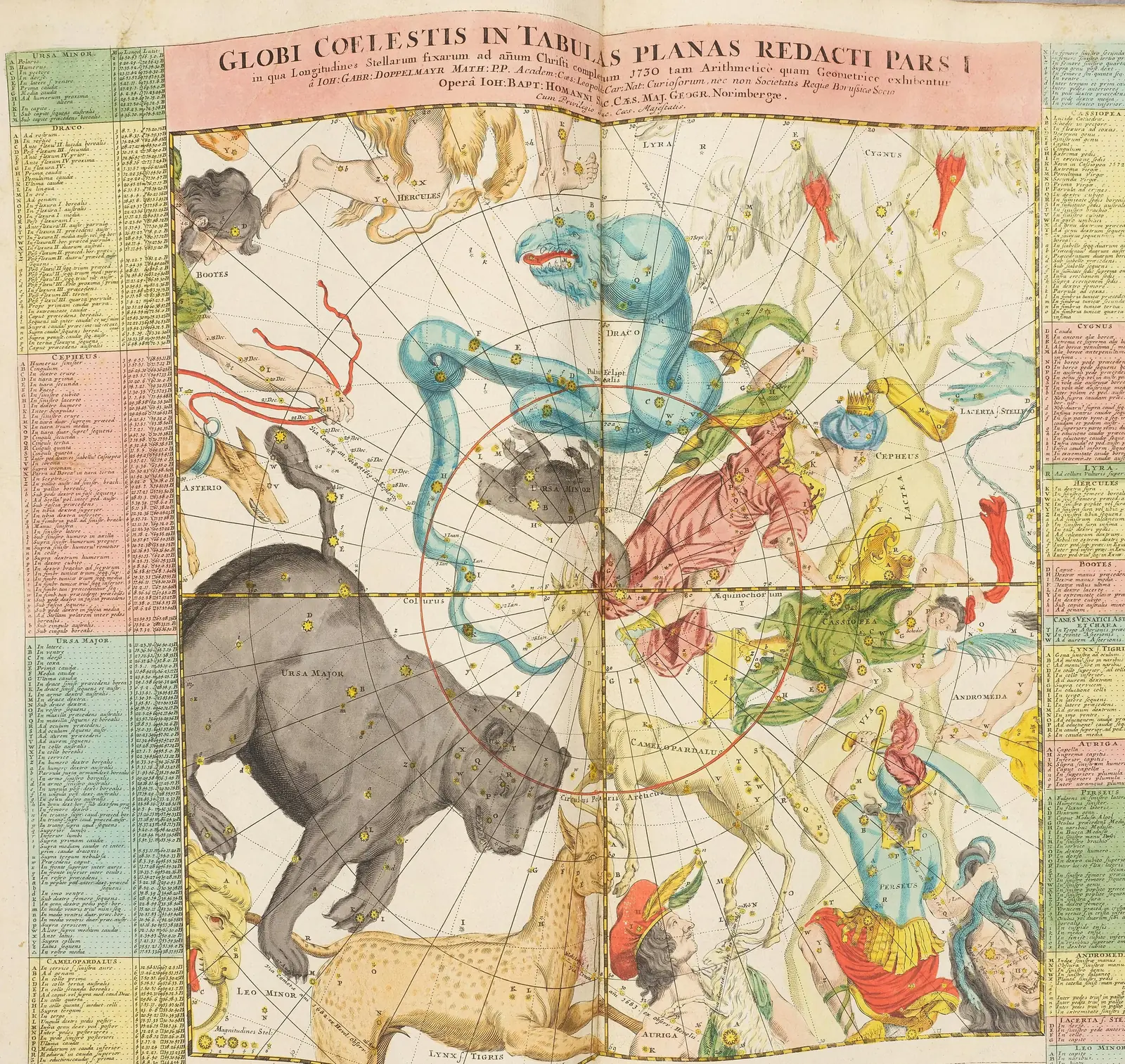
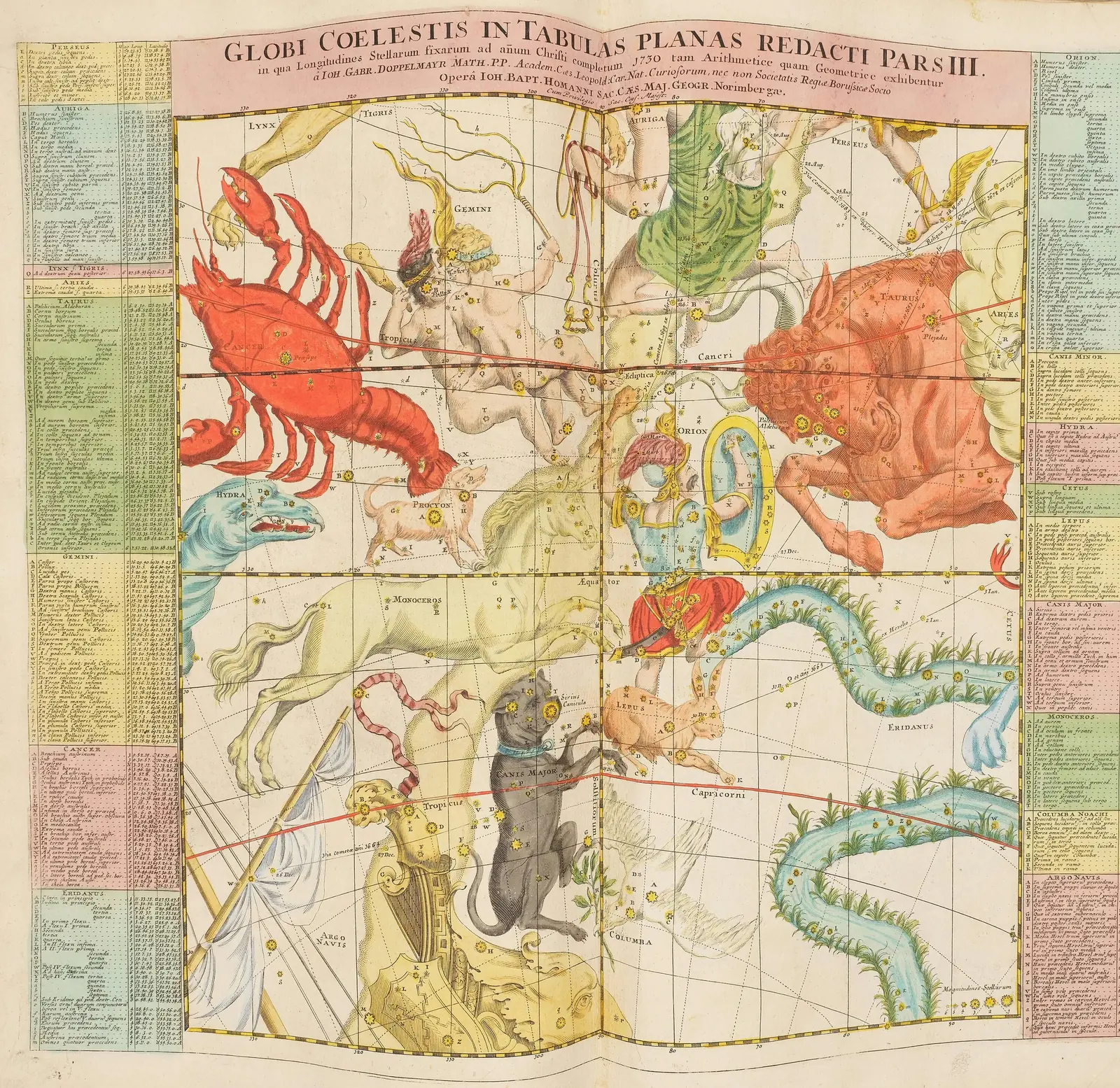
Johann Gabriel Doppelmayr, Atlas Novus Coelestis, 1742
At a glance
In 2027 the Sun moves through 13 constellations. It enters Ophiuchus on November 30 and leaves on December 18; Virgo holds it longest, 44.5 days.
- New Year's Day
- Sun in Sagittariusuntil Jan 20, 2027 · 08:25 UTC
- Ophiuchus
- Nov 30 to Dec 1818.3 days
- Scorpius
- Nov 23 to Nov 306.5 days, the shortest
- Vs 2026
- About 6 hours later5.9 to 6.3 h, crossing by crossing
- Lahiri Capricorn
- Jan 14, 2027vs constellation Jan 20
Check a 2027 birthdayOr any date from 1700 to 2200.
The dates
Thirteen doors the Sun walks through in 2027
Try this today
- Put a 2027 date that matters to you in the checker below and see which stars stand behind the Sun that day.
- Mark November 30 in your calendar if you like a fun fact: the Sun's first day in Ophiuchus.
Say you are planning ahead: a birthday party theme, a tattoo, a baby due next autumn, or you just want to win the next "what's my real sign" argument. You want the dates the Sun actually spends in front of each constellation in 2027, not the horoscope dates. Here they are.
The year opens with the Sun in Sagittarius, where it has been since Dec 18, 2026. It crosses into Capricornus on Jan 20, 2027 · 08:25 UTC, then works its way round: Aquarius on Feb 16, Pisces on Mar 12, Aries on Apr 19, Taurus on May 14 and Gemini on Jun 22.
The second half goes Cancer on Jul 21, Leo on Aug 11, Virgo on Sep 17, Libra on Oct 31, a quick week in Scorpius from Nov 23, Ophiuchus from Nov 30, and back into Sagittarius on Dec 18. Thirteen constellations, and the last crossing of the year hands the Sun to the archer again, where it stays until Jan 20, 2028.
These are astronomy dates. Western astrology still uses twelve equal tropical signs measured from the equinox, which is what your horoscope means by your sign. Think of this as the star map running underneath it.
The sky behind it
Computed from JPL DE442: the Sun's apparent geocentric position, precessed to B1875.0 and looked up in the IAU boundary table (Roman 1987). Each crossing is bisected to one second; the tables show the minute.
Year to year
Every crossing arrives about 6 hours later than in 2026
Try this today
- Find your birthday's constellation for 2026 and 2027 in the year strip. If you are right on a border, the answer can change between years.
- Scroll to the side-by-side table to see the exact shift for each crossing.
Line up 2026 and 2027 and you see the pattern immediately. The Sun entered Capricornus at Jan 20, 2026 · 02:18 UTC in 2026. In 2027 it does so at Jan 20, 2027 · 08:25 UTC. Every other crossing slips the same way, by 5.9 to 6.3 hours.
That is not the stars moving. It is the calendar. A 365-day year falls about a quarter of a day short of one full trip of the Sun around the sky, so each year the same crossing comes roughly six hours later on the clock. Three years of that adds up to most of a day, then February 29 resets it. 2028 is the next leap year.
The small spread between crossings, a few minutes either way, comes from the wobble of Earth's axis (nutation) and the pull of the Moon on Earth's position, both of which the DE442 ephemeris includes.
In practice, 1 of the 13 crossings land on a different UTC date in 2027: Gemini. If you saw a 2026 list somewhere, those are the rows that would now be a day off.
The sky behind it
Mean shift across the 13 crossings: 6.1 hours after subtracting 365 days. The Sun's tropical position at each crossing also creeps forward, by 54 arcseconds on average between 2026 and 2027, because the IAU borders are fixed to the stars while the equinox slides past them. Precession supplies about 50 arcseconds a year; the rest is nutation, a short wobble on top that changes from year to year.
Spring in the fishes
The 2027 spring equinox happens in Pisces, not Aries
Try this today
- On the night of the equinox, Mar 20, 2027, look for the constellation opposite the Sun: it is the one high in the south around midnight from northern latitudes.
- Look up the Babylonian list of constellations along the Sun's path. It was not twelve to begin with.
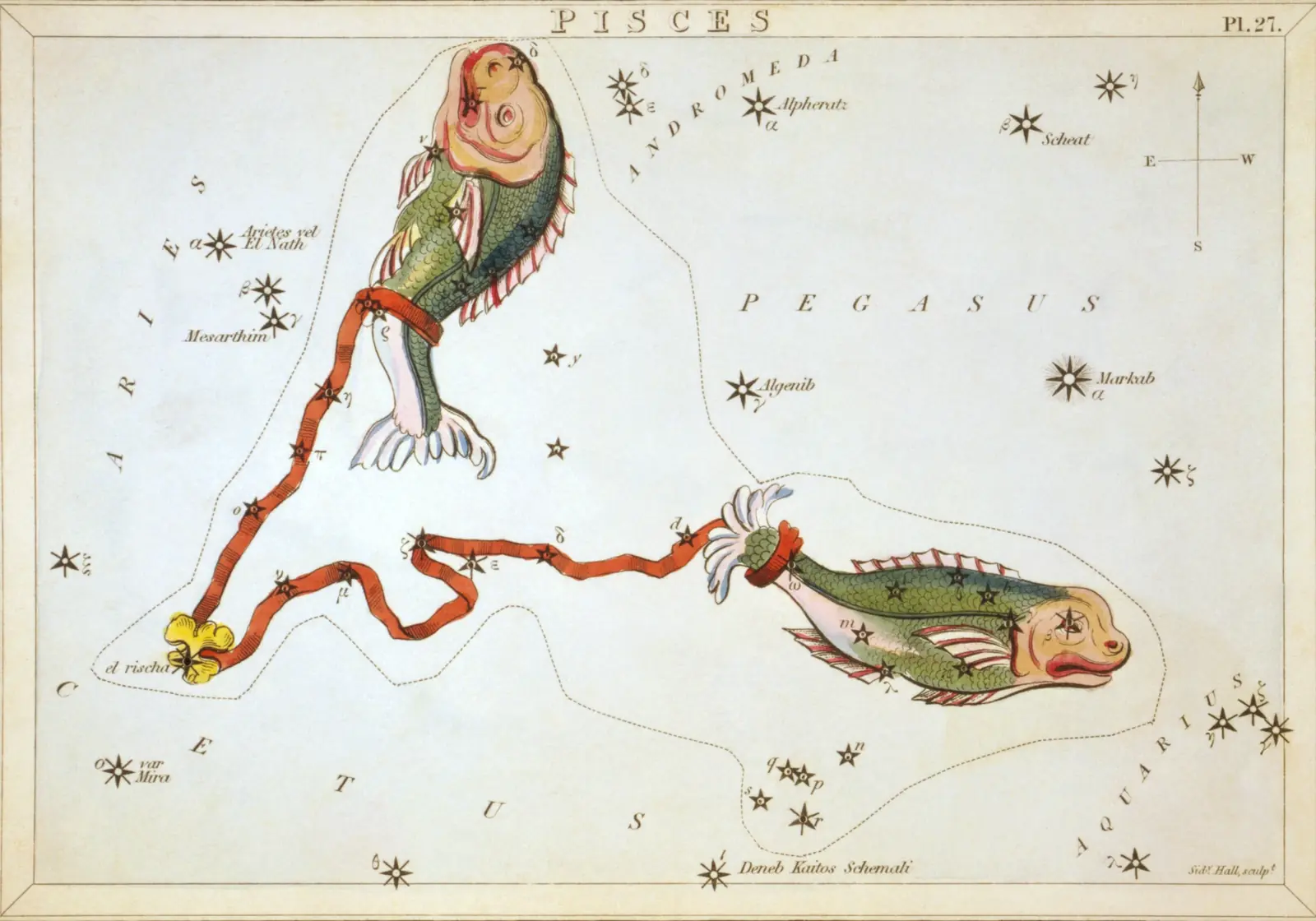
The March equinox is the starting gun of Western astrology: the instant the Sun reaches 0° Aries. In 2027 that is Mar 20, 2027 · 20:24 UTC.
Look up from the chart to the stars at that moment and the Sun is in the constellation Pisces, where it arrived on Mar 12, 2027 and stays for another 29.5 days, until Apr 19, 2027. The equinox point has been drifting backward through the fishes for about two thousand years, which is where the phrase "the Age of Pisces" comes from, and why people talk about an Age of Aquarius to follow. Astronomers and astrologers disagree on when, or whether, that new age starts, because it depends on where you draw the border.
The same thing happens at the other turning points. The September equinox on Sep 23, 2027, the start of tropical Libra, finds the Sun in the constellation Virgo. The December solstice on Dec 22, 2027, the start of tropical Capricorn, finds it in Sagittarius.
None of this makes the tropical zodiac wrong. It was always tied to the seasons. It just means the stars behind each season have shifted along by about a constellation.
The sky behind it
Pisces spans 37.0° of the ecliptic in 2027 (22°02′ Pisces to 29°04′ Aries tropical), the 3rd longest stay of the year.
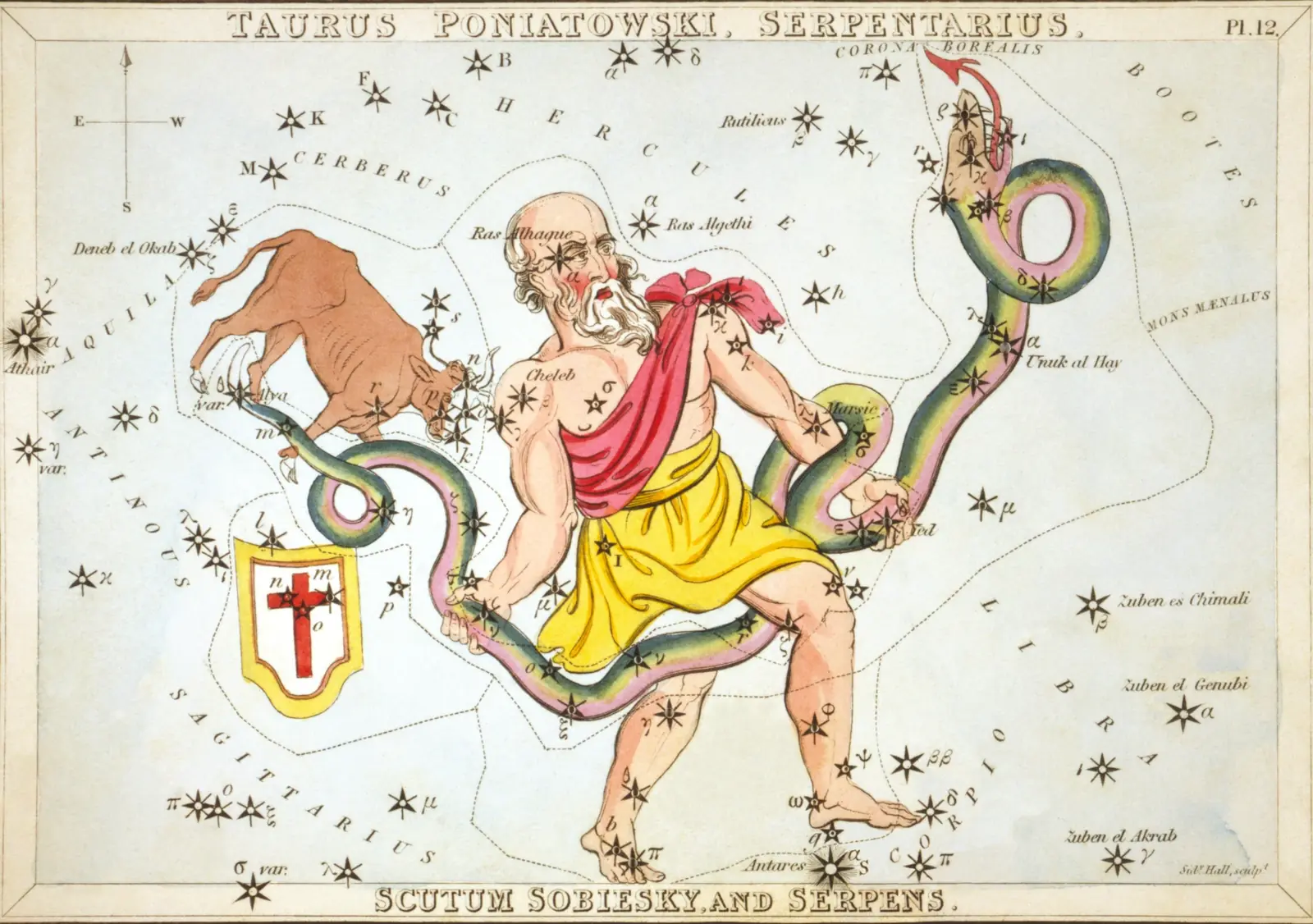
The serpent-bearer
Ophiuchus 2027: Nov 30 to Dec 18
Try this today
- Know someone born Nov 30 to Dec 18? Run their date in the checker. They might enjoy the serpent-bearer.
- Compare the Scorpius and Ophiuchus bars in the year strip. The gap is the whole story.
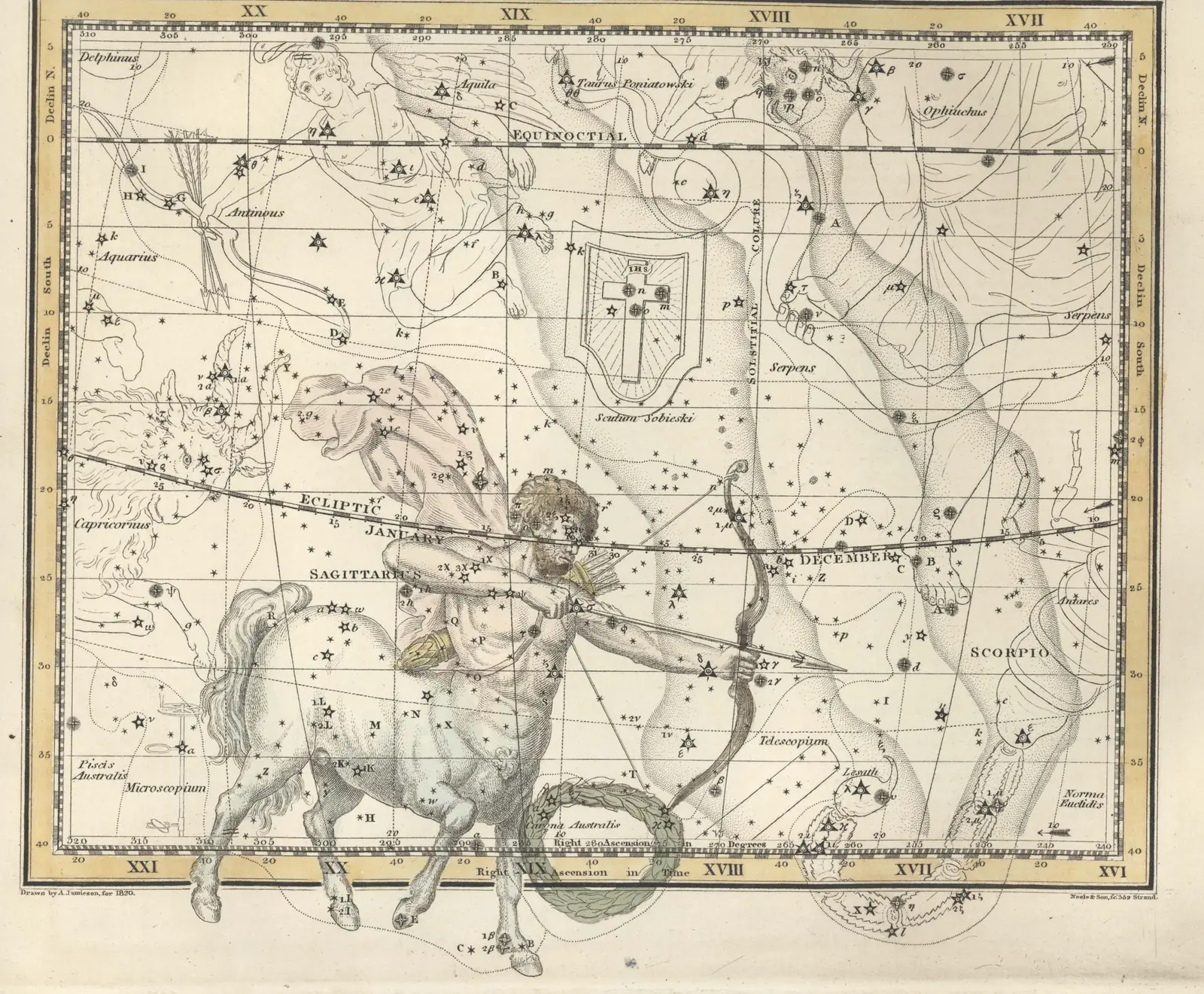
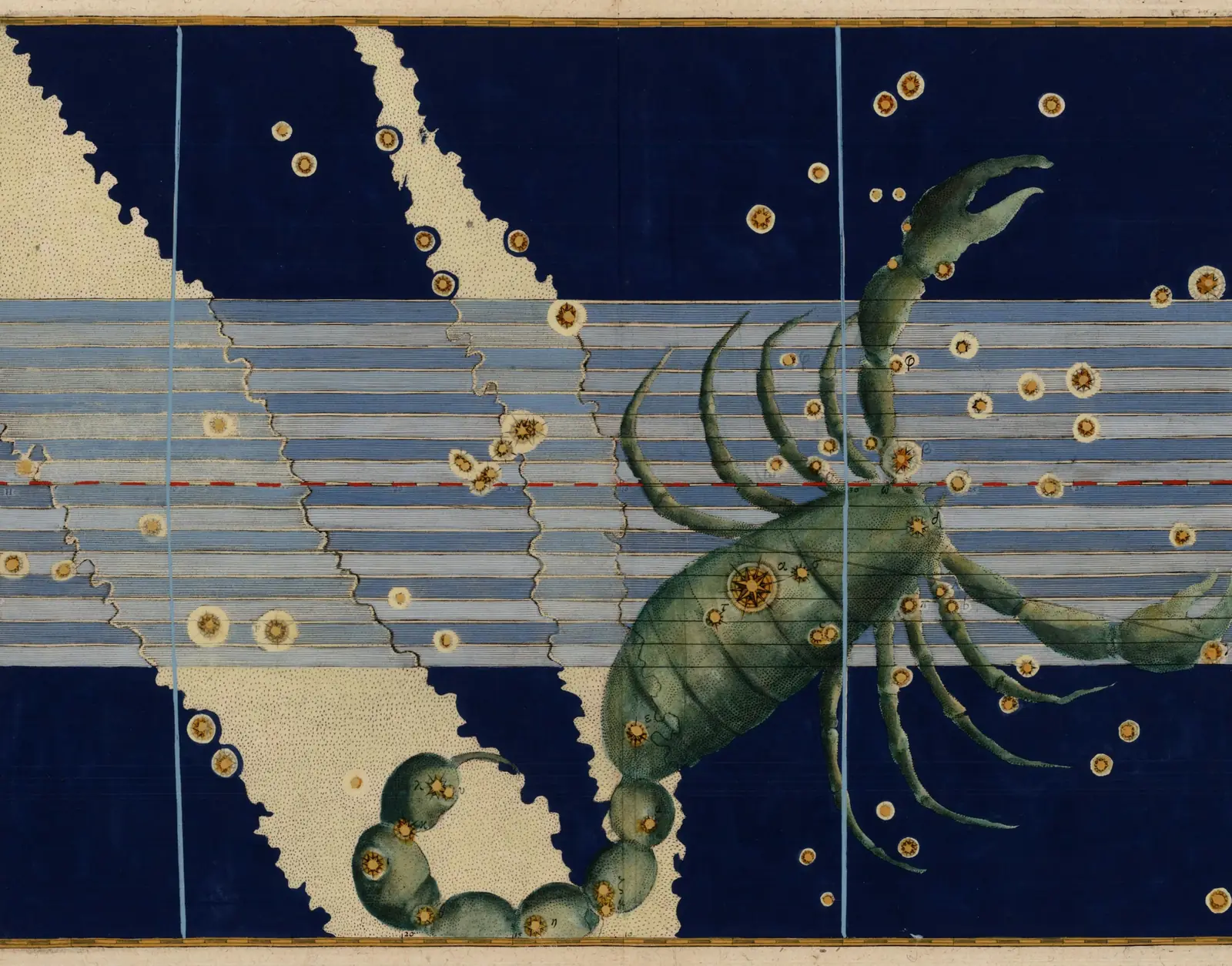
Johann Bayer's 1603 scorpion is a big, proud figure, yet only a sliver of it lies on the Sun's path. That sliver explains the strangest numbers of the year. The Sun only grazes Scorpius: in 2027 it enters on Nov 23, 2027 · 23:39 UTC and is gone by Nov 30, 2027 · 11:46 UTC, 6.5 days.
Then it walks across Ophiuchus' legs for 18.3 days, from Nov 30, 2027 · 11:46 UTC to Dec 18, 2027 · 19:20 UTC. If you are on the other side of the world, the date shifts: Nov 30, 10:46 PM in Sydney, Nov 30, 3:46 AM in Los Angeles.
Why does Ophiuchus get the Sun at all? The borders the IAU adopted in 1928 enclose whole traditional figures, and Ophiuchus' feet happen to sit on the ecliptic. The zodiac of twelve signs simply never gave him a slice; it was a measuring scheme, and twelve divides the circle and the year neatly.
Some modern writers have proposed a 13-sign astrology with Ophiuchus in it. It is a real idea with fans, but it is not how Western or Vedic astrology works, and it is not a NASA decision.
Who drew the lines
The borders were drawn once, in 1928, and never moved
Try this today
- Look at a star atlas from before 1928 next to a modern one. The figures match; the borders do not.
- Read the Babylonian star list: the old path of the Moon ran through more than twelve groups.
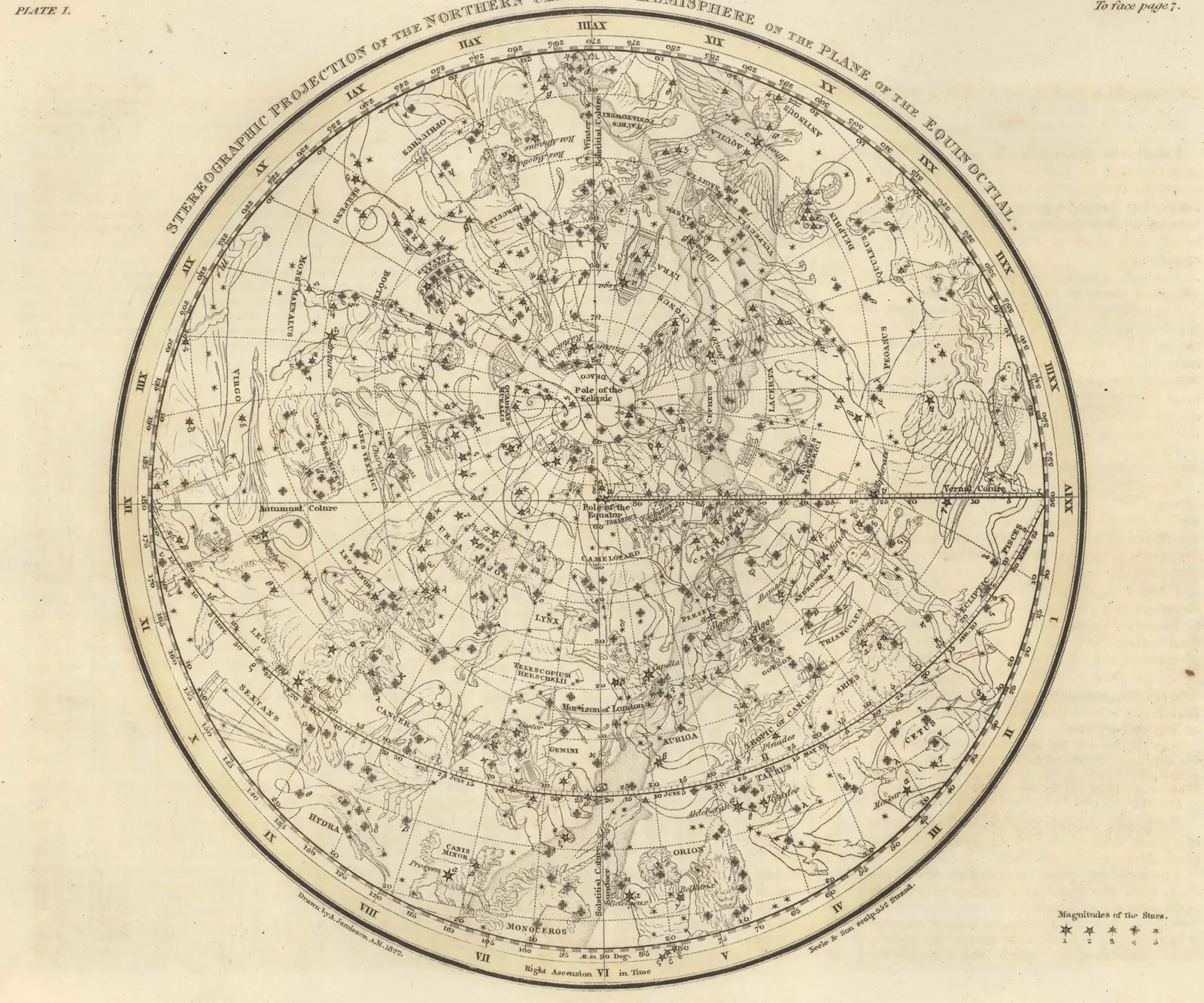
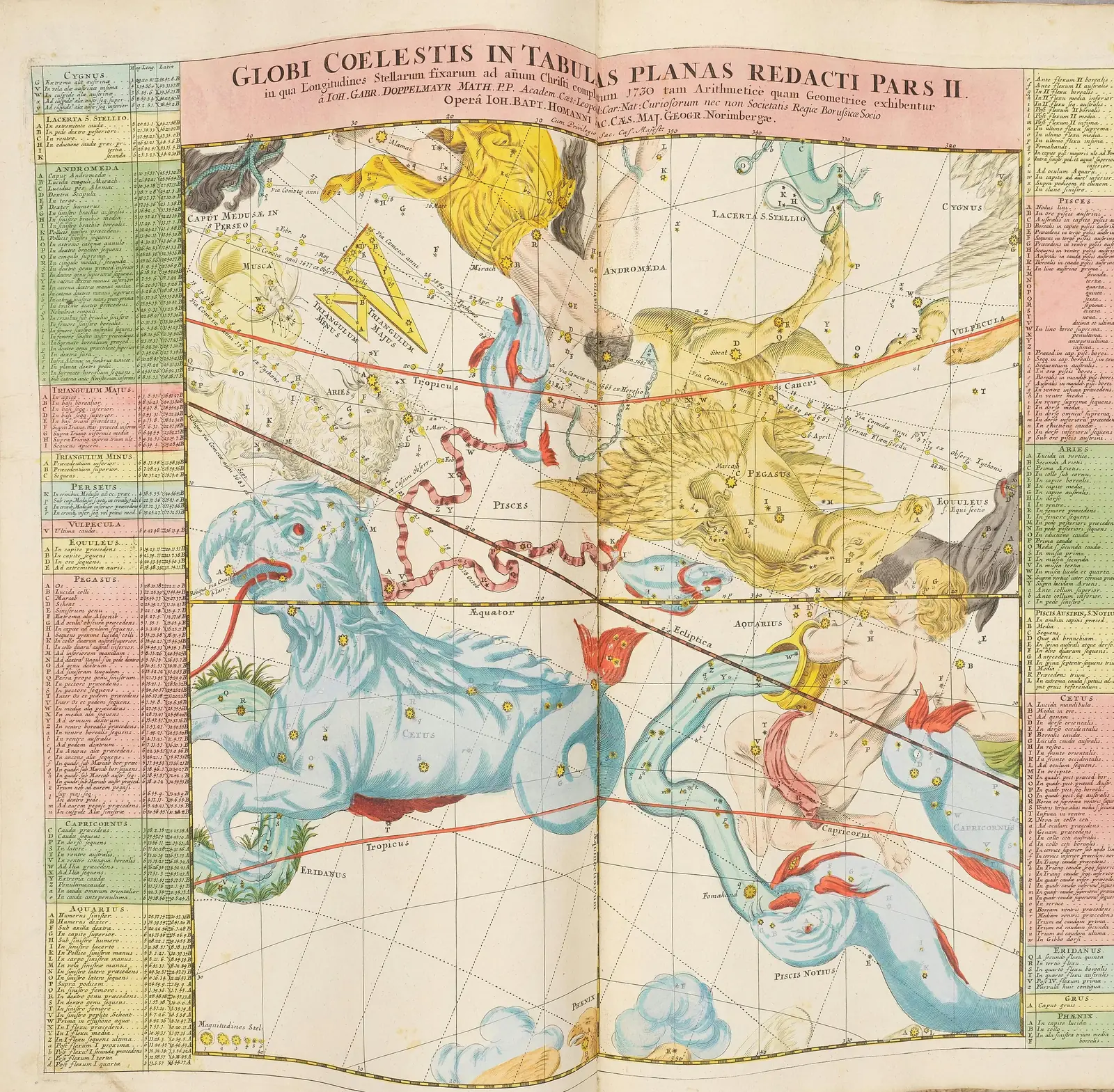
Old star atlases, like Doppelmayr's 1742 plates, drew constellation figures with loose, curving edges, and different atlases disagreed about where one figure ended and the next began. A star near the edge could belong to two constellations depending on the book.
The International Astronomical Union settled it. In 1922 it adopted the list of constellations and their three-letter abbreviations, and the Belgian astronomer Eugène Delporte drew precise borders, adopted in 1928 and published in 1930. Every border runs along a line of right ascension or declination for the equinox of 1875, so every point in the sky belongs to exactly one of the 88 constellations.
Those lines are fixed to the stars. That is why the Sun's crossing dates barely change from year to year, and why, over centuries, they drift against the calendar's seasons. Compute the borders for 2027 and you are using the same lines Delporte drew, just viewed through 152 years of precession.
So "real zodiac dates" is a modern idea in an exact sense: the dates exist because astronomers agreed on borders in the 20th century. Ancient astrologers never had them.
Find yours
Your 2027 birthday, against the real stars
Enter a date (2027 or any year from 1700 to 2200), plus a time and place if you know them. You get the constellation behind the Sun, your Western sign and your Lahiri sign. Underneath, the Sun's 2027 tour to scale, and a live note of where it is now.
Pick a date and press the button. The sample date is set inside the Sun’s 2027 stay in Ophiuchus, so you can see the 13th constellation turn up.
The Sun’s 2027 tour, to scale
Tap a constellation to see its dates. Bars show days; the stars do not share the sky evenly.
Ophiuchus: Nov 30, 11:46 UTC to Dec 18, 19:20 UTC. No sign carries its name.
Right now
Checking the sky...
More to read
Shorter reads. Each opens in place.
A near miss
The June solstice misses Gemini by a day
The June solstice is Jun 21, 2027 · 14:10 UTC. The Sun crosses from Taurus into the constellation Gemini 13.3 hours later, at Jun 22, 2027 · 03:29 UTC. In 2026 both landed on the same UTC date; in 2027 the six-hour slip pushes Gemini to the next day.
Continue readingShow less
Vedic dates
Lahiri sidereal dates are a different list
Vedic astrology uses equal 30° signs fixed near the stars (Lahiri ayanamsa 24.23° on Jan 1, 2027). Sidereal Capricorn, Makar Sankranti, begins Jan 14, 2027 · 15:30 UTC, 6 days before the Sun reaches the constellation Capricornus. See sidereal zodiac dates 2027.
Continue readingShow less
This year
Still in 2026?
The Sun's 2026 tour, with its own facts (Libra that never touches tropical Libra, Virgo's 44.5 days), is on real zodiac dates 2026.
Continue readingShow less
Real zodiac dates 2027, computed
The Sun's 2027 stays in each IAU constellation with the tropical and Lahiri sign dates, the same crossings next to 2026, and every border the Sun crosses with its tropical position.
| Constellation | Sun enters | Sun leaves | Days | Tropical sign begins | Lahiri sign begins |
|---|---|---|---|---|---|
| Sagittarius | Dec 18, 2026 · 13:06 UTC | Jan 20, 2027 · 08:25 UTC | 32.8 | Sagittarius: Nov 22, 2027 | Sagittarius: Dec 16, 2027 |
| Capricornus | Jan 20, 2027 · 08:25 UTC | Feb 16, 2027 · 18:56 UTC | 27.4 | Capricorn: Dec 22, 2027 | Capricorn: Jan 14, 2027 |
| Aquarius | Feb 16, 2027 · 18:56 UTC | Mar 12, 2027 · 20:26 UTC | 24.1 | Aquarius: Jan 20, 2027 | Aquarius: Feb 13, 2027 |
| Pisces | Mar 12, 2027 · 20:26 UTC | Apr 19, 2027 · 08:29 UTC | 37.5 | Pisces: Feb 18, 2027 | Pisces: Mar 15, 2027 |
| Aries | Apr 19, 2027 · 08:29 UTC | May 14, 2027 · 19:54 UTC | 25.5 | Aries: Mar 20, 2027 | Aries: Apr 14, 2027 |
| Taurus | May 14, 2027 · 19:54 UTC | Jun 22, 2027 · 03:29 UTC | 38.3 | Taurus: Apr 20, 2027 | Taurus: May 15, 2027 |
| Gemini | Jun 22, 2027 · 03:29 UTC | Jul 21, 2027 · 08:17 UTC | 29.2 | Gemini: May 21, 2027 | Gemini: Jun 15, 2027 |
| Cancer | Jul 21, 2027 · 08:17 UTC | Aug 11, 2027 · 07:18 UTC | 21.0 | Cancer: Jun 21, 2027 | Cancer: Jul 17, 2027 |
| Leo | Aug 11, 2027 · 07:18 UTC | Sep 17, 2027 · 08:33 UTC | 37.0 | Leo: Jul 23, 2027 | Leo: Aug 17, 2027 |
| Virgo | Sep 17, 2027 · 08:33 UTC | Oct 31, 2027 · 20:49 UTC | 44.5 | Virgo: Aug 23, 2027 | Virgo: Sep 17, 2027 |
| Libra | Oct 31, 2027 · 20:49 UTC | Nov 23, 2027 · 23:39 UTC | 23.1 | Libra: Sep 23, 2027 | Libra: Oct 17, 2027 |
| Scorpius | Nov 23, 2027 · 23:39 UTC | Nov 30, 2027 · 11:46 UTC | 6.5 | Scorpio: Oct 23, 2027 | Scorpio: Nov 16, 2027 |
| Ophiuchus | Nov 30, 2027 · 11:46 UTC | Dec 18, 2027 · 19:20 UTC | 18.3 | Not a sign | Not a sign |
| Sagittarius | Dec 18, 2027 · 19:20 UTC | Jan 20, 2028 · 14:38 UTC | 32.8 | Sagittarius: Nov 22, 2027 | Sagittarius: Dec 16, 2027 |
| Into | 2026 (UTC) | 2027 (UTC) | Later by |
|---|---|---|---|
| Capricornus | Jan 20, 2026 · 02:18 UTC | Jan 20, 2027 · 08:25 UTC | 6.1 h |
| Aquarius | Feb 16, 2026 · 12:54 UTC | Feb 16, 2027 · 18:56 UTC | 6.0 h |
| Pisces | Mar 12, 2026 · 14:30 UTC | Mar 12, 2027 · 20:26 UTC | 5.9 h |
| Aries | Apr 19, 2026 · 02:29 UTC | Apr 19, 2027 · 08:29 UTC | 6.0 h |
| Taurus | May 14, 2026 · 13:57 UTC | May 14, 2027 · 19:54 UTC | 6.0 h |
| Gemini | Jun 21, 2026 · 21:19 UTC | Jun 22, 2027 · 03:29 UTC | 6.2 h |
| Cancer | Jul 21, 2026 · 02:04 UTC | Jul 21, 2027 · 08:17 UTC | 6.2 h |
| Leo | Aug 11, 2026 · 01:09 UTC | Aug 11, 2027 · 07:18 UTC | 6.1 h |
| Virgo | Sep 17, 2026 · 02:15 UTC | Sep 17, 2027 · 08:33 UTC | 6.3 h |
| Libra | Oct 31, 2026 · 14:40 UTC | Oct 31, 2027 · 20:49 UTC | 6.1 h |
| Scorpius | Nov 23, 2026 · 17:27 UTC | Nov 23, 2027 · 23:39 UTC | 6.2 h |
| Ophiuchus | Nov 30, 2026 · 05:39 UTC | Nov 30, 2027 · 11:46 UTC | 6.1 h |
| Sagittarius | Dec 18, 2026 · 13:06 UTC | Dec 18, 2027 · 19:20 UTC | 6.2 h |
| When (UTC) | From | Into | Sun's tropical position |
|---|---|---|---|
| Jan 20, 2027 · 08:25 UTC | Sagittarius | Capricornus | 0°02′ Aquarius |
| Feb 16, 2027 · 18:56 UTC | Capricornus | Aquarius | 27°52′ Aquarius |
| Mar 12, 2027 · 20:26 UTC | Aquarius | Pisces | 22°02′ Pisces |
| Apr 19, 2027 · 08:29 UTC | Pisces | Aries | 29°04′ Aries |
| May 14, 2027 · 19:54 UTC | Aries | Taurus | 23°48′ Taurus |
| Jun 22, 2027 · 03:29 UTC | Taurus | Gemini | 0°32′ Cancer |
| Jul 21, 2027 · 08:17 UTC | Gemini | Cancer | 28°23′ Cancer |
| Aug 11, 2027 · 07:18 UTC | Cancer | Leo | 18°26′ Leo |
| Sep 17, 2027 · 08:33 UTC | Leo | Virgo | 24°15′ Virgo |
| Oct 31, 2027 · 20:49 UTC | Virgo | Libra | 8°12′ Scorpio |
| Nov 23, 2027 · 23:39 UTC | Libra | Scorpius | 1°27′ Sagittarius |
| Nov 30, 2027 · 11:46 UTC | Scorpius | Ophiuchus | 8°02′ Sagittarius |
| Dec 18, 2027 · 19:20 UTC | Ophiuchus | Sagittarius | 26°38′ Sagittarius |
All times are UTC. In the Americas the local date can be a day earlier; in Asia and Australia a day later.
Quick answers
What are the real zodiac dates for 2027?
By the IAU borders: Sagittarius until Jan 20, Capricornus Jan 20, Aquarius Feb 16, Pisces Mar 12, Aries Apr 19, Taurus May 14, Gemini Jun 22, Cancer Jul 21, Leo Aug 11, Virgo Sep 17, Libra Oct 31, Scorpius Nov 23, Ophiuchus Nov 30, then Sagittarius again from Dec 18. Each date is when the Sun enters, in UTC.
When is Ophiuchus season 2027?
The Sun is in the constellation Ophiuchus from Nov 30, 2027 · 11:46 UTC to Dec 18, 2027 · 19:20 UTC, about 18.3 days. Locally that entry is Nov 30, 3:46 AM in Los Angeles, Nov 30, 11:46 AM in London and Nov 30, 10:46 PM in Sydney.
What are true sidereal zodiac dates for 2027?
"True sidereal" usually means the Sun's real constellation, using the IAU borders, which is what this page lists. That is different from Lahiri sidereal, the Vedic system of 12 equal signs: Lahiri Aries starts Apr 14, 2027, while the Sun reaches the constellation Aries on Apr 19, 2027.
Are the real zodiac dates the same every year?
Almost. Each crossing in 2027 comes 5.9 to 6.3 hours later than the same crossing in 2026, because a calendar year is about six hours shorter than the Sun's circuit. That is enough to move the UTC date of 1 of the 13 crossings. The leap day in 2028 pulls them back.
Did NASA change the zodiac signs for 2027?
No. NASA has never changed the zodiac. A 2016 NASA education page explained that the Sun passes through 13 constellations, and that was widely misread. The constellation dates for 2027 are on this page; astrology's signs are unchanged.
What constellation is the Sun in on my birthday in 2027?
Use the checker on this page: enter the date, and if you like the time and place. It shows the constellation, your tropical (Western) sign and your Lahiri sidereal sign side by side, and warns you if the Sun crosses a border within 12 hours.
Why does the Sun spend so long in Pisces in 2027?
Pisces is a wide constellation along the Sun's path, 37.0 degrees, so the Sun needs 37.5 days to cross it, from Mar 12 to Apr 19. The March equinox on Mar 20, 2027 falls inside that stay.