Other zodiacs · Egypt
Egyptian zodiac signs: the god list is new, the Dendera sky is real
The 12 god signs you see everywhere have no ancient source. The real Egyptian zodiac is carved on a sandstone ceiling from about 50 BC, and its eclipses still check out.
Photo: NPS / Patrick Myers
At a glance
The popular 12 Egyptian god signs are a modern list. The documented Egyptian zodiac is the Dendera ceiling, carved about 50 BC and now in the Louvre, with the twelve signs and 36 decans.
- Modern god list
- 12 gods, 28 date rangesno ancient source; labelled in the calculator
- Dendera zodiac
- c. 50 BC, sandstoneLouvre, Paris, since 1922
- Its eclipses, recomputed
- Annular solar, March 7, 51 BCand a total lunar eclipse, September 25, 52 BC
- The Sun's decan as this page was built
- 0° to 10° Scorpioface of Mars; next decan November 2
- Sky slid since then
- 28.9°precession over 2075 years, almost one sign
Find your three Egyptian answersModern god sign, real decan, Dendera figure: labelled side by side.
The honest answer
The 12 Egyptian god signs are a modern list

Try this today
- Look up your god sign below, then read who that god actually was. The real mythology is richer than the personality blurbs.
- Next time the graphic shows up in your feed, reply with the Dendera ceiling. It is a much better flex.
You have probably seen it: a neat graphic, twelve gods, and a promise that the Egyptians knew you were a Bastet. Maybe you sent it to the group chat. It is a fun list. It is also not ancient.
The popular Egyptian zodiac gives each of 12 gods two to four scattered date ranges, 28 ranges in all. Thoth, for example, gets April 1 to 19 and November 8 to 17. 3 of the gods get three or more separate slices of the year. No papyrus, coffin, temple wall or Greek writer on Egypt lays out a calendar like this. Even sites that publish the list, such as TheCollector, describe it as a modern system, and the dates differ slightly from site to site.
So where did the idea come from? It borrows real ingredients. Egyptians did watch the stars closely, and their 36 decans were tied to the turning year. Gods were linked to stars. Somewhere in the modern retelling, those true pieces were rearranged into a personality chart with birthdays.
Here is how we handle it. The calculator still tells you your god sign, because you came here to find it. But it labels it as modern, and puts the real ancient material next to it: the decan your Sun sits in, and how the one surviving Egyptian zodiac carved your sign.
What Egypt really watched
The 36 decans: Egypt's star clock
Try this today
- This year the Sun began decan 1 (0° to 10° Aries) on Mar 20, 14:46 UTC. Find your birthday in the table further down to see your slice.
- On a clear winter night, find Sirius, the brightest star in the night sky, down and to the left of Orion's belt (as seen from the northern hemisphere).
Decan calculator: Sun, Moon and risingAries decans, one by one
Picture a priest on a temple roof before dawn, watching the eastern horizon. Each night a particular group of stars rose in turn, marking the hours. Every ten days or so, a new group took over the job of rising just before the Sun.
Those groups are the decans, from the Greek dekanoi, "tenths." There were 36 of them. Thirty-six ten-day weeks make 360 days; add five extra days and you have the Egyptian civil year of 365. Decan lists first appear painted on coffin lids from the First Intermediate Period, and they were in use as a star clock by about the 21st century BC (Wikipedia: Decan). In the oldest lists, the sequence began with Sirius, which the Egyptians called Sopdet and the Greeks Sothis, whose dawn rising came with the Nile flood.
The decans also turn up in the Book of Nut, an astronomical text about the sky goddess Nut, and on royal monuments such as the cenotaph of Seti I at Abydos (Book of Nut). That is the real Egyptian contribution to the sky we use: a way to cut the year, and the night, into slices.
After Alexander's conquest of Egypt in 332 BC, Greek astrologers in Alexandria folded the decans into the Babylonian zodiac. Each of the twelve signs got three decans of 10° each. Each slice was given a planet in a fixed order, the "faces," starting with Mars at 0° Aries. That is the system our calculator uses.
The sky behind it
Decan ingresses on this page are the moments the Sun's geocentric apparent ecliptic longitude (true ecliptic and equinox of date) crosses each multiple of 10°, computed with skyfield and the JPL DE442 ephemeris. Faces follow the Chaldean order (Saturn, Jupiter, Mars, Sun, Venus, Mercury, Moon) starting from Mars.
The documented zodiac
The Dendera zodiac: a whole sky on one ceiling
Try this today
- Find your sign on the ceiling using the figure list below, then look at a photo of the relief and try to spot it.
- If you are in Paris, the relief is in the Louvre's Egyptian Antiquities department. Look up: it was made to be seen from below.
Climb to the roof of the temple of Hathor at Dendera, in Upper Egypt, and you reach a small chapel used for the rites of Osiris. Its ceiling once held a round relief carved in sandstone, about 2.55 m across. That is the Dendera zodiac.
The disc is a map of the sky centred on the north pole. Ursa Minor, the little bear, is drawn as a jackal. Around it the twelve signs run in a loose spiral, and around them an outer ring of 36 figures stands for the decans. Four women and four pairs of falcon-headed figures, set 45° apart, hold the whole sky up (Wikipedia).
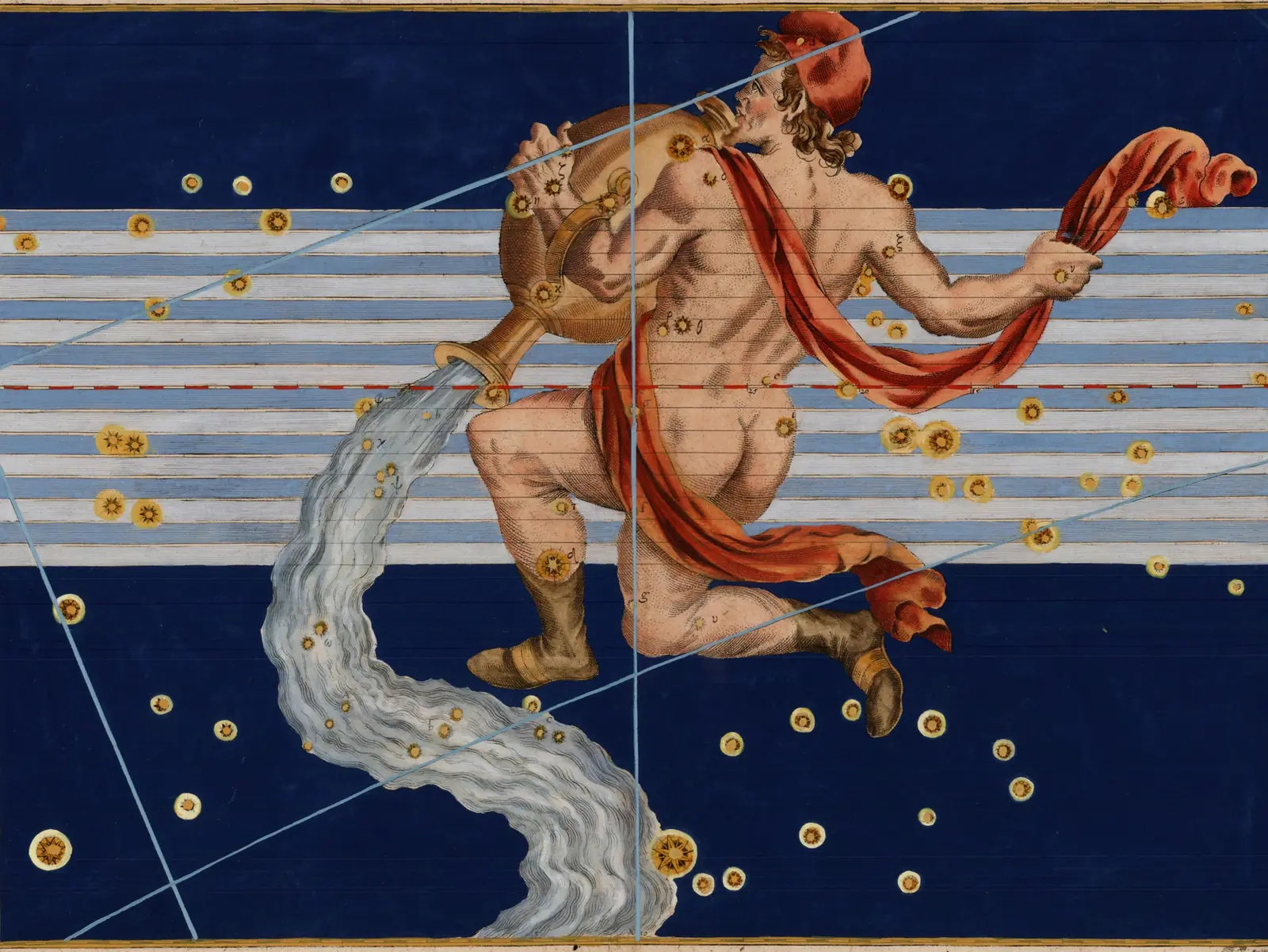
The signs are the ones you know, with an Egyptian accent. The ram, the bull, the scorpion and the goat-fish look Greco-Roman. Gemini is two figures walking together. Virgo holds an ear of wheat. Sagittarius is a winged centaur. And Aquarius is Hapi, the Nile flood god, pouring water from two vases (Wikipédia). The full list is in the tables below.
The ceiling also carries the five planets the Egyptians knew and two eclipses. A solar eclipse is shown as a disc with Isis holding a baboon, the god Thoth, by the tail; a lunar eclipse as an Eye of Horus locked in a circle. Éric Aubourg matched them to a annular solar eclipse on March 7, 51 BC and a total lunar eclipse on September 25, 52 BC. We ran both dates through an ephemeris: the eclipses are real, and NASA's eclipse catalogue lists them too.
The sky behind it
Eclipse check: Swiss Ephemeris 2.10 (Moshier mode, Julian calendar) finds a annular solar eclipse at March 7, 51 BC, about 11:42 UT, Sun at 14°17′ Pisces, and a total lunar eclipse at September 25, 52 BC, about 23:23 UT, Moon at 0°16′ Aries. NASA GSFC's Five Millennium Canon lists the same two (catalogued as -0050 Mar 07, annular, and -0051 Sep 26 02:28 TD, total, which is the evening of September 25 in Universal Time).
How it got to Paris
Saws, jacks and gunpowder: the Dendera affair
Try this today
- Read Champollion's side of the argument: he trusted the writing on the stone over the star guesses, which is a good rule for any old object.
In January 1799, during Napoleon's campaign in Egypt, the artist Vivant Denon reached Dendera and found the rooftop chapel. He came back that spring and drew the ceiling, working almost in the dark. His engravings came out in 1802, and a more careful survey followed in the Description de l'Égypte (Linda Hall Library).
Then it got messy. The dealer Sébastien Louis Saulnier hired Claude Lelorrain to remove the relief with saws, jacks, scissors and gunpowder. It reached Paris by 1821, and Louis XVIII paid 150,000 francs for it. It was shown in the Royal Library, later the national library, and moved to the Louvre in 1922. A copy now fills the hole in the chapel ceiling.
Paris argued about it for years, in what became known as the Dendera affair. If the zodiac was very old, it seemed to challenge the biblical timeline. Some scholars, the mathematician Joseph Fourier among them, read the star positions as thousands of years old. Jean-François Champollion, fresh from cracking hieroglyphs, read the inscriptions and placed it in the Greco-Roman period. He was right.
The modern date comes from the sky on the ceiling itself. Sylvie Cauville and Éric Aubourg matched the planets to a configuration that recurs only about once in a thousand years, and settled on about 50 BC, when Cleopatra VII was coming to power. In 2022 the Egyptologist Zahi Hawass started a petition to bring it back to Egypt, along with the Rosetta Stone.
The sky behind the ceiling
The sky over Dendera in 50 BC, recomputed
Try this today
- Compare your Western Sun sign with the star figure behind it in the calculator. If they differ, that gap is the precession since antiquity.
Scholars place the planetary picture on the ceiling between June 15 and August 15, 50 BC (Rosicrucian Egyptian Museum). So we rebuilt that sky. The table further down gives every planet on three dates in the window.
A few things jump out. Saturn sat in Libra the whole time. Jupiter moved through Cancer and Leo. Mars was retrograde in Capricorn, sliding back about 10° over those two months. The Sun ran from 20°07′ Gemini to 18°46′ Leo. If you were born under that sky, those would have been your placements.
Then there is the drift. Earth's axis wobbles slowly, so the equinox point creeps backward against the stars, about one degree every 72 years. Between July 15, 50 BC and July 15, 2026, it moved 28.9° by the Lahiri measure used in Vedic astrology. In 50 BC the signs and the star figures were only about 4.6° apart. Now they are 24.2° apart.
That is why the Dendera ceiling matters for anyone who has asked whether their sign "changed." The carvers drew a zodiac that almost lined up with its stars. Western astrology kept the signs tied to the seasons; Vedic astrology kept them tied to the stars. Neither is a mistake, they just measure from different starting lines.
The sky behind it
Positions for 50 BC are geocentric tropical longitudes from the Swiss Ephemeris in Moshier mode (Julian calendar, about noon at Dendera), because the DE442 file we use covers 1550 to 2650 only. Precession is the change in the Lahiri ayanamsa between the two dates: -4.63° in 50 BC and 24.23° in 2026.
Egyptian zodiac calculator
Three Egyptian answers for your birthday
Enter a birth date. You get the modern god sign (labelled modern), the real decan your Sun sat in (computed in your browser), and how the Dendera ceiling carved your sign. Each answer says plainly how old it is.
Any year from 1800 to 2100. We place the Sun at noon UTC on that day, so no birth time is needed.
Pick a date and you will get three answers side by side: the modern god sign, the decan your Sun sits in, and how the Dendera ceiling carved your sign.
Browse the 12 modern god signs
The Nile (Hapi)
Dates on the modern list: Jan 1 to 7; Jun 19 to 28; Sep 1 to 7; Nov 18 to 26.
Hapi was the god of the Nile's yearly flood, shown as a plump figure pouring water. The flood made Egyptian farming possible.
The god is ancient. The dates are not: they appear on modern astrology sites, which disagree with each other on a few days.
More to read
Shorter reads. Each opens in place.
The family tree
Where the twelve signs came from
Babylonian astronomers had divided the Sun's path into twelve equal signs by about the 5th century BC. Greek astronomers took the system up, and after 332 BC Greek-speaking rulers brought it to Egypt. Dendera is what happened when that imported zodiac met Egyptian art and the old decan stars.
Continue readingShow less
Still in use
Egyptian decans in astrology today
Modern astrologers still read decans: three 10° slices per sign, each with a planetary ruler. Two systems survive, the triplicity decans and the older Chaldean faces shown here. The Golden Dawn later tied the 36 decans to the numbered tarot cards from two to ten.
Continue readingShow less
No shame
If you love your god sign anyway
Keep it. Plenty of people enjoy a modern list for what it is. The only thing we ask is that it gets introduced honestly: a modern game built on real Egyptian gods, not a secret of the pharaohs. Then go read about your god. Thoth was credited with inventing writing. Bastet had a whole city, Bubastis, as her cult centre.
Continue readingShow less
Egyptian zodiac tables
The modern list for reference, the Dendera figures, the Sun's decan dates for 2026 and 2027, and the sky in the window scholars give for the ceiling.
| God sign | Dates on the modern list | Who the god was |
|---|---|---|
| The Nile (Hapi) | Jan 1 to 7; Jun 19 to 28; Sep 1 to 7; Nov 18 to 26 | Hapi was the god of the Nile's yearly flood, shown as a plump figure pouring water. The flood made Egyptian farming possible. |
| Amun-Ra | Jan 8 to 21; Feb 1 to 11 | Amun of Thebes, joined with the sun god Ra, became the chief god of the New Kingdom state. |
| Mut | Jan 22 to 31; Sep 8 to 22 | Mut was a mother goddess worshipped at Thebes as Amun's consort, often shown wearing a vulture headdress. |
| Geb | Feb 12 to 29; Aug 20 to 31 | Geb was the earth, lying beneath his sister-wife Nut, the sky. |
| Osiris | Mar 1 to 10; Nov 27 to Dec 18 | Osiris was the king of the dead and a god of rebirth and growing grain. The Dendera ceiling sits in a chapel built for his rites. |
| Isis | Mar 11 to 31; Oct 18 to 29; Dec 19 to 31 | Isis, wife of Osiris and mother of Horus, was famed for her magic. Her cult spread across the Roman world. |
| Thoth | Apr 1 to 19; Nov 8 to 17 | Thoth was the god of writing, reckoning and the Moon, shown as an ibis or a baboon. |
| Horus | Apr 20 to May 7; Aug 12 to 19 | Horus was the falcon-headed sky god, son of Isis and Osiris. Every living pharaoh was identified with him. |
| Anubis | May 8 to 27; Jun 29 to Jul 13 | Anubis, the jackal-headed god, watched over embalming and guided the dead. |
| Seth | May 28 to Jun 18; Sep 28 to Oct 2 | Seth was the god of the desert, storms and disorder, the brother and rival of Osiris. |
| Bastet | Jul 14 to 28; Sep 23 to 27; Oct 3 to 17 | Bastet was a cat goddess of home and protection, worshipped at Bubastis in the Nile Delta. |
| Sekhmet | Jul 29 to Aug 11; Oct 30 to Nov 7 | Sekhmet was a lioness goddess of war and of healing, the fierce side of the sun's power. |
| Sign | On the ceiling |
|---|---|
| Aries | a ram, in its familiar Greco-Roman form |
| Taurus | a bull |
| Gemini | two human figures walking together |
| Cancer | placed at the inner end of the spiral of signs, just above the lion |
| Leo | a lion standing on a serpent, with a woman walking behind it |
| Virgo | a woman holding an ear of wheat in her left hand |
| Libra | a balance with its two pans |
| Scorpio | the scorpion (sources give no extra detail on how it is drawn) |
| Sagittarius | a winged centaur |
| Capricorn | a creature half goat, half fish |
| Aquarius | Hapi, the Nile flood god, pouring water from two vases |
| Pisces | two fish joined together |
| Decan | Slice | Face (Chaldean order) | 2026 | 2027 |
|---|---|---|---|---|
| 1 | 0° to 10° Aries | Mars | Mar 20, 14:46 | Mar 20, 20:25 |
| 2 | 10° to 20° Aries | Sun | Mar 30, 16:59 | Mar 30, 22:41 |
| 3 | 20° to 30° Aries | Venus | Apr 9, 20:41 | Apr 10, 02:14 |
| 4 | 0° to 10° Taurus | Mercury | Apr 20, 01:39 | Apr 20, 07:18 |
| 5 | 10° to 20° Taurus | Moon | Apr 30, 08:04 | Apr 30, 13:45 |
| 6 | 20° to 30° Taurus | Saturn | May 10, 15:50 | May 10, 21:23 |
| 7 | 0° to 10° Gemini | Jupiter | May 21, 00:37 | May 21, 06:18 |
| 8 | 10° to 20° Gemini | Mars | May 31, 10:31 | May 31, 16:13 |
| 9 | 20° to 30° Gemini | Sun | Jun 10, 21:14 | Jun 11, 02:50 |
| 10 | 0° to 10° Cancer | Venus | Jun 21, 08:25 | Jun 21, 14:11 |
| 11 | 10° to 20° Cancer | Mercury | Jul 1, 20:04 | Jul 2, 01:49 |
| 12 | 20° to 30° Cancer | Moon | Jul 12, 07:46 | Jul 12, 13:28 |
| 13 | 0° to 10° Leo | Saturn | Jul 22, 19:13 | Jul 23, 01:05 |
| 14 | 10° to 20° Leo | Jupiter | Aug 2, 06:23 | Aug 2, 12:10 |
| 15 | 20° to 30° Leo | Mars | Aug 12, 16:47 | Aug 12, 22:35 |
| 16 | 0° to 10° Virgo | Sun | Aug 23, 02:19 | Aug 23, 08:14 |
| 17 | 10° to 20° Virgo | Venus | Sep 2, 10:54 | Sep 2, 16:41 |
| 18 | 20° to 30° Virgo | Mercury | Sep 12, 18:08 | Sep 12, 23:59 |
| 19 | 0° to 10° Libra | Moon | Sep 23, 00:05 | Sep 23, 06:02 |
| 20 | 10° to 20° Libra | Saturn | Oct 3, 04:45 | Oct 3, 10:33 |
| 21 | 20° to 30° Libra | Jupiter | Oct 13, 07:51 | Oct 13, 13:43 |
| 22 | 0° to 10° Scorpio | Mars | Oct 23, 09:38 | Oct 23, 15:33 |
| 23 | 10° to 20° Scorpio | Sun | Nov 2, 10:08 | Nov 2, 15:55 |
| 24 | 20° to 30° Scorpio | Venus | Nov 12, 09:17 | Nov 12, 15:08 |
| 25 | 0° to 10° Sagittarius | Mercury | Nov 22, 07:23 | Nov 22, 13:16 |
| 26 | 10° to 20° Sagittarius | Moon | Dec 2, 04:37 | Dec 2, 10:21 |
| 27 | 20° to 30° Sagittarius | Saturn | Dec 12, 00:57 | Dec 12, 06:47 |
| 28 | 0° to 10° Capricorn | Jupiter | Dec 21, 20:50 | Dec 22, 02:42 |
| 29 | 10° to 20° Capricorn | Mars | Dec 31, 16:27 | Dec 31, 22:11 |
| 30 | 20° to 30° Capricorn | Sun | Jan 10, 06:10 | Jan 10, 11:52 |
| 31 | 0° to 10° Aquarius | Venus | Jan 20, 01:45 | Jan 20, 07:30 |
| 32 | 10° to 20° Aquarius | Mercury | Jan 29, 21:46 | Jan 30, 03:35 |
| 33 | 20° to 30° Aquarius | Moon | Feb 8, 18:28 | Feb 9, 00:08 |
| 34 | 0° to 10° Pisces | Saturn | Feb 18, 15:52 | Feb 18, 21:33 |
| 35 | 10° to 20° Pisces | Jupiter | Feb 28, 14:18 | Feb 28, 20:03 |
| 36 | 20° to 30° Pisces | Mars | Mar 10, 13:58 | Mar 10, 19:34 |
| Body | June 15, 50 BC | July 15, 50 BC | August 15, 50 BC |
|---|---|---|---|
| Sun | 20°07′ Gemini | 18°47′ Cancer | 18°46′ Leo |
| Moon | 25°10′ Pisces | 28°24′ Aries | 12°23′ Gemini |
| Mercury | 16°33′ Gemini | 12°04′ Leo | 7°22′ Virgo |
| Venus | 5°18′ Leo | 2°52′ Virgo | 16°35′ Virgo |
| Mars | 27°01′ Capricorn | 22°56′ Capricorn | 17°07′ Capricorn |
| Jupiter | 23°23′ Cancer | 29°39′ Cancer | 6°23′ Leo |
| Saturn | 4°55′ Libra | 5°49′ Libra | 8°04′ Libra |
All times are UTC. In the Americas the local date can be a day earlier; in Asia and Australia a day later.
Quick answers
What is my Egyptian zodiac sign?
On the popular modern list, your sign is one of 12 gods (the Nile, Amun-Ra, Mut, Geb, Osiris, Isis, Thoth, Horus, Anubis, Seth, Bastet, Sekhmet), each covering two to four scattered date ranges. The calculator above finds yours in a second. Just know the list is modern: no ancient Egyptian source assigns birthdays to gods.
Is the Egyptian zodiac real?
The god-sign list is not ancient. What is real: Egyptian star clocks with 36 decans, attested on coffin lids from about the 21st century BC, and the Dendera zodiac, a carved sky from about 50 BC now in the Louvre. That ceiling shows the Babylonian-Greek twelve signs, adapted with Egyptian figures.
What is the Dendera zodiac?
A round sandstone relief, about 2.55 m across, carved for the ceiling of a chapel of Osiris on the roof of the Hathor temple at Dendera in Upper Egypt. It shows the twelve zodiac signs, the five planets, 36 decan figures and two eclipses. It was cut out and taken to France in the early 1820s and has hung in the Louvre since 1922.
How old is the Dendera zodiac?
About 50 BC. Sylvie Cauville and Éric Aubourg dated it from the planets carved on it, and the eclipses on it match a annular solar eclipse on March 7, 51 BC and a total lunar eclipse on September 25, 52 BC. We recomputed both.
What are the Egyptian decans?
Thirty-six star groups that rose one after another at night, each taking its turn about every ten days. Egyptians used them as a star clock; the sequence began with Sirius, which the Egyptians called Sopdet and the Greeks Sothis. Greek astrologers in Egypt later turned them into 36 slices of 10° each across the zodiac, three per sign.
Which Egyptian zodiac sign is the Nile?
On the modern list, the Nile (sometimes called Hapi, after the flood god) covers January 1 to 7, June 19 to 28, September 1 to 7 and November 18 to 26. On the real Dendera ceiling, Hapi appears too, but as Aquarius, pouring water from two vases.
Does the Egyptian zodiac match Western signs?
Not on the modern list: the god signs are scattered through the year, so one god can cover parts of three Western signs. The ancient Dendera zodiac, on the other hand, uses the same twelve signs as Western astrology, because both come from the Babylonian zodiac by way of the Greeks.
Is Ophiuchus on the Dendera zodiac?
No serpent-bearer appears among the twelve signs on the ceiling. Its signs are the familiar twelve, from the ram to the fish. The 13th-sign idea is a separate, modern story.